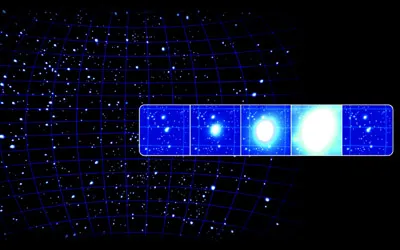
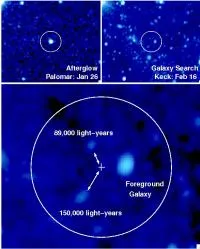
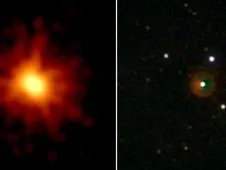
Using the combined power of the Swift satellite and the Gemini Observatory, astronomers detected a mysterious type of cosmic explosion that took place 7.4 billion years ago, more than halfway to the Big Bang.
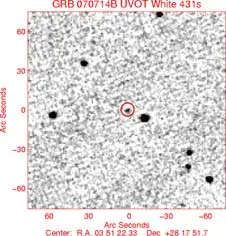
It is a short-duration gamma-ray burst, known as GRB. The short burst is almost twice the distance of the record explosion that had been recorded until now.
The discovery was presented by John Graham of Johns Hopkins University at the meeting of the American Astronomical Society held in Texas.
GRBs are among the most powerful explosions in the Universe, releasing enormous amounts of energy in the form of X-rays and gamma rays. In general, they can be classified as long or short. Long GRBs are thought to be triggered by the collapse and explosion of massive stars. In contrast, a variety of mechanisms have been proposed for short-duration ones. The most popular model says that short bursts occur when two neutron stars merge and collapse into a black hole.
The burst that seems to want to seize the record is GRB 070714B, a name it received when it was detected on July 14, 2007. Swift discovered the GRB in the constellation Taurus. Due to its energy and duration, it was categorized as short-duration. Normally, if a GRB lasts more than 3 seconds, it is already considered long-duration.
A rapid follow-up with the 2m Liverpool Telescope and the 4m William Herschel Telescope found an optical glow at the same location as the burst, allowing astronomers to identify the galaxy that hosted it.
Graham and his colleagues aimed the Gemini North telescope in Hawaii at the galaxy. It revealed that the host galaxy has a spectral line of ionized oxygen. The amount that line was shifted to the red reveals a redshift of 0.92, which translated to distance means 7.4 billion light-years.
The explosion is difficult to explain, since given the distance and the energy (100 times greater than the average of short bursts) it seems to classify the GRB as long, despite its short duration.
One possibility is that GRB 070714B concentrated its energy in two narrow beams of particles, one of which pointed directly at Earth. This would make it seem more powerful than it really is.
Sources and related links
- *Goddard:NASA and Gemini Probe Mysterious Distant Explosion
- *JHU:Astronomers Find Record-Old Cosmic Explosion
About the images
Image captured by the Swift satellite.
Credit:Swift/UVOT Science Team/NASA