Astronomers discovered a distant stellar system that is so unusual it seemed to be unique of its kind. It is a system of two eclipsing yellow supergiant stars. And then they realized there was another system like it, much closer to us. Additionally, it is suggested that these stars would be the progenitors of a new class of supernova.

In a paper published in a recent edition of Astrophysical Journal Letters, astronomers from Ohio University suggest that these systems are the progenitors of a rare type of supernova.
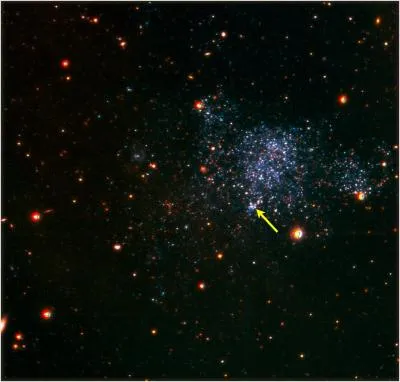
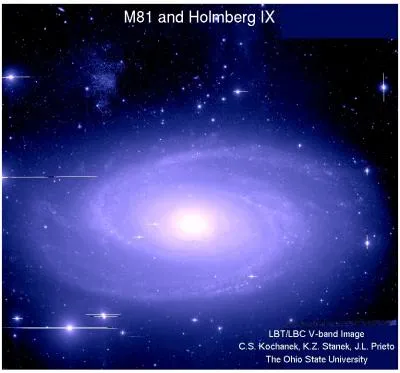
The team discovered a stellar system 13 million light-years away, in the small galaxy Holmberg IX which orbits the large galaxy M81. They studied the system between January and October 2007 with the Large Binocular Telescope (LBT) in Arizona.
The system is unusual, as it is an eclipsing binary system of yellow supergiants. It contains two very bright and massive yellow stars that orbit each other very closely. In fact, they do so so closely that they share a large amount of material, so the shape of the system looks like a peanut.
In a repetitive cycle, one star moves in front of the other, which blocks our view of one of the stars, eclipsing it. The two stars appear to be almost identical, each with between 15 and 20 times the mass of our Sun.
José Prieto, from Ohio and author of the paper, analyzed the new system as part of his doctoral dissertation. In his research, he searched the records to determine if his group had found such a system for the first time.
To his surprise, he discovered another one much closer, 230,000 light-years away in the Small Magellanic Cloud which orbits our Milky Way.
That other system had been discovered in the '80s but had been misidentified. When Prieto reexamined the data that astronomers recorded at that time, he saw that it was similar to the one detected outside M81. The stars were even of similar size.
"We didn't expect to find one of these systems, let alone two," says Kris Stanek, a professor at Ohio. "You never expect this kind of thing. But I think it shows how flexible you must be in astrophysics. We need the 8.4-meter LBT to detect the first binary, but the second is so bright you could see it with binoculars in your backyard. Although, if we hadn't found the first one, perhaps we would never have found the second."
"This shows that there are still valuable discoveries hidden in plain sight. You must keep your eyes wide open and connect the dots."
The finding could help solve another mystery. Of all the supernovae that have been studied over the years, two have been linked to yellow supergiants.
Over millions of years, a very massive star oscillates between being a cold red supergiant and a hot blue one. They spend most of their lives at one end of the spectrum or the other, but spend very little time in the middle, where they are classified as yellow. Most stars end their lives in a supernova at the red end of the cycle; some at the blue end. But none do so during the short transitional phase in between.
At least, that's what astronomers think.
Prieto, Stanek, and their colleagues suspect that yellow binary systems like the ones they found could be the progenitors of those rare supernovae.
"When two stars orbit each other very closely, they share material and the evolution of one affects the other. It is possible that two supergiants in such a system could evolve more slowly and spend more time in the yellow phase, long enough for one of them to explode as a yellow supergiant," explains Prieto.
Sources and related links
- EurekAlert:2 new star systems are first of their kind ever found
- Ohio State University:Two new star systems are first of their kind ever found
- LBT Discovery of a Yellow Supergiant Eclipsing Binary in the Dwarf Galaxy Holmberg IX
The Astrophysical Journal, 673:L59–L62, 2008 January 20
DOI: 10.1086/527415
J. L. Prieto, K. Z. Stanek, C. S. Kochanek, et al.
About the images
The eclipsing binary system of yellow supergiants: The stars orbit each other very closely and share material, making their shape look like a peanut.
Credit:Kevin Gecsi, Ohio State University.
The arrow indicates the approximate location of the recently discovered system in the galaxy Holmberg IX.
Credit:Ohio State University.
The galaxy M81, in an image from Ohio astronomers and their colleagues, using the LBT. The dwarf galaxy Holmberg IX is seen here top left of M81.
Credit:Ohio State University