The latest image from the Hubble Space Telescope reveals a sharp view of the spiral galaxy NGC 2397. The image shows a supernova in its early stages, SN 2006bc, discovered in March 2006.
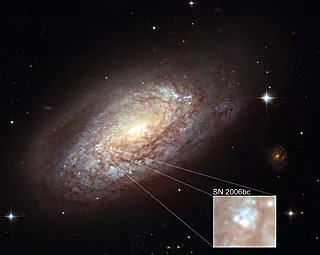
NGC 2397 is a classic spiral galaxy with extensive dust lanes along the edges of its arms.
Located 60 million light-years from Earth, the galaxy is composed mainly of old, yellow and red stars in its central portion, while star formation continues in the more outer and blue spiral arms. The brightest of these young stars can be seen individually in the high-resolution image from Hubble's Advanced Camera for Surveys (ACS).
An atypical feature of this image is the view of supernova SN 2006bc taken when its brightness was fading. Astronomers from Queen's University Belfast in Northern Ireland, led by Professor of Astronomy Stephen J. Smartt, requested the image as part of a long-term project studying the explosive massive stars called supernovae.
When a supernova is discovered in a nearby galaxy, the group begins a meticulous search of previous Hubble images of the same galaxy to locate the star that later exploded; usually one among hundreds of millions of stars in the galaxy. This is like scrutinizing for days through CCTV footage to find a candidate sequence. If astronomers find a star located at the site of the later explosion, they must calculate its mass and type from the brightness and color data. Only six stars have been identified before exploding and the Queen's team discovered the nature of five of them.
In the latest work on Hubble images, to be presented at the 2008 National Astronomy Meeting in Belfast, the team reveals the results of its ten-year search for those elusive supernova precursor stars. It appears that stars with masses as low as seven times the mass of the Sun can explode as supernovae. The team did not find any very massive stars, suggesting that those stars perhaps collapse to form black holes that either do not produce a supernova or if they do, it is too faint to observe. This intriguing possibility will be discussed at the aforementioned meeting.
The images were obtained on October 14, 2006 with the ACS through three color filters (blue, green, and infrared).
Sources and related links
SpaceTelescope: Exploding star in NGC 2397
About the images
Credit: NASA, ESA & Stephen Smartt (Queen’s University Belfast, UK)
I recommend visiting the SpaceTelescope site which contains images in various resolutions.