The Near-Earth Object (NEO) program office at the Jet Propulsion Laboratory has not changed its current estimate for the very low probability (1 in 45,000) of an impact by asteroid Apophis in 2036.
According to the U.S. space agency, they were not contacted by any young German student. Recent press reports, on the contrary, claimed that a 13-year-old boy "corrected" NASA in its calculations of Apophis's impact probability.
As the media reported, the student's conclusion was based on the possibility of a collision with an artificial satellite during Apophis's close approach in 2029. However, it will not pass near the geosynchronous satellite belt in 2029 and the possibility of a collision with a satellite is extremely remote.
Even so, even if that possibility were considered, it does not affect the current impact probability, which remains at 1 in 45 thousand.
NASA detects and tracks asteroids and comets that pass near Earth. The Near-Earth Object observation program, also called "Spaceguard," classifies and computes the trajectories of objects to determine if any could be potentially hazardous to our planet.
But just in case one slips by them or is not detected with sufficient advance, there are projects to get rid of those damn space rocks, as we have already discussed here.
Sources and related links
About the images
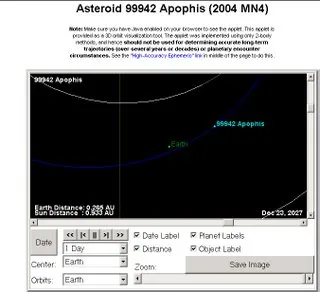
Image of the orbit of asteroid Apophis. JPL/NASA