Thanks to a fortuitous observation with the Swift satellite, astronomers have captured, for the first time, a star exploding as a supernova.
"For years we have dreamed of seeing a star just as it is exploding, but actually finding one is a once-in-a-lifetime event," says Alicia Soderberg, of Princeton University. "This new supernova will be the Rosetta Stone of supernova studies in the following years."
Until now, a star exploding had not been observed, but rather when the explosion had already occurred. Something similar happened in 1987 when supernova 1987A was discovered, in the Large Magellanic Cloud.
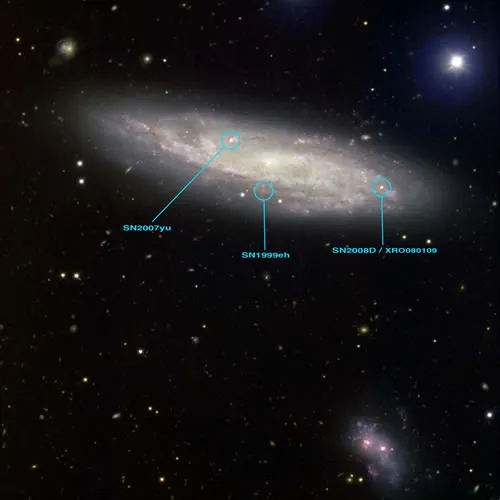
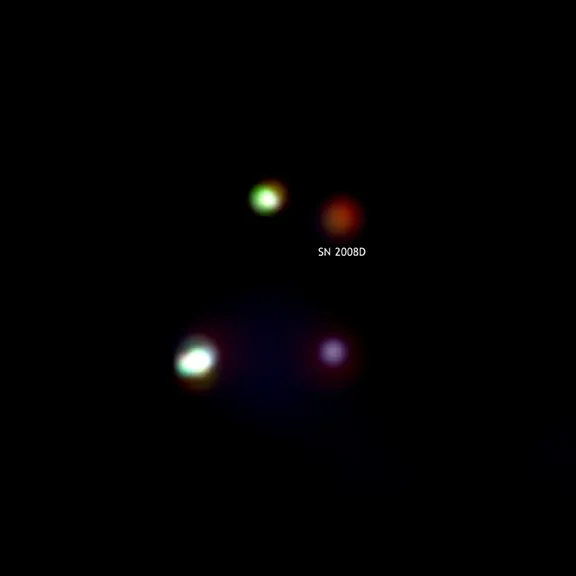
On January 9, Soderberg and Edo Berger were using Swift to observe a supernova known as SN 2007uy in the spiral galaxy NGC 2770, located 90 million light-years from Earth in the constellation Lynx. At 9:33 a.m. (Eastern Time) they detected an extremely bright X-ray outburst. They quickly recognized that it came from another location in that same galaxy.
In a paper submitted to Nature, Soderberg and 38 colleagues show that the energy and the X-ray outburst are consistent with a shock wave through the surface of the progenitor star, which is suspected to be a Wolf-Rayet star. This marks the birth of the supernova now known as SN 2008D.
Due to the significant outburst, Soderberg mounted an international observing campaign to study the event. Observations were made with large telescopes such as Hubble, Chandra, the VLA, Gemini North, Keck, the Apache Point telescope and the mythical telescopes of Palomar Observatory.
The combined observations helped scientists establish the energy of the initial outburst, which helps theorists better understand supernovae. The observations also show that SN 2008D is a Type Ibc supernova, rich in helium, which occurs when a massive star explodes. No evidence of a matter jet was found in the radio and X-ray observations, which would rule out that it was a Gamma-ray Burst (GRB).
The results will be published in the May 22 issue of Nature under the title:"An extremely luminous X-ray outburst marking the birth of a normal supernova", by Alicia Soderberg and 38 co-authors.
Sources and related links
- Chandra: NASA’s Swift Satellite Catches First Supernova in The Act of Exploding
- Gemini: Catching the Light of a Baby Supernova
About the images
Top image
NGC 2770 by the Gemini Multi-Object Spectrograph on Gemini North on Mauna Kea, Hawaii. The supernova discovered while exploding, SN2008D, is indicated, as well as the supernova the scientists were originally studying, SN2007uy, and SN1999eh.
Credit: Gemini Observatory GMOS-North
Bottom image
Credit: NASA/CXC/Wisconsin/D.Pooley et al.