First precise measurement of the temperature of the background radiation of the distant Universe.
Astronomers used ESO's VLT to detect for the first time in ultraviolet the carbon monoxide molecule in a galaxy almost 11 billion light-years away. This detection allows them to obtain the most precise measurement of the cosmic temperature at that remote epoch.
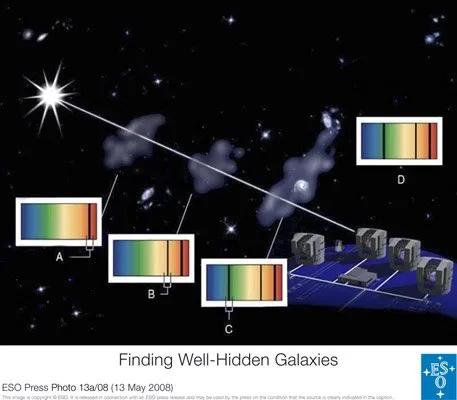
The team of astronomers pointed the UVES spectrograph of the Very Large Telescope (VLT) of the European Organisation for Research in the Southern Hemisphere (ESO) for more than 8 hours at a well-hidden galaxy whose light took 11 billion years to reach us, that is almost 80% of the age of the Universe.
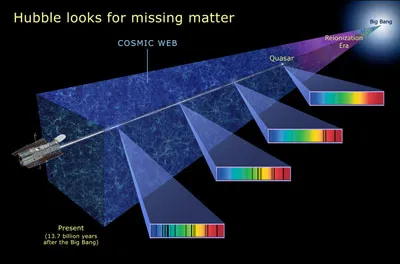
The only way to see this galaxy is through the imprint its gas leaves on the spectrum of an even more distant quasar. "Quasars are used here only as beacons in the very distant Universe. The interstellar gas clouds in galaxies, located between the quasars and us along the same line of sight, absorb parts of the light emitted by the quasars. The resulting spectrum consequently presents dark 'valleys' that can be attributed to well-known elements and possible molecules," explains Raghunathan Srianand, who led the team in the observations.
Thanks to the power of the VLT and a careful selection of the target -selected from almost ten thousand quasars- the team was able to discover the presence of normal hydrogen and deuterated molecular hydrogen (H2, HD) and carbon monoxide molecules (CO) in the interstellar medium of this remote galaxy. "This is the first time that these three molecules have been detected in absorption in front of a quasar, a detection that has remained elusive for more than a quarter of a century," says Cédric Ledoux (ESO), a team member.
The same team has broken the record for the most distant detection of molecular hydrogen in a galaxy we see as it was when the Universe was less than 1.5 billion years old.
Interstellar gas is the reservoir from which stars form and as such is an important component of galaxies. Moreover, since the formation and state of molecules are very sensitive to the physical conditions of the gas, which in turn depends on the rate at which stars form, the detailed study of the chemistry of the interstellar medium is an important tool for understanding how galaxies form.
Based on their observations, the astronomers showed that the prevailing physical conditions in the interstellar gas in this remote galaxy are similar to what is seen in our Milky Way galaxy.
But more importantly, the team was able to measure with the best precision to date, the temperature of the cosmic background radiation in the distant Universe. [1] "Unlike other methods, measuring the cosmic background temperature using the CO molecule involves very few assumptions," declares co-author Pasquier Noterdaeme.
If the Universe formed in a "Big Bang", as most astrophysicists infer, the glow of this primordial fireball must have been much hotter in the past. That is exactly what was found in the new measurements. "Given the current measured temperature of 2.725 K, one would expect the temperature 11 billion years ago to be about 9.3K," says co-author Patrick Petitjean. "Our set of observations allows us to deduce a temperature of 9.15K plus or minus 0.7K, in excellent agreement with theory."
"We believe our analysis is pioneering in studies of interstellar chemistry at high redshift and demonstrates that it is possible, along with the detection of other molecules such as HD or CH, to use interstellar chemistry to address important cosmological issues," adds Srianand.
The results have been presented in a letter to the Editor in Astronomy and Astrophysics.
Sources and related links
- ESO: A Molecular Thermometer for the Distant Universe
- First detection of CO in a high-redshift damped Lyman-alpha system
R. Srianand, P. Noterdaeme, C. Ledoux, P. Petitjean
A&A 482, L39-L42 (2008)
DOI: 10.1051/0004-6361:200809727
[1] One of the fundamental predictions of the Hot Big Bang theory for the creation of the Universe is the existence of the Cosmic Microwave Background radiation. This radiation was discovered in 1964 by Arno Penzias and Robert Wilson, who were later awarded the Nobel Prize in 1978. Precision measurements made with the COBE and WMAP satellites showed that this ancient radiation fills the Universe with a current average temperature of 2.725 degrees Kelvin or what is the same -270.4º Celsius. A particular prediction of the theory is that the Universe cools as it expands, or looking at it the other way, it increases if we go back in time. For this, the expansion of the Universe is taken into account (1+redshift). Given the redshift of the galaxy in the study (2.41837), one would expect a temperature of 2.725x(1+2.41837)=9.315º Kelvin or -263.835º Celsius.
About the images
ESO PR Photo 13a/08
Finding well-hidden galaxies
In this schematic representation, the VLT observes (D) the features associated with three systems, located at different distances (A, B and C) and whose light is thus shifted by different amounts. The quasar, which acts as a beacon, is the bright object on the left side of the image.