Astronomers had found a star that was too heavy and did not match theoretical models. Now, they determined that it weighs half as much as thought and is surrounded by a thick belt of gas and dust.
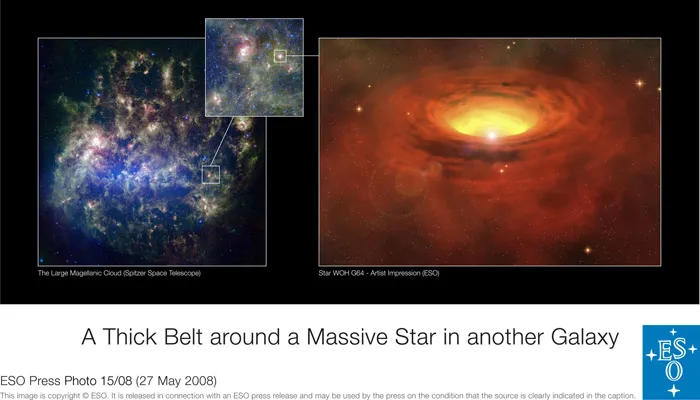
It is WOH G64, a red supergiant star almost 2,000 times the size of our Sun, located 163,000 light-years away in the Large Magellanic Cloud.
"Previous estimates gave an initial mass of 40 times the mass of our Sun, but this was a real problem because it was too cold, compared to what theoretical models predict for a star that massive. Its existence could not be explained," says Keiichi Ohnaka, who led the work on this object.
New observations, made with ESO's VLT Interferometer, concluded that the gas and dust around the star is arranged in a thick ring, rather than a spherical shell, and thus the star is less hidden than had been assumed. This implies that the object has half the luminosity previously thought and therefore is less massive. Astronomers infer that the star began its life with a mass of 25 times the mass of the Sun. For such a star, the observed temperature is close to what would be expected.
"Even so, the star's characteristics mean it could be experiencing a very unstable phase accompanied by large mass losses," adds co-author Markus Wittkowski of ESO. "We estimate that the belt of gas and dust surrounding it contains between 3 and 9 solar masses, which means the star has already lost between one-tenth and one-third of its initial mass."
To reach this conclusion, the team used the MIDI instrument to combine the light collected from three pairs of the VLT's 8.2m telescopes. It is the first time MIDI has been used to study a single star outside our galaxy.
The observations allowed the scientists to clearly determine the star. Comparisons with models allowed them to conclude that the star is surrounded by a gigantic and thick torus, expanding from about 120 AU to more than 30,000 AU!!
(AU is Astronomical Unit and equals the average distance between Earth and the Sun, 150 million km)
"Everything is huge in this system. The star itself is so large that it would almost fill all the space between the Sun and Saturn's orbit. And the torus surrounding it is perhaps a light-year in diameter."
The name WOH 64 refers to it being entry 64 in the catalog of Westerlund, Olander and Hedin, published in 1981 and based on observations made at La Silla.
Sources and related links
- The Behemoth Has a Thick Belt
- "Spatially resolved dusty torus toward the red supergiant WHO G64 in the Large Magellanic Cloud"
by K. Ohnaka et al., Astronomy and Astrophysics, 484, 371-379 (2008)
DOI: 10.1051/0004-6361:200809469
About the images
Credit:
ESO PR Photo 15/08: The torus around WOH G64