The European Organization for Astronomical Research (ESO) celebrates the tenth anniversary of the first light of the Very Large Telescope (VLT), the world's most advanced optical telescope. To celebrate, ESO is presenting two incredible images of nebulae.
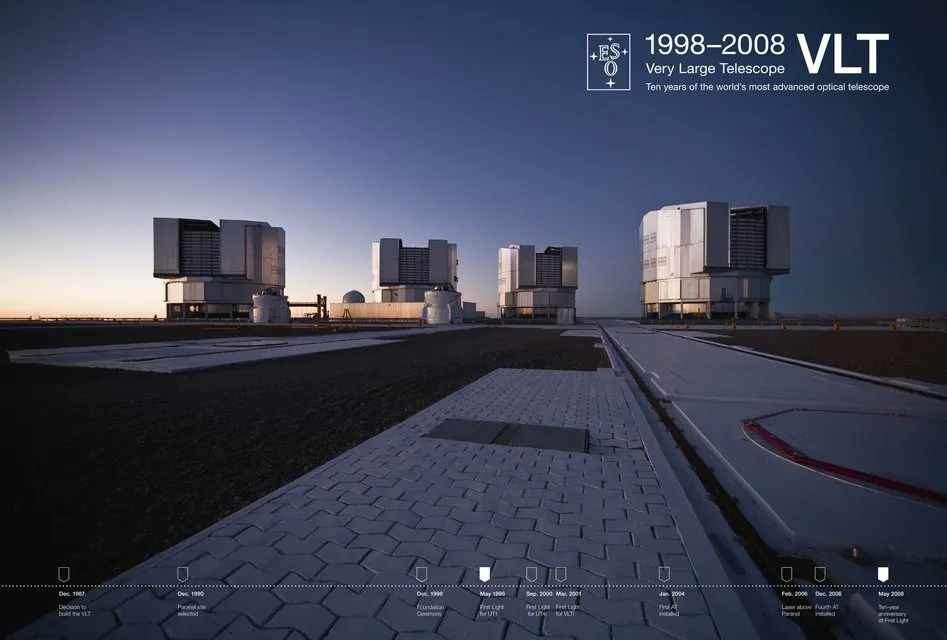
Since then, the VLT evolved into a set of four 8.2m telescope units equipped with no less than 13 state-of-the-art instruments and four 1.8m auxiliary telescopes. The telescopes can work individually and can also be combined in groups of two or three to form a gigantic "interferometer", the VLTI, which allows astronomers to see details that would be seen with a much larger telescope.
Atop the 2600m high Paranal Mountain in the Chilean Atacama Desert, the VLT's design sets the standard for ground-based astronomy. It provides the scientific community with a facility with a significantly greater light-gathering power than other installations available today, offering imaging and spectroscopic capability at visible and infrared wavelengths.
The first scientifically useful images, which marked the First Light of the VLT, were obtained on the night of May 25 to 26, 1998, with a test camera attached to "Antu", Telescope Unit number 1. They were officially presented to the press on May 27, exactly ten years ago.
For this special occasion, ESO is presenting two incredible images of different nebulae, located in the constellation Carina.
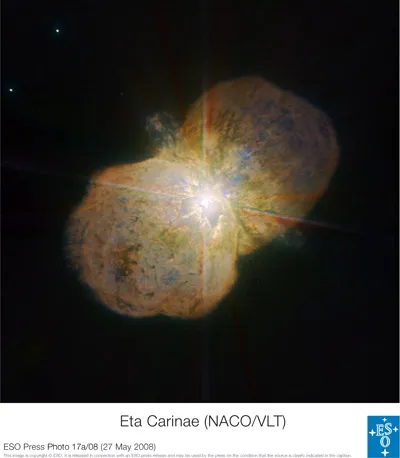
The first, Eta Carinae, has the shape of a "little man" and surrounds a star doomed to explode within the next 100,000 years.
Eta Carinae shines brighter than a million suns, it is the most luminous known star in the Galaxy. It is the closest example of a luminous blue variable, the last phase in the life of a very massive star before it explodes in a powerful supernova.
Eta Carinae is surrounded by a bipolar cloud of dust and gas known as The Homunculus ("Little Man" in Latin), which astronomers think was ejected from the star during a strong outburst seen in 1843. [1]
Eta Carinae was one of the first objects focused during the first light of the VLT. This recently obtained image has a resolution 6 to 7 times better than the one taken a decade ago.
The second is of a larger nebula, whose internal turmoil is created by a young cluster of massive stars.
The second image was obtained with the ISAAC instrument on Antu.
Located 9,000 light-years away, NGC 3576 is also in the direction of the constellation Carina. It is 100 light-years in diameter, that is, 25 times greater than the distance between the Sun and its nearest star.
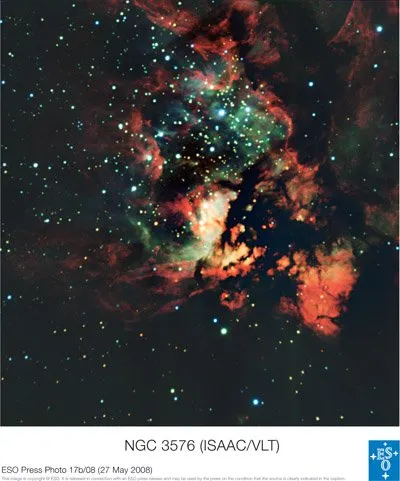
The intriguing nebula is a gigantic region of bright gas, where stars are currently forming. The intense radiation and winds from the massive stars are sweeping away the gas from which they formed, creating the dramatic scene. The nebula is estimated to be 1.5 million years old, a blink of an eye on cosmological timescales.
Astronomers from the University of Cologne, Germany, have studied this region with the VLT to determine the proportion of stars that have protoplanetary disks from which planets form. By observing young regions of different ages, astronomers hope to estimate the lifetime of the disks and thus better understand how planets form. In particular, scientists are interested in searching for the effect of the strong radiation from the stars, as well as stellar encounters in these dense regions, on the surviving disks.
[1] Actually, since the distance to Eta Carinae is about 7500 light-years, the eruption must have taken place 7700 years ago.
Sources and related links
- The Perfect Science Machine
- The Little Man and the Cosmic Cauldron
About the images
Credits:
ESO PR Photo 16a/08
The VLT 10th anniversary poster
ESO PR Photo 17a/08
The Homunculus (NACO/VLT)
ESO PR Photo 17b/08
NGC 3576