Empty space was not always as puzzling as it is now. Until the 1920s, physicists saw the vacuum as most of us still do: a featureless nothing, a true void. Everything changed with the birth of quantum mechanics. According to that theory, the space around a particle is filled with countless 'virtual' particles, of very short duration.
These particles are more than a theoretical abstraction. Sixty years ago, the German physicist Hendrik Casimir suggested a simple experiment to show that virtual particles can move objects in the real world. What would happen, he asked, to two metal plates placed very close to each other in a complete vacuum? Before quantum mechanics, physicists would have said the plates would stay there unchanged. But Casimir realized that the pressure of all the virtual particles outside the plates should exert a tiny force that would push the plates together.
Physicists tried for decades to measure the Casimir force with great precision, but it was not until 1997 that technology allowed a measurement like the one performed by Steve Lamoreaux, now at Yale. He detected the force between two surfaces separated by only a few thousandths of a millimeter.
This Casimir effect ceased to be a simple theoretical curiosity without practical value.
Now, it is thought that -in the future- this effect could power nanoscale devices and some laboratories are working on ways to use this force to challenge the conventional limitations of mechanical design. Federico Capasso, a physicist at Harvard, leads a small team that is trying to create a repulsive Casimir force by adjusting the shape of the plates. His entire set of experiments fits on a desk and the objects he works with are so small that most are not visible without a microscope.
'Once you have a repulsive force between two plates, you should be able to eliminate static friction,' says Capasso. That could lead to useful applications, such as frictionless bearings. 'But the experiments are enormously difficult, so I can't tell you when and how.'
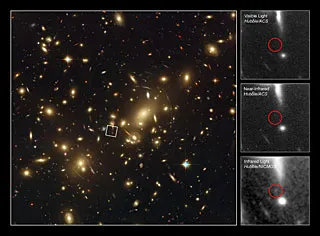
However, despite its oddity, this does not puzzle physicists. The same cannot be said for dark energy, an incredible discovery by astronomers a decade ago when observing supernovae. These stellar explosions revealed a universe in accelerated expansion, when the opposite would have been expected, that gravity would slow down the expansion. Some unknown form of energy seems to belong to the fabric of space and counteracts the gravitational pull of matter.
Observations have allowed physicists to estimate the amount of dark energy by deducing the force needed to produce this acceleration effect. The result is a tiny amount of energy per cubic meter of vacuum. Since most of the cosmos consists of empty space, this small amount accumulates to the point that this kind of energy completely dominates the dynamics of the universe.
The difficult questions arose quickly: What is this energy and where does it come from? Physicists simply do not know. According to quantum mechanics, the energy of empty space comes from the virtual particles that dwell there. But when physicists used the equations of quantum theory to calculate the amount of virtual energy, they got a ridiculously high number. So large -more than 120 orders of magnitude- that this energy would shatter the universe, doubling its size every 10-43 seconds.
'We have made a prediction based on our best theories and it is wrong,' says Sean Carroll, a theoretical physicist at Caltech. 'That means we can't just adjust a parameter here and there; we must think deeply about what our theories are.'
But there is no doubt that this elusive energy exists and inevitably someone has thought about how to exploit it. The notion of unlimited energy has inspired a legion of pseudo-physicists who dream of finally developing a perpetual motion device, a machine that would solve the world's energy problems forever.
A simple web search allows you to find some ideas that seem quite crazy. Are they all doomed to failure?
'Perhaps not as much as trying to prove the Earth is flat,' says John Baez. 'One thing I can say is that I hope they don't work, because if you can extract energy from the vacuum, it would mean the vacuum is not stable.' 'For normal physicists,' he says with a laugh, 'the definition of vacuum is that it is the lowest possible energy situation, it has less energy than anything else.' What Baez is saying is that as long as we are capable of taking energy from the vacuum, success would mean that the universe is much more unstable than we ever dreamed.
The reasoning is this: if the vacuum is not in the lowest possible energy state, then, at some point in the future, the vacuum could fall to a lower state, expelling energy that would threaten the structure of the cosmos. If some clever engineer could ever extract energy from the vacuum, it could trigger a chain reaction at the speed of light and destroy the universe.
But if we cannot take energy from the vacuum, perhaps we can have different benefits from empty space.
The Large Hadron Collider (LHC) is about to start up, which will collide protons traveling at nearly the speed of light. (See 'What can we expect from the LHC?') In the debris of the collisions, physicists hope to find evidence of another strange component of space, one that would explain why particles have mass. Physicists believe the universe contains what they call the Higgs Field, which would cover all of space. Its detection would not be a surprise: they have been looking for it since 1964 when Peter Higgs, a physicist at the University of Edinburgh, proposed its existence.
Higgs wanted to explain why matter has mass and more specifically why each particle has a different mass. He theorized the existence of an invisible field filling all of space and argued that particles acquire mass by interacting with this field. What we interpret as particle mass would really be the strength of its interaction with the Higgs field.
If the Higgs field exists, the LHC should find a particle called the Higgs boson. Just as light, an electromagnetic field, is transmitted by particles called photons, physicists expect there to be carrier particles for the Higgs field and these would be the bosons.
The discovery of the Higgs boson could answer one of the most enigmatic aspects of our reality.
"If it is found, it wouldn't be very exciting. It would be a relief, rather. Well, it would be exciting, but only in the same sense that you lose your keys and then find them. Someone would win the Nobel Prize for it, but after the initial excitement, particle physicists would be grumpy, because it would mean that what we thought was true, was true, and all the things we don't understand, we would still not understand them, and without new evidence."
Some researchers, however, hope that the LHC will find evidence of something very new: the extra dimensions of space. According to M-theory, the most audacious attempt to explain the foundations of physics, the space around us could be constituted of 11 dimensions. M-theory proposes that the building blocks of the universe are not particles but loops of energy or strings, as they call them. For complicated mathematical reasons, the strings would need 11 dimensions to vibrate. And if we experience only 4 dimensions (three spatial and one temporal) in our daily life, it would be because the others are incredibly small, evident only at subatomic scales.
One way to imagine it is like a tightrope walker walking on a cable. For him, the cable would be essentially one-dimensional, a line. But for an ant on the cable, it would experience it as three-dimensional, since it could walk around the cable. String theorists would say we are like the tightrope walker, except that our "string" is an 11-dimensional space, of which we are only capable of experiencing 4.
M-theory could be seen heading towards something more than a theoretical oddity, if experiments at the LHC yielded missing or surplus particles, which could mean that some particle fell into another dimension or that from another dimension a new one arrived, respectively.
Some physicists like to think that M-theory will form the basis of what they call the Theory of Everything, a set of laws that would completely describe the universe in all its strangeness, where dark energy, quantum mechanics, extra dimensions and blog readers would fit in the same package.
It would be somewhat paradoxical that the virtual particles of quantum mechanics, the ones that fill spatial vacuum, would allow building a complete explanation of the cosmos: A theory of nothing for a theory of everything.
Sources and related links
- Based on the article:
Nothingness of Space Could Illuminate the Theory of Everything, by Tim Folger - An Argentine behind the Higgs boson
About the images
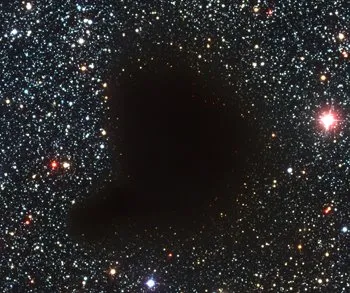
Courtesy:ESO