Astronomers commonly observe intense flashes of light from a variety of stellar explosions and outbursts, such as novae and supernovae. Hubble discovered a cosmic flash on February 21, 2006. It remained bright for 100 days and then faded away.
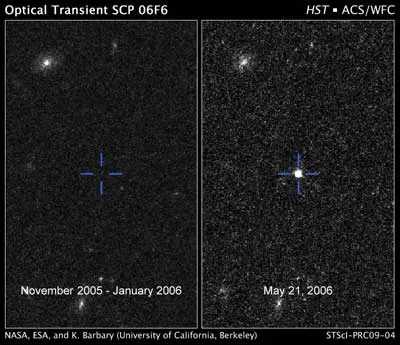
The rise and fall in brightness has never been recorded in any other cosmic event. Supernovae reach their maximum after no more than 70 days. Thus, this observation defies simple explanations, according to Kyle Barbary of Berkeley Lab. The scientist describes the rare observation at the astronomical society meeting taking place in California. "We have never seen anything like this," he notes.
The spectral fingerprints of light from the object, cataloged as SCP 06F6, have eluded identification. They are not due to any specific element. One assumption is that the absorption lines of molecular carbon are redshifted in a star a billion light-years away.
But searches for the source, through various catalogs, have found, until now, no evidence of a star or galaxy at the location of the flash, which was discovered by the laboratory's Supernova Cosmology project, by accident.
Hubble had been pointed at a galaxy cluster 8 billion light-years away in the constellation Bootes. But the mysterious object could be anywhere in between, even in a halo of our Milky Way.
Reports published since the discovery suggest a zoo of possibilities: the core collapse and explosion of a carbon-rich star, a collision between a white dwarf and an asteroid, the collision of a white dwarf and a black hole...
According to Barbary, no model offers until now a complete explanation for the observations.
Variable surveys, like the one conducted by the planned Large Synoptic Survey Telescope, could finally find similar events in the universe and perhaps then understand this strange phenomenon.
Sources and related links
- Star Light, Star Bright, Its Explanation is Out of Sight
- Discovery of an Unusual Optical Transient with the Hubble Space Telescope and at Supernova Cosmology Project
About the images
NASA, ESA, and K. Barbary (University of California, Berkeley/Lawrence Berkeley National Lab, Supernova Cosmology Project)