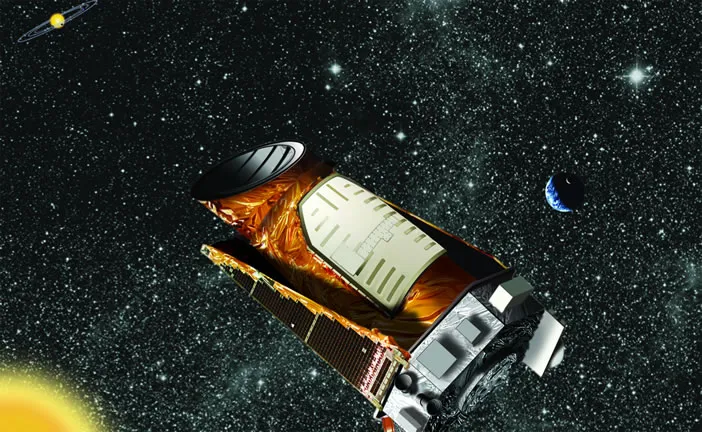
Two independent groups have made the first detection, with observatories on the Earth's surface, of thermal emissions from exoplanets. Until now, almost everything about the atmospheres of planets orbiting other stars in the Milky Way came from observations made from space. These new results open a new frontier in the study of other worlds, especially important given that the main "workhorse" in these studies, the Spitzer Space Telescope, will see its capabilities limited.
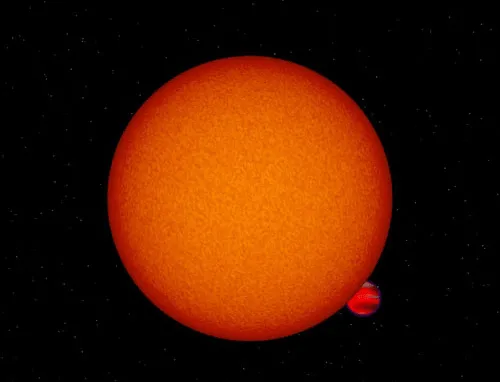
Transiting exoplanets are detected increasingly often as they pass in front of their host star, as seen from our planet. The transit causes a variation in the star's light that can be detected. 55 planets have been detected this way since the first observation of planet HD 209458 b in 1999. As the planet orbits its star, the light from the system varies. This is very difficult to detect due to the little light emitted by exoplanets, which reflect very little light from the star. Fortunately, some of these planets are very hot and emit mainly at infrared wavelengths.
One of the teams of scientists observed a planet called OGLE-TR-56b, a "hot Jupiter". It is a massive planet that orbits very close to its star, so it is thought to be hot enough to emit optical and near-infrared radiation and be detectable from Earth.
It is a planet that emits a lot of heat and has little to no wind in its atmosphere, according to Mercedes López-Morales, co-author of the report, from the Carnegie Institution. The observations were made at the Very Large Telescope and the Magellan Telescope, in Chile.
These large instruments were needed because the part of the galaxy observed is very crowded and the planet is very faint, as pointed out by author David Sing of the Institut d'Astrophysique de Paris. Sing and Lopez-Morales measured the highest temperature of an exoplanet atmosphere: 2700º Kelvin.
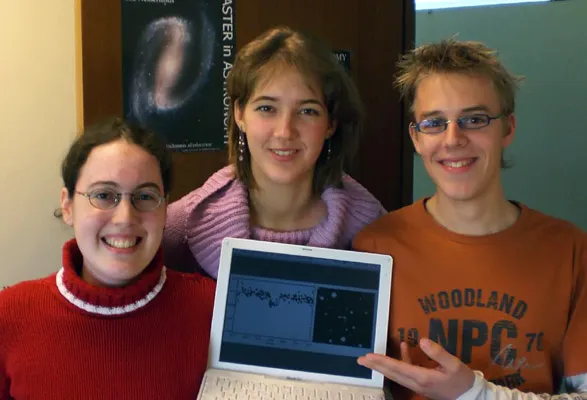
In the other study, published together with the previous one in Astronomy & Astrophysics, astronomers in the Netherlands detected thermal emission in the near infrared from the exoplanet called TrES-3b.
Scientists Ernst De Mooij and Ignas Snellen used the 4.2m William Herschel Telescope on La Palma, Canary Islands. To be able to detect the light coming from the planet, they observed it exactly at the moment it passed behind the star. They observed the event at infrared wavelengths, where the planet is brighter compared to the star (although the planet is still fainter than the star) and estimated its temperature at 2000º Kelvin.
Sources and related links
- First ground-based detection of light from transiting exoplanets
- Ground-based K-band detection of thermal emission from the exoplanet TrES-3b, by E.J.W. De Mooij and I.A.G. Snellen
A&A 493, L35-L38 (2009)
DOI: 10.1051/0004-6361:200811239
Ground-based secondary eclipse detection of the very-hot Jupiter OGLE-TR-56b, D. K. Sing and M. Lopez-Morales
A&A 493, L31-L34 (2009)
DOI: 10.1051/0004-6361:200811268
About the images
Artist's impression of the star OGLE-TR-56 and its transiting planet
© D. Sing (IAP) / A&A.