The most detailed map of the Moon revealed craters never before seen at the lunar poles. The map also reveals secrets of the satellite's interior.
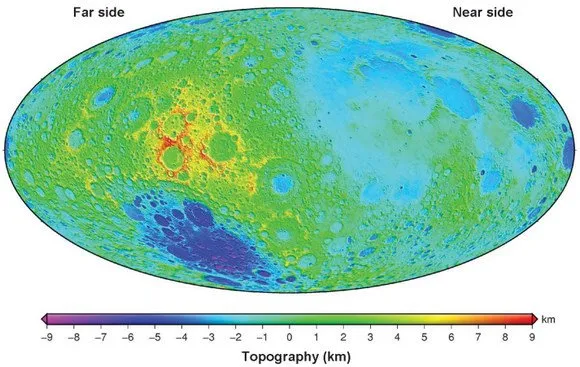
The map was published in Science by an international team of scientists.
"The surface can tell us a lot about what is happening inside the Moon, but until now mapping has been limited," said C.K. Shum, a professor at Ohio University and part of the team. "With these new high-definition maps, we can confirm that there is very little water on the Moon currently, even in its deep interior. And we can use that information to think about water on other planets, including Mars."
The scientists mapped Earth's natural satellite with the SELENE satellite, through the onboard instrument LALT. SELENE, also known as Kaguya, is a Japanese lunar study probe. The principal investigator of the instrument, Hiroshi Araki of the National Astronomical Observatory of Japan, is the lead author of the study.
The map is the first to cover the Moon from pole to pole, with detailed measurements of the surface topography, on both sides of the Moon. The highest point—on the rim of the Dririchlet-Jackson crater near the equator—rises 11 kilometers, while the lowest point, the floor of the Antoniadi crater near the south pole, is 9 kilometers deep.
In part, the new map will serve as a guide for future lunar rovers. But Araki and his colleagues did something more with the map: they measured the roughness of the surface and used that information to calculate the rigidity of the crust.
If water flowed beneath the surface, the crust would be somewhat flexible, but it is not. The surface is too rigid to allow liquid water, even deep within the Moon.
Earth's surface is more flexible, in contrast, with the surface rising or falling as water flows below or above the ground. Even our planet's tectonic plates are due to the liquid lubrication of the crust.
And Mars? On a scale of surface rigidity, it falls between Earth and the Moon, indicating that there may have been liquid water, but the surface is now very dry.
So far, no surprises. But the rigidity of Mars together with the complete absence of tectonic plates suggests that if there is water inside the red planet, it is not located near the surface, where it could lubricate the crust, explained Shum.
The LALT map is the most detailed ever created of the Moon. The last three Apollo missions mapped part of the surface in the 1970s and the Clementine mission in 1994 achieved a resolution between 20-60 kilometers in certain places, but not over the entire surface.
The SELENE mission offers a resolution of 15 kilometers consistently over the entire surface, thanks to a satellite tracking system.
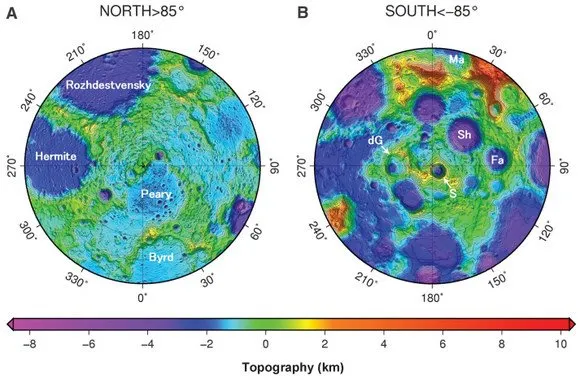
The map also revealed several smaller craters at the poles that had never been seen. For example, a crater 15 km in diameter can be seen inside the larger Gerlache crater at the south pole.
Sources and related links
- New high-res map suggests little water inside moon
- Lunar Global Shape and Polar Topography Derived from Kaguya-LALT Laser Altimetry
H. Araki, S. Tazawa, H. Noda, Y. Ishihara, S. Goossens, S. Sasaki, N. Kawano, I. Kamiya, H. Otake, J. Oberst, C. Shum
Science 13 Febrero 2009: 897-900.
DOI: 10.1126/science.1164146 - Farside Gravity Field of the Moon from Four-Way Doppler Measurements of SELENE (Kaguya)
Noriyuki Namiki et al
Science 13 Febrero 2009: 900-905 - Long-Lived Volcanism on the Lunar Farside Revealed by SELENE Terrain Camera
Junichi Haruyama et al
Science 13 Febrero 2009: 905-908 - Lunar Radar Sounder Observations of Subsurface Layers Under the Nearside Maria of the Moon
Takayuki Ono et al.
Science 13 Febrero 2009: 909-912 - UniverseToday:New high-res maps suggest little water in moon
About the images
Topographic map of the Moon obtained with Kaguya (SELENE). Credit: Hiroshi Araki et al. 2009
Topographic maps of the lunar poles obtained with Kaguya (SELENE). Credit: Hiroshi Araki et al. 2009