A team of French astronomers captured one of the sharpest color images ever achieved. They observed the star T Leporis, which appears in the sky as small as a two-story house on the Moon. The image was taken with the Very Large Telescope Interferometer (VLTI), emulating a virtual telescope of 100 meters and revealing a spherical molecular shell around the old star.
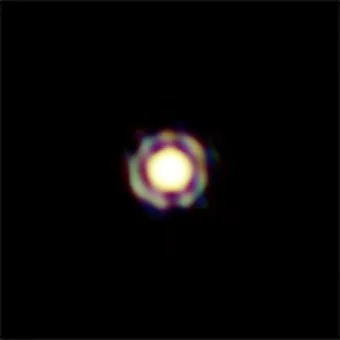
"This is one of the first images made with near-infrared interferometry," said Jean-Baptiste Le Bouquin, the scientist who led the study.
Interferometry is a technique that combines light from several telescopes and results in a vision as clear as that of a telescope whose diameter would be equal to the greatest separation between the telescopes used. For this to be possible, the components of the VLTI system must be positioned with incredible precision (one of a fraction of a micrometer over 100 meters) and maintained throughout the observations. Quite a challenge.
When doing interferometry, astronomers often encounter fringes, the characteristic pattern that dark and bright lines produce when two beams of light combine, from which they can study the physical properties of the objects studied. But if an object is observed several times with different combinations and configurations of telescopes, it is possible to combine these results to reconstruct an image of the object. That is what they have done with ESO's VLTI, using the 1.8-meter auxiliary telescopes.
"We were able to construct an incredible image and reveal the onion-like structure of the atmosphere of a giant star in the final stages of its life, for the first time," explained Antoine Mérand, a team member. "Numerical models and indirect data have allowed us to imagine the star's appearance before, but it is very amazing that we can now see it, and in color."
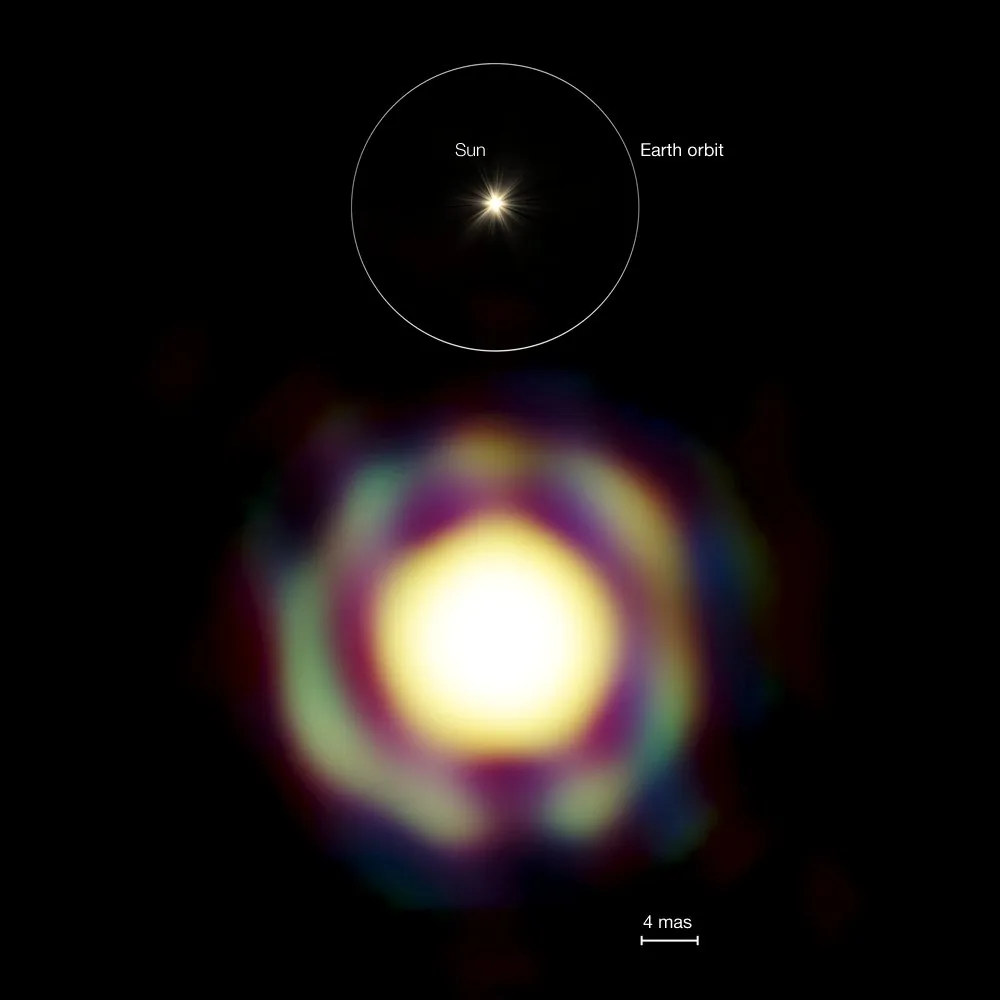
Although it is only 15 x 15 pixels, the image shows an extreme close-up of a star 100 times larger than our Sun, a diameter corresponding to almost the distance between Earth and our star. The star, in turn, is surrounded by a sphere of molecular gas, which is three times larger.
T Leporis, in the constellation Lepus (The Hare), is located 500 light-years away. It belongs to the family of Mira variable stars, well known to astronomers. These are giant variables that have already exhausted their nuclear fuel and are losing mass. They are near the end of their lives as stars and will soon die, turning into white dwarfs. The Sun will become a Mira star in a few billion years.
Mira stars are among the largest factories of molecules and dust in the universe and T Leporis is no exception. It pulsates with a period of 380 days and loses the equivalent of our planet's mass in a year. Since molecules and dust form in the layers of the atmosphere surrounding the central star, astronomers would like to be able to see these layers. But it is not a simple task, given that the stars themselves are very far away and, despite their enormous size, their apparent radius in the sky can be a millionth of the Sun's apparent radius.
"T Leporis appears so small from Earth that only an interferometric facility, like the VLTI at Paranal, can obtain an image of it. VLTI can observe stars 15 times smaller than those the Hubble Space Telescope can see," said Le Bouquin.
To create this image, astronomers had to observe the star for several consecutive nights, using the four auxiliary telescopes (AT). The ATs were combined in different groups of three, and were moved to different positions, creating more configurations so astronomers could emulate a virtual telescope nearly 100 meters in diameter and thus create the image.
Sources and related links
- Hundred metre virtual telescope captures unique detailed colour image
On the ESO site there is an animation illustrating a close-up of T Leporis - Pre-maximum spectro-imaging of the Mira star T Lep with AMBER/VLTI
Forthcoming in Astronomy and Astrophysics
About the images
Images of T Leporis and the star compared to Earth's orbit around the Sun.
Credit:ESO