The Whole Earth Telescope (WET), a worldwide network of observatories, is synchronizing its lenses to provide around-the-globe coverage of a cold, dying star.
As the star reaches the twilight of its life, scientists hope it can shed light on some astronomical mysteries.
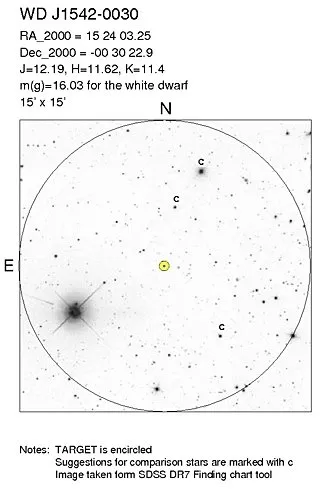
It is a white dwarf star, designated WDJ1524-0030, in the constellation Ophiuchus, which is losing its brightness as it cools. It will be monitored continuously from May 15 to June 11 by WET, a global collaboration of telescopes formed in 1986.
It will be a relay race among observatories in the U.S., China, South Korea, Chile, Germany, Lithuania, India, New Zealand, Poland, France, the Canary Islands, Italy, Russia, South Africa and Austria.
The hundreds of photographs of the white dwarf will be archived and analyzed by researchers to better understand these and other stars and even some processes here on Earth.
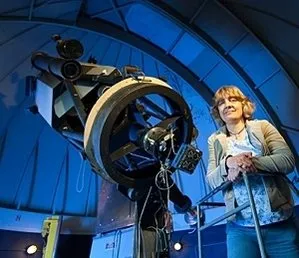
"A white dwarf is the size of Earth and as dense as the Sun. This star pulsates or trembles as energy waves travel through it, its outer surface sloshes back and forth, like waves in the ocean," explained Judi Provencal, a professor of physics and astronomy at the University of Delaware and director of an asteroseismology research center.
"What is interesting for scientists is the shape of the pulses. From them, we can measure how the atmosphere is moving around in these pulsating stars and try to understand what is happening inside them," the scientist indicated.
There are hundreds of white dwarfs in our galaxy; however, only 30 percent are bright enough for scientists to study using the technique of asteroseismology, which can determine a star's age, temperature and composition from its oscillations and brightness.
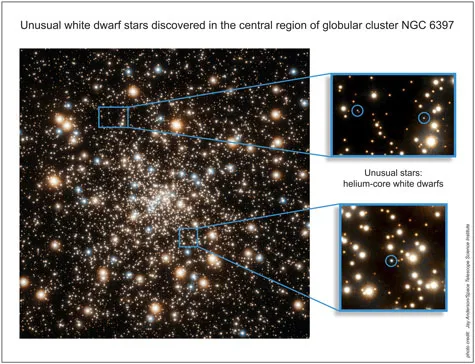
Provencal says that WDJ1524-0030 is one of only 20 percent of the stars in the universe whose atmosphere is composed of helium instead of hydrogen. The team hopes to determine the composition of the star's core, whether hydrogen or oxygen. We had reported on these stars here in "The largest collection of unusual white dwarfs".
The discovery process will take about two years to take all the images, analyze the data and interpret them. The results will be applied to other stars, including our Sun and even to our planet.
This field of research, still very novel, could help in many aspects of astronomy. We had spoken about seismology previously, used, for example, to study "The music of the stars".
To achieve these observations, there will be an additional effort in organizing the more than 20 telescopes participating around the world, which are the following:
* Beijing Astronomical Observatory (BAO), China (2.1 m/6.9 ft)
* Bohyunsan Optical Astronomy Observatory (BOAO), South Korea (1.8 m/5.9 ft)
* Cerro Tololo Inter-American Observatory (CTIO), Chile (0.9 m/3 ft)
* Institut für Astronomie und Astrophysik Tübingen, Germany (0.8 m/2.6 ft)
* Kitt Peak National Observatory, Arizona, USA (2.1 m/6.9 ft)
* Las Cumbres Observatory, California, USA
* Lulin Observatory, Taiwan (1 m/3.2 ft)
* McDonald Observatory, Texas, USA (2.1 m/6.9 ft)
* Moletai Astronomical Observatory, Lithuania (1.5 m/4.9 ft)
* Mt. Abu Observatory, India (1.2 m/3.9 ft)
* Mt. Cuba Astronomical Observatory, Delaware, USA (0.6 m/2 ft)
* Mt. John Observatory of the University of Canterbury, New Zealand (1 m/3.2 ft)
* Mt. Suhora Astronomical Observatory, Cracow Pedagogical University, Poland (0.6 m/2 ft)
* Observatoire de Haute-Provence (OHP), France (1.93 m/6.3 ft)
* Observatorio del Teide, Tenerife, Canary Islands, Spain (0.6 m/2 ft)
* Osservatorio Astronomico di Bologna, Italy (1.5 m/4.9 ft)
* Peak Terskol Observatory, Russian Federation (2 m/6.6 ft)
* South African Astronomical Observatory (SAAO), South Africa (1 m/3.2 ft)
* Southern Astrophysical Research Telescope (SOAR), Chile (4.2 m/13.8 ft)
* Paul and Jane Meyer Observatory, Texas, USA (0.6 m/2 ft)
* Southeastern Association for Research in Astronomy Observatory (SARA), Florida, USA (1 m/3.2 ft)
* Vienna Observatory, Austria (0.68m/2.2 ft)
Sources and related links
About the images
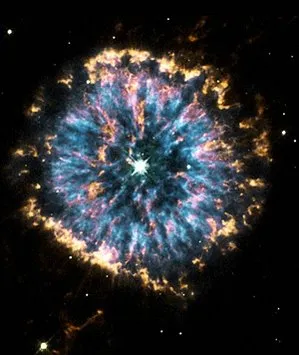
Photographed by Hubble, the bright star inside this nebula is a very young white dwarf. Credit: Space Telescope Institute/NASA and the Hubble Heritage Team
From the international command center at Mt. Cuba Observatory, Delaware, Judi Provencal is coordinating the WET observation.
Photo by Kevin Quinlan
The star marked in yellow is the white dwarf WDJ1524-0030. The stars marked with "c" will also be monitored during the observations.