The main mission of the Spitzer Space Telescope has just ended, after more than five and a half years of investigating the cosmos with its infrared vision. The telescope ran out of the liquid helium that cools its instruments to operating temperatures and will begin its "warm era".
With two channels of one instrument operating at full capacity, the space observatory will continue to provide fruitful scientific data. The science of this "new era" will not be the same as the one that is ending.
"We like to think of Spitzer as a rebirth," said Robert Wilson, of NASA's JPL.
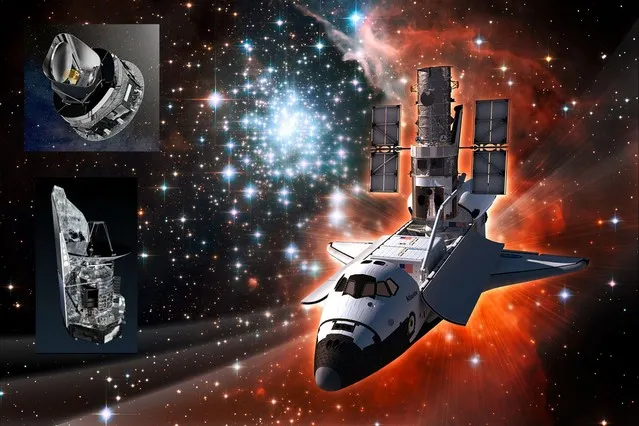
Spitzer is the last of NASA's Great Observatories, a set of telescopes designed to see the visible and invisible colors of the universe. This includes the Chandra and Hubble observatories. While the latter is being repaired and renewed (the WFC 2 was removed to install the WFC3, the sensors and battery were changed and the six gyroscopes in a spacewalk of almost 8 hours), Spitzer loses some capabilities, since by running out of coolant, two of its instruments - a multiband photometer and an infrared spectrograph - will stop working.
The proper temperature for the operation of those instruments was -271º Celsius or less than 3 degrees above absolute zero. Its new "warm" temperature, however, is no summer: it will be -242º Celsius.
However, the two detectors of shorter wavelengths in its infrared camera will continue to function perfectly. With them they will still be able to detect a range of objects: asteroids in our solar system, planet-forming disks, giant gas planets and distant galaxies. And it will still be able to see through the dust that bathes our galaxy and blocks visible light.
Since its launch on August 25, 2003, Spitzer has made countless advances in astronomy, from the study of comets, star-forming regions and distant galaxies.
Some of the new objectives of the observatory will be to refine the Hubble constant, search for very distant and primitive galaxies, measure the size of asteroids and characterize the atmospheres of giant gas planets, in synergy with the planets that the Kepler mission will discover.
Spitzer went into pause at 3:11 p.m. Pacific Time (22:11 Universal Time), on May 15, as a result of running out of its liquid helium coolant. Scientists and engineers will spend the next few weeks recalibrating the instrument for a higher temperature and preparing it to begin its science operations.
If Spitzer could talk: An interview with NASA's coldest space telescope
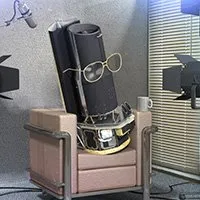
Interviewer: It's cold out here
Spitzer: Sorry. Although I'm warming up a bit, I still need to be very cold so that my two infrared channels continue to function.
Interviewer: Why do infrared telescopes need to be cold?
Spitzer: Good question. Infrared light is produced by heat. So, engineers reduce my own heat to make sure I'm measuring only the infrared light from the objects I'm studying. This is the same reason I orbit around the Sun, far from Earth, and why I have large sun shields, to stay cold.
Interviewer: Tell me Spitzer, what do you think has been your greatest discovery?
Spitzer: Probably my work on exoplanets, which are planets that orbit other stars besides the sun. I don't like to brag, but I was the first telescope to see the light from an exoplanet. I was the first to split that light into a spectrum. Oh, sorry, with my technical language again. Light is made of many different wavelengths in the same way that a rainbow is made of different colors. I was able to split the light from an exoplanet into several infrared wavelengths. Spectral information teaches us about the atmospheres of planets.
Interviewer: What did you learn about the planets?
Spitzer: For one thing, I learned that hot gas exoplanets, called "hot Jupiters," are not alike. Some are wild, with temperatures as hot as fire and almost as cold as ice. Others are more regular. I also created the first temperature map of an exoplanet, and saw a storm of colossal proportions across a rare exoplanet - it has an orbit that swings it very close to its star and then farther away, about where Earth is in our solar system.
Interviewer: It seems you really like planets.
Spitzer: Well, you know, I wasn't originally designed to see exoplanets! It was a complete surprise to me to have this incredible ability. I can tell you that I have, and always will have, a thing for planetary disks. Because I have infrared eyes I can see the warm, dusty planetary materials swirling in disks around young stars. I can also see older disks full of planetary remnants. In fact, I've seen hundreds of disks so far. What's been fun is finding them around all kinds of weird stars, like ones that are dead, ones that are doubled like twins and as small as planets. The bottom line is that the planet-growing process seems to happen easily all over the galaxy, and perhaps the universe.
Interviewer: Does this mean aliens could be anywhere?
Spitzer: I can't give you a good answer for that. Yes, disk studies are showing us that rocky planets are common, but I don't know if planets can have life. Also, keep in mind that, so far, no one has detected planets like Earth. These would be rocky worlds around stars like our sun that have the right temperature for lakes and oceans. That work will be done by the Kepler mission, which will begin the hunt very soon.
Interviewer: Have you seen other objects besides disks and planets?
Spitzer: Oh, yes, certainly. I've observed comets in our solar system, the most distant galaxies known, and everything in between. I was very excited to find hundreds of black holes hidden billions of light-years away. Astronomers knew they were there because they spew X-rays into space that can be detected as a diffuse glow. But the objects themselves were full of dust. My infrared eyes, unlike human eyes, can see through dust, so I was able to find a bunch of these missing black holes.
Interviewer: Is there any other discovery you want to mention?
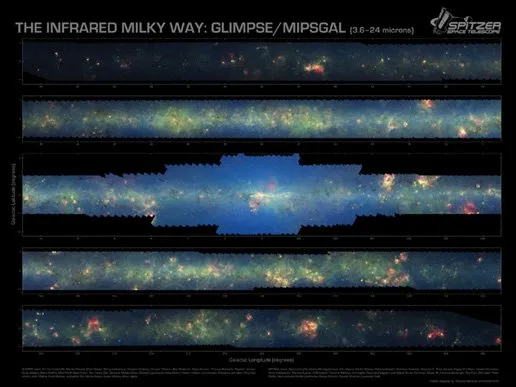
Spitzer: There are many to list, but I am particularly proud of this huge mosaic I took of a long strip of our Milky Way. It looks imposing when you print it poster-size, and it is the best view of the crowded central portion of our galaxy. You see, the middle of the Milky Way is very active in stars and dust. It's chaos and visible light cannot escape. These observations not only look very good, they also helped astronomers remap the structure of our galaxy. The new map shows only two spiral arms of stars instead of four as was previously believed.
Interviewer: And what does the future hold?
Spitzer: Well, I am looking forward to the warm mission, because now that I have only two infrared channels working, I have much more time to look at large regions of space for longer periods of time. I can help astronomers answer some really important questions, for which we didn't have time before.
Interviewer: Can you list some specific projects you will be working on?
Spitzer: I plan to continue studying exoplanets, including new "hot Jupiters" that Kepler is expected to find. I will also refine the estimates of the rate at which our local universe, or space, is expanding. And I will look at the very distant universe, trying to see some of the most distant objects possible. Oh, and I will also study thousands of asteroids in our solar system, and try to get the first real estimate of their distribution. This will tell us roughly how often large asteroids could approach Earth.
Interviewer: That sounds ominous.
Spitzer: Actually, this information will help us prepare for it. And NASA diligently tracks near-Earth objects. More information can only help.
Interviewer: Will you continue taking nice images?
Spitzer: Do you think my images are nice? Thank you. Yes, I will keep taking many photographs. For example, I will continue investigating star-forming regions in our galaxy, which often create spectacular images.
Interviewer: Anything else you want to add?
Spitzer: My cold years have been more than I could ask for and I hope for more adventures to come. I would also like to thank all the scientists and engineers who have worked so hard to make my mission a great success. And, if any of my fans want more information, they can go to www.spitzer.caltech.edu/spitzer.
Sources and related links
- If Spitzer Could Talk: An Interview with NASA's Coolest Space Telescope
- NASA's Spitzer Telescope Warms up to New Career
- NASA's Spitzer Begins Warm Mission
About the images
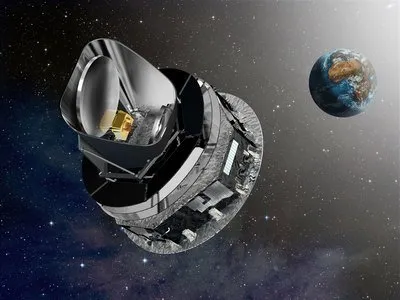
Artistic conception of Spitzer giving an interview.
NASA/JPL-Caltech