A way to summarize the scientific revolution in three words: data matters.
Deep reflection is indispensable, but it is not enough if we want to progress. Instead, the acquisition of data opens our perspectives, allowing us to support, discard, or propose new hypotheses that expand our knowledge. In this sense, this week we took three great steps to reinforce our "cosmic intelligence quotient."
Surely Galileo deserves credit for his imagination and intellectual courage. But what separates him from the generations of thinkers that preceded him is the telescope. With Galileo, for the first time, there are genuine new data available. The telescope is not just an aid for the eye, but for the brain. When applied to the heavens, an observer—any observer—can see things that Aristotle never dreamed of and thus, be a little "smarter" and better informed about the nature of the cosmos than the great minds of antiquity. With the scientific revolution we realized that deep thought does not take us very far, unless we can also improve the quality and scope of our data. Seeing better makes us smarter.
In this sense, this was a banner week for reinforcing our cosmic I.Q..
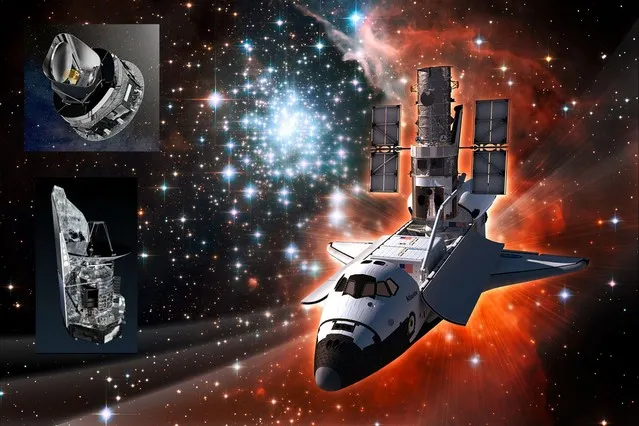
Herschel is the infrared satellite that will take over where the Spitzer Observatory left off. Its 3.5-meter mirror is the largest ever launched into space and will investigate at longer wavelengths than Spitzer, pushing infrared astronomy towards colder targets in our galaxy and in the distant universe.
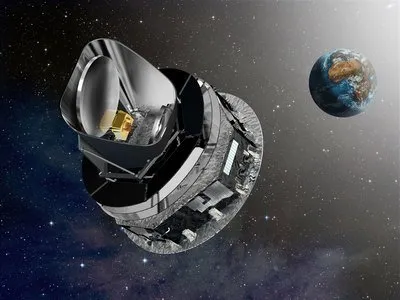
Planck is the new effort to explore the cosmic microwave background radiation, refining the vision of its predecessor, the WMAP satellite, which will allow us to bring our understanding even closer to what happened in the Big Bang and the distribution of energy, as well as its temperature fluctuations.
Together with the Fermi Gamma-ray Observatory, launched last year, they represent the space observatories of the 21st century. Meanwhile, Hubble gets a little closer to being a cutting-edge observatory with the addition of two new instruments, such as the Cosmic Origins Spectograph. And we eagerly await the James Webb Telescope.
It is difficult to imagine what Galileo would have done with the technology, but he would have understood the motivation behind these spacecraft: They are built to make us smarter.
This is a translation of the article "How Space Makes You Smarter" written by Ivan Semeniuk in Sky and Telescope. Needless to say, the term "intelligence" is very broad and, in a way, controversial in its definition and much more so in its quantification. I believe I understand that Semeniuk is trying to tell us that the data we obtain from reality (in this case, satellites and orbital observatories) enrich our knowledge and allow us to use our intellectual capacities to try to understand nature. Therefore, "making us smarter" must be understood in that context.
Sources and related links
- "How Space Makes You Smarter", by Ivan Semeniuk in Sky and Telescope
- Theory of multiple intelligences
About the images
Composite image of the Space Shuttle Atlantis carrying Hubble and the star-forming region NGC 3603 (Credit ESA/Luis Calçada and NASA), and the Herschel and Planck observatories (Credit: ESA)