Using the European Southern Observatory's Very Large Telescope (VLT), astronomers measured the size of the giant galaxy Messier 87 and were surprised to find that the outer parts have been stripped away by effects still unknown. The galaxy appears to be on a collision course with another giant galaxy.
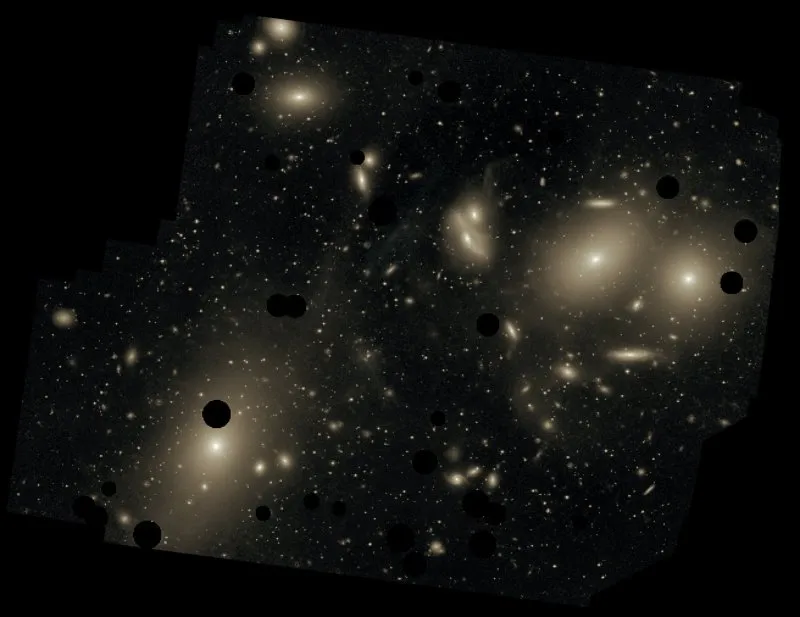
The new observations reveal that the stellar halo of M87 has been "trimmed," with a diameter of one million light-years, significantly smaller than expected, despite being about three times the extent of the halo around our Milky Way. (Although the standard value for our galaxy's diameter is 100 thousand light-years, its stellar halo extends to almost double that). Beyond this zone, only a few intergalactic stars are seen.
"This is an unexpected result," noted co-author Ortwin Gerhard. "Numerical models predict that the halo around Messier 87 should be several times larger than what our observations revealed. Clearly, something must have cut the halo previously."
The team used the FLAMES spectrograph on the VLT at the Paranal Observatory in Chile to perform ultra-precise measurements of planetary nebulae in the outskirts of M87 and in the intergalactic space of the Virgo cluster, to which the galaxy belongs.
Planetary nebulae are the spectacular final phase of stars like the sun, when the stars eject their outer layers into space. Their name comes from ancient observers who, using telescopes much less powerful than current ones, thought that some of these nearby objects, like the Helix Nebula, resembled the disks of the giant planets in the solar system.
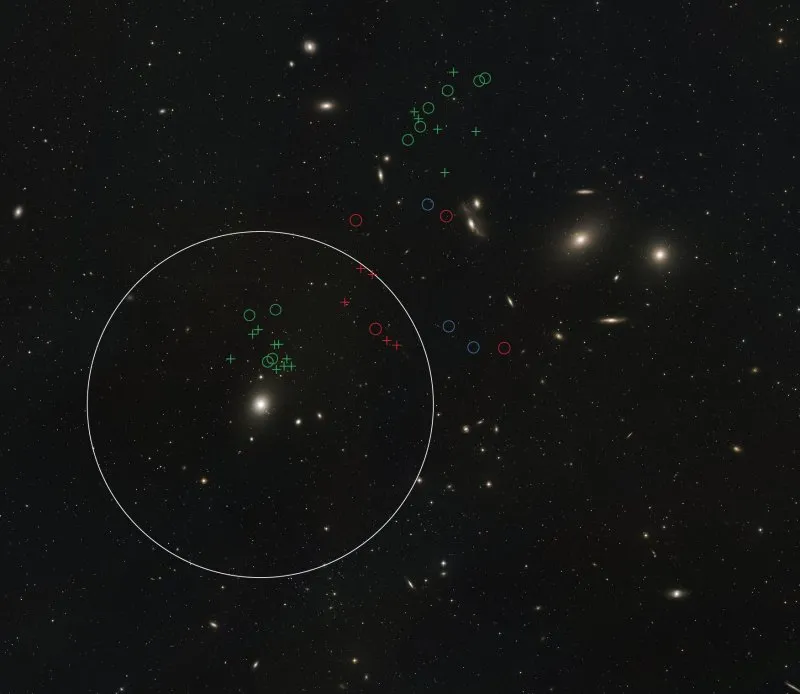
Planetary nebulae have strong emission lines, which makes them easy to detect at great distances and thus they are used to investigate the motions of stars in the faintest outer regions of distant galaxies. Furthermore, planetary nebulae are representative of the stellar population in general. Since they have a relatively short life (a few tens of thousands of years) astronomers can estimate that one star in 800 million stars like the sun is visible as a planetary nebula at any given moment. Thus, planetary nebulae can provide help in estimating the number, type of stars and their motions in the outer regions of galaxies.
The observed light from a planetary nebula in the Virgo Cluster is as faint as a 30-watt light bulb at a distance of 6 million kilometers (about 15 times the Earth-Moon distance).
Messier 87 (also cataloged as NGC 4486 and ARP 152) is located about 50 million light-years away in the Virgo Cluster, the nearest cluster of galaxies.
Astronomers proposed several explanations for the "shrinking" of M87, such as the collapse of dark matter or the encounter with M84, but these scenarios cannot be confirmed and further observations of the planetary nebulae around the galaxy will be necessary to obtain an answer.
But astronomers do seem to be sure that Messier 87 and Messier 86 are on a collision course in this dynamic cluster of galaxies.
Sources and related links
- Giant Galaxy Messier 87 finally sized up
- The edge of the M87 halo and the kinematics of the diffuse light in the Virgo cluster core
Michelle Doherty et al.
arXiv:0905.1958v1
Accepted for publication in Astronomy and Astrophysics: 22 April 2009
DOI: 10.1051/0004-6361/200811532
About the images
This deep image of the Virgo Cluster obtained by Chris Mihos and his colleagues using the Burrell Schmidt telescope shows the diffuse light between the galaxies belonging to the cluster. The dark spots indicate where bright foreground stars were removed from the image.
Chris Mihos (Case Western Reserve University)/ESO
Location of the planetary nebulae in the outskirts of M87.
ESO/Digitized Sky Survey 2