Astronomers have found that a type of recently discovered stars, called ultracool subdwarfs, follow unusual orbits. One of them could be a visitor originating in another galaxy.
Adam Burgasser and John Bochanski of MIT presented their findings at the meeting of the American Astronomical Society in Pasadena. The result allows for a better understanding of the origin of these peculiar stars recognized as a different class of stars in 2003. They are characterized by their low temperature (ultracool) and low concentrations of elements other than hydrogen and helium. Being very low luminosity (up to 10,000 times less than the Sun) they are difficult to detect, like brown dwarfs, sometimes called "failed stars", halfway between stars and planets.
Burgasser was intrigued by the rapid motions of these ultracool subdwarfs. "Most nearby stars travel more or less together with the Sun, tracing circular orbits around the center of the Milky Way once every 250 million years," he explained. Ultracool subdwarfs, on the other hand, seem to be in a great hurry to travel at speeds of up to 500 km/s.
The team of astronomers took measurements of positions, distances and motions of nearly two dozen of these rare stars. Then they used the measurements to calculate the orbits using a numerical code developed to study galaxy collisions. The calculations showed an unexpected diversity in the orbits of this type of star. Some fall deeply into the center of the galaxy in eccentric orbits, while others perform slower orbits far beyond the Sun's orbit. And, unlike most nearby stars, these rare cool stars spend a great amount of time thousands of light-years above or below the disk of our galaxy. The view from someone living on a planet around one of these stars would be dazzling!
The calculations confirm that all these stars are part of the Milky Way's halo, a very sparse population of stars that likely formed in the distant past of our galaxy. However, one of the subdwarfs, designated 2MASS 1227-0447, in the constellation Virgo, has an orbit that indicates it could have a very distinct "lineage", perhaps extragalactic.
"Our calculations show that this subdwarf travels up to 200,000 light-years from the galactic center, almost 10 times farther than the Sun," said Bochanski. They speculate that this star could come from another minor galaxy that, at some point, was close to our galaxy and thus was "captured" by the gravitational forces of the Milky Way.
Astronomers had already identified streams of stars in our galaxy that would have originated in others, but they were distant and massive red giants.
"If we can identify which star stream this star is associated with or from which dwarf galaxy it came, we could learn much more about the type of stars that have built the Milky Way's halo over the last 10 billion years," commented Burgasser.
Sources and related links
- Ultracool stars take 'wild rides' around, outside the Milky Way
About the images
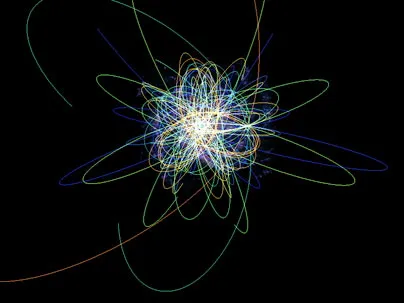
The image shows the orbits of the recently discovered ultracool subdwarfs inside and around the Milky Way, seen from 150,000 light-years away. Credit: Adam Burgasser
Simulation of the orbit of the ultracool dwarf LSR 1610-0040 around the Milky Way, visualized using Digital Universe. The simulation goes from 500 Myr in the past to 500 million years in the future at a rate of 12 million years per second. In the middle the motion is slowed by a factor of 100 as the star passes the Sun. The small star clusters indicate the locations of globular clusters, while the lined surfaces in the center of the Milky Way indicate the approximate extents of the Bulge and the bar.
Credit: Adam Burgasser/Digital Universe/American Museum of Natural History with assistance from Brian Abbot.