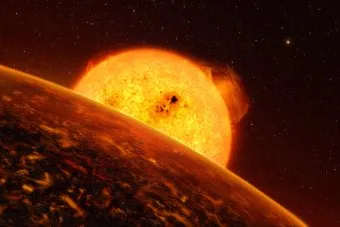
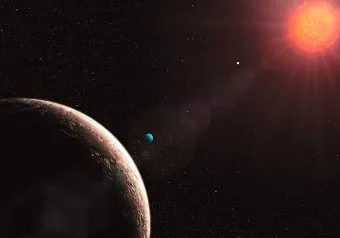
An exoplanet that orbits its star in a retrograde orbit has been found for the first time. The planet is also the most inflated and some astronomers suspect that both properties may be the result of an encounter with another planet.
The solar system generally rotates like a music disc, with most objects orbiting the Sun in the same direction. This is thought to occur as a result of the objects all forming in the same cloud of gas and dust.
However, some objects, including comets and asteroids, move in orbits so inclined relative to the orbital plane of the planets that they end up traveling in the opposite direction. Astronomers think that happens due to interaction with other objects.
Three exoplanets were previously found whose orbits are inclined relative to the plane in which they must have been born. But now, a planet called WASP-17b surpasses the previous ones, being inclined 150º so it moves in the opposite direction.
The researchers led by David Anderson of Keele University in the United Kingdom, found the planet by observing how it dimmed the light of its star as it passed (or transited) in front of it. The observations were made by the telescope array of the South African Astronomical Observatory.
Further observations showed the rotation of the star: one half appears to approach us and the other half, to move away. If the planet orbited the star in the same direction as the star, it would have blocked some of the light from the approaching side first. But the researchers found the opposite.
A close collision with the right trajectories can throw a planet into a retrograde orbit, indicated Coel Hellier, a team member.
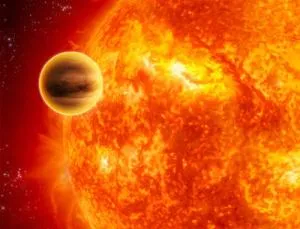
WASP-17b, 1,000 light-years from Earth, is also one of the largest exoplanets found to date. It has almost half the mass of Jupiter, but twice its diameter, perhaps dethroning the largest exoplanet observed until now. And its density resembles a huge ball of Styrofoam. It is located only 7 million kilometers from its star, eight times closer than Mercury is to the Sun, and orbits it once every 3.7 days.
Planets that have suffered gravitational interactions tend to be thrown into an elongated orbit, rather than a circular one. And, particularly in those cases where planets get very close to their stars, like WASP-17b, they feel large tidal forces.
Thus, the planet feels the stellar gravity with different strength along its orbit and this variation causes a deformation in the object, generating heat, which would cause its expansion.
No consensus
Hellier believes the explanation accounts for the team's observations. But not everyone thinks the same. Collier Cameron, whose group wrote the planet detection program, is skeptical. "The theorists will have to work hard," he commented to New Scientist.
Instead, he believes the star could have an unseen smaller companion, whose gravity causes the plane of the planet's orbit to change over time, through the so-called "Kozai Mechanism," which is seen, for example in Saturn's moon Betsla (S/2004 S 18).
Another case: The Dracula of the Solar System
An icy object in the Kuiper belt was found to have a retrograde orbit. The so-called 2008 KV42, lies in the belt of bodies beyond Neptune and has an orbit inclined 103.5º relative to the plane of Earth's orbit (the Ecliptic). That is, it travels in the opposite direction to the rest of the planets.
It was nicknamed "Drac" for "Dracula," since vampires supposedly have the power to walk on walls.
Observations by Brett Gladman of the University of British Columbia suggest it is 50 km in diameter and travels in an orbit that takes it from the distance of Uranus to more than twice that of Neptune (between 20 and 70 astronomical units).
Gladman indicated that it was probably born in the same place as Halley-type comets which also have highly inclined retrograde orbits.
Distant object found in retrograde orbit
(Distant object found orbiting Sun backwards)
http://www.youtube.com/watch?v=7u_xIc5myyk
It is not clear where those comets come from. Computer models suggest they do not arise from the two birthplaces of other types of comets: the Kuiper belt or the Oort Cloud (a shell or bubble of icy bodies that lies between 20,000 and 200,000 AU from the Sun).
Gladman's team calculates that 2008 KV42 arises beyond the Kuiper Belt, but closer than the Oort Cloud, in a region between 2,000 and 5,000 AU from the Sun, in what some astronomers call the inner Oort Cloud.
Sources and related links
- WASP-17b: an ultra-low density planet in a probable retrograde orbit
D. Anderson et al.
arXiv:0908.1553v1 - New Scientist: Planet found orbiting its star backwards for first time, by Lisa Grossman
- New Scientist: Distant object found orbiting Sun backwards , by Jeff Hecht
- CFEPS:Discovery of the retrograde trans-neptunian object 2008 KV42.
About the images
- Illustration: ESA/C. Carreau
- The orbit of 2008 KV42. Illustration: CFEPS)