Astronomers discovered a transient object-event called AT2018cow, nicknamed "cow", the cow. What is it about?
First, a disquisition on the word "transitorio" (transient, in English), also applicable to the word "variable". In astronomy, an event is said to be transient when its duration is relatively brief. In astronomy everything is big, both distances and times, but there are phenomena whose duration is not measured in millions of years, but in seconds, minutes, hours, days, weeks, months or years. It is clear, however, that everything is transient. Galaxies, even if they take millions or billions of years to form, then deform, they do not last forever. In an analogous way, everything is variable and not only the so-called variable stars. Our Sun is a variable, but every star will have varied in brightness throughout its stellar evolution. Only that in some cases this variation is more frequent. Therefore, a variable star is a characterization of the object at a given moment, it is the description of a phenomenon...transient. As a synthesis, everything is in transition.
In astronomy there are surveys of transient events. Thus, thousands of transient object-phenomena have been discovered that professionals immediately try to understand and in many cases they run into the fact that current definitions are not enough to categorize an event.
In recent years, supernova-type phenomena have been detected whose light curves do not match the standards considered until now. An example is AT2017gfo, the first confirmed kilonova, which was related to a neutron star merger detected by gravitational waves in 2017. In other cases, these transient events have absolute magnitude peaks (between -15 and -22) and luminous peak times (between 1 and 10 days) that make them difficult to explain with a simple scenario.
The discovery of "the cow" and its explanations
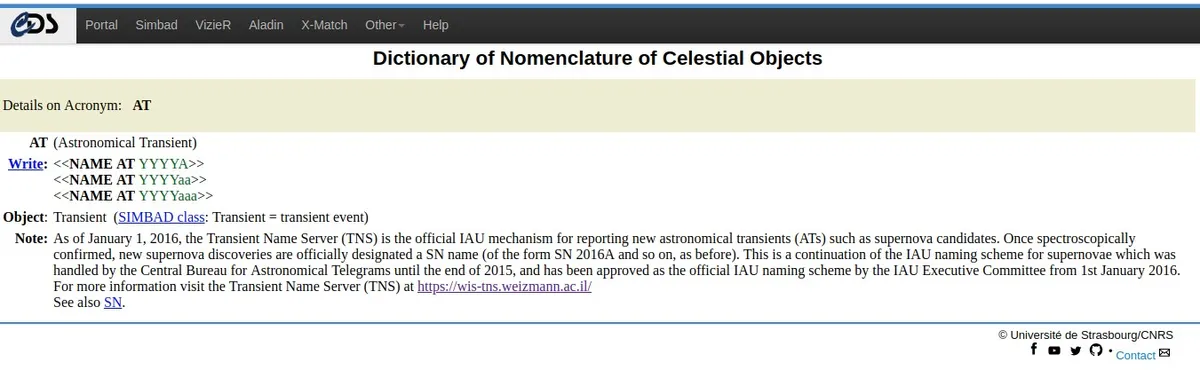
Now astronomers have found another unusual, rapidly evolving luminous phenomenon: AT2018cow. The name or designation is automatic and corresponds to an acronym formed by the letters AT meaning "Astronomical Transient", followed by the year of discovery and then three random letters generated by the Transient Name Server. So the three letters of this new event, "cow", do not correspond to the word "cow", in English, chosen for some particular reason, but it is only a coincidence that the randomly chosen characters form a word. Despite that, the newly discovered object was nicknamed "the cow".
The Cow, a luminous phenomenon, was discovered with the ATLAS telescopes whose name means "Asteroid Terrestrial-impact Last Alert System", as it was designed to find near-Earth objects that could be dangerous and is a robotic survey operated by the University of Hawaii with two 50 cm (20 inch) telescopes on two islands, at the Haleakala and Mauna Loa observatories. It began operations in 2015 and has been fully operational since last year.
The Cow was discovered on June 16, 2018 and then the object was monitored with a variety of instruments at different wavelengths.
WHAT IS THIS "COSMIC COW"?
The luminous peak of AT2018cow was remarkably high: ~1.77 x 10^44 erg/s, much more than a typical supernova. And it reached the peak very quickly, brightening by more than 5 magnitudes in just 3 days, while a "common" supernova has peak times between 10 and 20 days. It also has other unusual characteristics such as the blackbody temperature peak and low ejected mass.
In a new work, a team of astronomers led by Simon Prentice (Queen’s University Belfast, UK) presented an analysis of the first 18 days of the event. The authors say that the formation of a magnetar -a magnetized neutron star, produced by the merger of a binary system of neutron stars- could explain the observations.
To confirm it, observations already made in radio and X-rays will have to be considered.
However, Prentice's team was not the only one to suggest a possible explanation and others that were given were different: a cataclysmic variable, a GRB (gamma-ray burst), a type Ic-BL supernova (Type I class c supernovae, collapse of a massive star without hydrogen and helium layers, which also have very broad spectral lines, associated with the gas moving at speeds of 20,000 km/s, compared to a normal Type Ic supernova, according to the definition in Astrobites).
So astronomers are determined to create new theoretical models that match the data and explain the causes of the event, similar to how music fans often despair in finding a possible interpretation for the lyrics of a song.
A MEDDLING COW
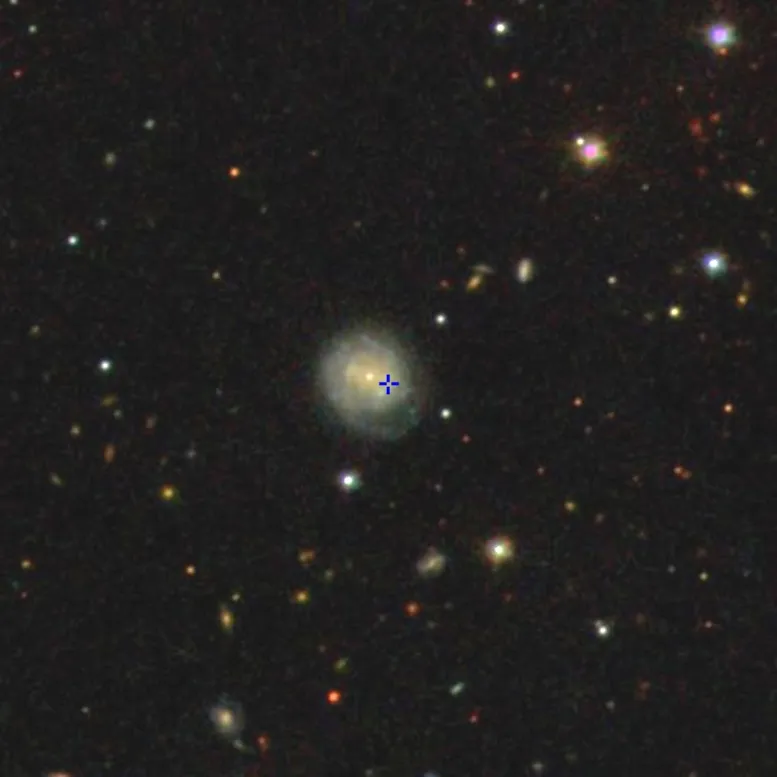
AT2018cow coincides with the spatial location of the galaxy CGCG 137-068, an "island-universe" 200 million light-years away, in the constellation Hercules.
The object varies its brightness perhaps with the frequency of a baión or baiao, that Brazilian musical rhythm from Bahía (Pernambuco).
In "Un baión para el ojo idiota", the third album by Patricio Rey y los Redonditos de Ricota -whose title referred to the cadence of images from the mass media that captivate the viewer who is alone at home watching tv- contained the track "Aquella solitaria vaca cubana".
The story goes that this song was inspired by a news item that "a piece of satellite fell from the sky by accident and went to fall on a poor cow that was innocently grazing in some corner of Cuba". The cow was named Rufina and the fact, or event, caused a transient diplomatic problem on November 30, 1960. Only a few months later, on April 12, 1961, the USSR would launch Yuri Gagarin into space aboard the Vostok 1 spacecraft.
The lyrics say: "I was looking at the sky just in time/saved from the eternal engine, just in time."
A couple of years earlier, another song by the group said: This is ephemeral/now ephemeral./How time flies!/Tick... tock ephemeral/ephemeral lights/(But I believe you...)

Credit: Breckenridge Public Library.
Sources and related links
- “The Cow: Discovery of a Luminous, Hot, and Rapidly Evolving Transient,” S. J. Prentice et al 2018 ApJL 865 L3. DOI: 10.3847/2041-8213/aadd90
- AAS Nova: Unexpected Discovery of a Bright Cow
https://aasnova.org/2018/09/28/unexpected-discovery-of-a-bright-cow/ - AT2018cow on Wikipedia
https://en.wikipedia.org/wiki/AT2018cow - Faro de Vigo: Space insurance and the cow Rufina
https://www.farodevigo.es/especiales/miralfuturo/seguros-espaciales.html - Exordio a Rufina, vaca mártir (See the included video)
https://www.cibercuba.com/lecturas/exordio-rufina-vaca-martir - When Los Redondos explained their works
https://www.redondossubtitulados.com.ar/cuando-los-redondos-explicaron-sus-letras/ - Astrobites en español: Classifying Supernovae
https://astrobitos.org/2016/12/08/clasificando-supernovas/
About the images
Initial image: Sloan Digital Sky Survey
Newspaper image: Breckenridge American (Breckenridge, Tex.), Vol. 41, No. 68, Ed. 1 Tuesday, December 6, 1960, newspaper, December 6, 1960; Breckenridge, Texas. (texashistory.unt.edu/ark:/67531/metapth136048/: accessed September 30, 2018), University of North Texas Libraries, The Portal to Texas History, texashistory.unt.edu; crediting Breckenridge Public Library.