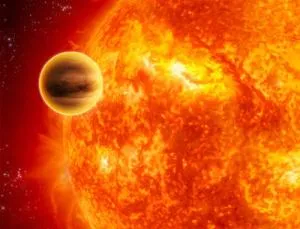
The largest set of measurements with the HARPS instrument have firmly established the nature of the smallest known exoplanet, CoRot-7b, revealing its mass of five times that of Earth. Combined with the planet's known radius, which is less than half that of our home, it is deduced that its density is quite similar to Earth's, suggesting a rocky planet. The data also reveal the presence of another Super-Earth in that stellar system.
"We have done everything we could to learn what the object discovered by CoRot looks like and we found a unique system," noted Didier Queloz, leader of the team that made the observations.
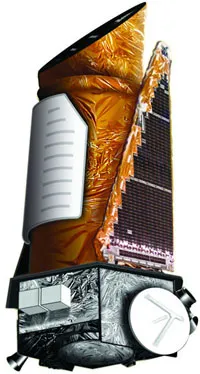
In February 2009, the discovery of the small exoplanet by the CoRot satellite, around the star TYC 4799-1733-1 was announced a year after its detection and after several months of difficult measurements with ground-based telescopes. The star, now known as CoRot-7, is located towards the constellation Monoceros (the Unicorn) at a distance of 500 light-years. Slightly smaller and cooler than our Sun, CoRoT-7 is possibly younger as well, at 1,500 million years old.
Every 20.4 hours, the planet eclipses a small fraction (one part in 3000) of the star's light for just over an hour. The planet, designated CoRoT-7b, is located only 2.5 million kilometers away from its star, or 23 times closer than Mercury is to the Sun. It has a radius 80% larger than our planet.
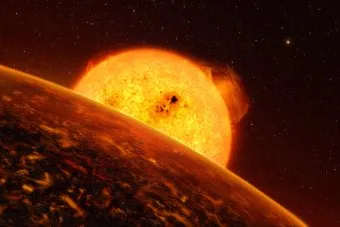
CoRoT-7b is so close to its star that the place must look like Dante's Inferno
The initial data, however, could not provide the exoplanet's mass. That requires very precise measurements of the star's velocity, which is affected very slightly by the gravitational pull of the orbiting planet. The problem with CoRoT-7b is that these tiny signals are blurred by stellar activity in the form of "sunspots," like those on our Sun, which are cooler regions on the star's surface. Therefore, the main signal is related to the star's rotation, which completes one full revolution in 23 days.
Artistic panorama of CoRoT-7 http://www.youtube.com/watch?v=4DP4xluhRPc
To get an answer, astronomers had to use the best exoplanet-hunting device in the world, the High Accuracy Radial velocity Planet Searcher (HARPS), which in Spanish would be "Buscador de Planetas por Velocidad Radial de Alta Precisión". This spectrograph is attached to ESO's 3.6-meter telescope at the La Silla Observatory, Chile.
"Even though HARPS is certainly unbeatable when it comes to detecting small exoplanets, the measurements of CoRoT-7b proved so demanding that we had to collect 70 hours of observations of the star," pointed out co-author François Bouchy.
With the HARPS data, astronomers were able to deduce the 20.4-hour signal in the data and thus infer that the exoplanet has a mass five times greater than Earth's, making it one of the lightest planets found so far.
"Since the planet's orbit is aligned so that we see it cross the face of its star - that is, transiting - we can measure, and not simply infer, the mass of the exoplanet, which is the smallest that has been measured precisely for an exoplanet," noted Claire Moutou, a team member. And she added: "Furthermore, since we have both the radius and the mass, we can determine the density and get a better idea of the internal structure of this planet."
Gliese 581e, also discovered by HARPS, has a minimum mass of approximately twice that of Earth, but the exact geometry of its orbit is undefined, so the actual mass is not known precisely. In contrast, CoRoT-7b, by transiting its star, its geometry is known and it is possible to measure the planet's mass precisely.
CoRoT-7b belongs to the category of "Super-Earths," exoplanets with masses more similar to planets like ours than to a gas giant like Neptune, for example. About a dozen of these bodies have been detected, but in the case of CoRoT-7b, it is the first time the density has been measured for such a small exoplanet. The calculated density is close to that of our planet, suggesting that the planet's composition is similarly rocky.
"The excellent light curves from the CoRoT space telescope gave us the best measurement of the radius and HARPS the best measurement of mass for an exoplanet. Both were necessary to discover a rocky planet with a density similar to Earth's," indicated co-author Artie Hatzes.
Close-up of CoRoT-7 http://www.youtube.com/watch?v=lWOwo0JwxA8
The exoplanet deserves another distinction as the exoplanet closest to its star known, which also makes it the fastest: it orbits its star at a speed exceeding 750 thousand kilometers per hour, more than seven times faster than Earth's motion around the Sun. "In fact, CoRoT-7b is so close that the place must look like Dante's Inferno, with a probable temperature on its day side over 2,000 degrees and -200 degrees on its night side. Theoretical models suggest the planet could have lava or boiling oceans on its surface. With such extreme conditions, this planet is definitely not a place for life to develop," explained Queloz.
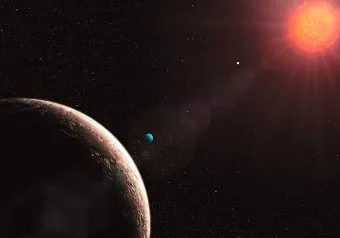
As a legacy of HARPS's sublime precision, astronomers found in their data that the star hosts another exoplanet, a bit farther out than CoRoT-7b. Designated as CoRoT-7c, it orbits its star in 3 days, 17 hours and has a mass of about eight Earths. But, unlike CoRoT-7b, this sibling world does not pass in front of its star as seen from Earth, so researchers cannot measure its radius and therefore not its density either.
By virtue of these findings, CoRoT-7 remains the first known star to have a planetary system with two short-period Super-Earths, with one that transits its star.
Sources and related links
- ESO: First Solid Evidence for a Rocky Exoplanet
- The CoRoT-7 planetary system: two orbiting Super-Earths
D. Queloz et al.
Special edition of Astronomy and Astrophysics on CoRoT
volume 506-1, October 22, 2009
DOI: 10.1051/0004-6361/200913096
About the images
- Illustration of CoRoT-7b. Credit:ESO/L. Calcada