The Gould Belt is a vast ring of active stellar nurseries, young stars, and molecular clouds that surrounds the Solar System.
The ring is named in honor of Benjamin Gould, who identified it in 1879 in Uranometría Argentina. It is a fragmented ring about 3,000 light-years in diameter. It contains bright young O and B type stars and lies within the local arm of the Milky Way. Our Sun appears to be almost at the center of the Belt.
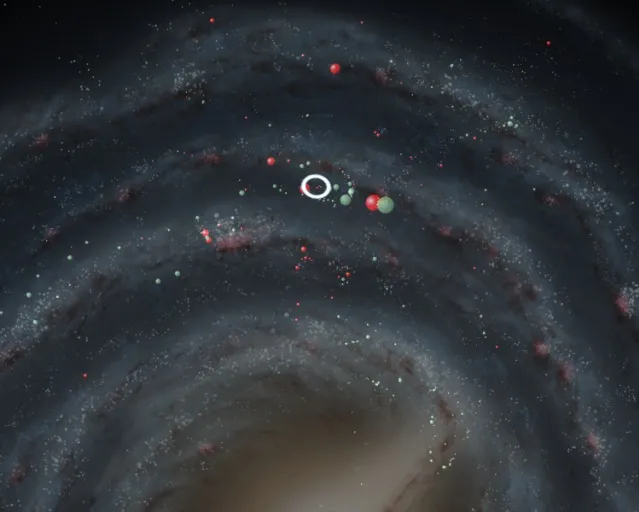
The image below shows approximately where the Gould Belt is in the Milky Way. The Solar System should be imagined as an invisible dot near the center of the white ring denoting the Belt.
Where did the Gould Belt come from? It is not known, certainly. But one hypothesis is that an ancient supernova sent radiation and material like a water wave generated by a rock in a pond. This would have caused a ring of activity in the surrounding interstellar medium. This model works quite well, given that the Local Bubble—a region of low density in which the Sun and a few other stars reside—fits reasonably well inside the Gould Belt. Perhaps both structures, the bubble and the belt, come from a remote stellar explosion.
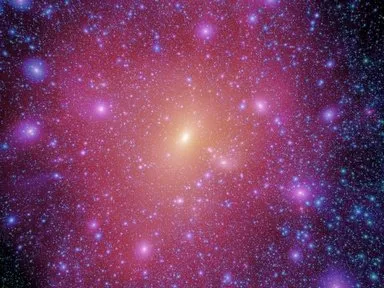
It is also possible that a much larger interaction took place. A recent article (by Kenji Bekki, referenced below) suggests that the belt originated 30 million years ago when a giant dark matter clump collided with a huge molecular cloud in the spiral arm of our galaxy.
What if it is an illusion? It is possible that no Gould Belt exists and we only believe we perceive this ring shape in the layout of our local region. After all, when it comes to detailed structures in the galaxy we cannot see much beyond our own spiral arm. Perhaps they are merely coincidental shapes from our point of view, as Robert Simpson points out, who is part of two surveys of this region.
The close looks: Surveys
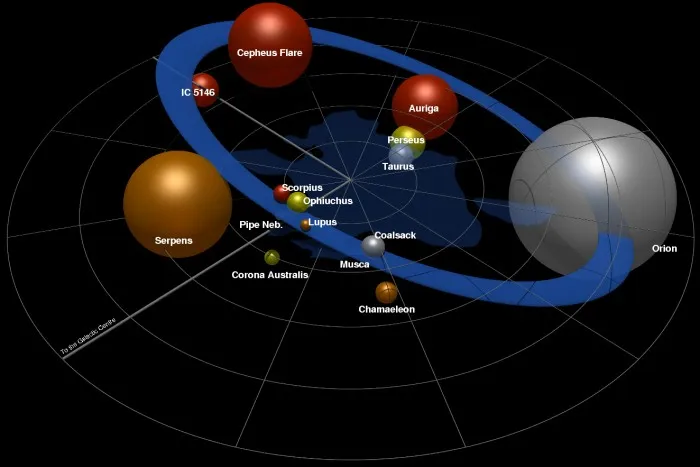
The first image in this note, by Jason Kirk, shows the star-forming clouds in the Gould Belt. The Belt itself is marked as a blue ring and the Local Bubble is shown as a shaded region. The size of the star-forming regions is proportional to their mass, assuming uniform density.
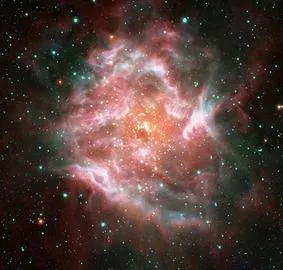
The image was created for the Spitzer Gould Belt Survey. This survey hopes to discover new star-forming regions in the molecular clouds of the Belt by using the Spitzer Space Telescope in collaboration with the Herschel and JCMT observatories. The first observations began in September. The first region already completed is IC5146, for which there is this image in the survey gallery:
Other surveys
Spitzer's is not the only study of this region. Other surveys are:
JCMT Gould Belt Legacy Survey
Spitzer c2d Legacy Survey
Herschel Gould Belt Key Program
Sources and related links
- Orbiting frog: The Gould Belt
- Dark impact and galactic star formation: Origin of the Gould belt
Kenji Bekki
Monthly Notices of the Royal Astronomical Society: Letters
Volume 398 number 1, (p L36-L40), (September 2009)
DOI: 10.1111/j.1745-3933.2009.00702.x
arXiv:0906.5117v1 - The Last Monolith: The Gould Belt
About the images
- Gould Belt. Credit: http://galaxymap.org/
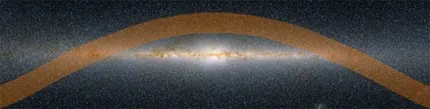
- Distribution of the Gould Belt in the sky.
Credit: 2MASS/J. Carpenter, T. H. Jarrett, & R. Hurt - Molecular clouds in the Gould Belt. Credit: Jason Kirk
- IC5146. Credit: Spitzer Gould Belt Survey