Because of their way of thinking, must scientists necessarily be atheists or agnostics? Do scientists seek and find the Truth? What role does the press play in this? Is it true that the apocalypse is coming?

Marcelo Gleiser recounts in his blog Cosmos and Culture that when he gives a talk he is asked if he believes in God and that, to the surprise of some, he answers no.
The author accounts for the religious positions of Newton, for example, and distinguishes them from a certain atheist fundamentalism like that of Richard Dawkins.
Gleiser identifies as agnostic, a position unacceptable to fundamentalists, but he believes (and I share his idea) that it is the only position consistent with the so-called scientific method. Certainly that method uses various procedures, which is why many think there is not ONE method, but a great variety.
As we translated here in a previous post, in reference to the Logic of Skepticism, there is a way of thinking that seems, to some of us, the best. It consists of keeping in mind that in the face of extraordinary claims ("I have seen an Apparition", "I have been abducted by an ET", "I have conversed with a pink elephant", etc.), we seek extraordinary evidence, as Carl Sagan said.
However, BEFORE that can happen, before obtaining enough evidence, EVERYONE adopts some position. Either we believe or we do not believe that extraordinary claim. This is how it is, and it is valid, because we have prior experiences, a system of beliefs and instilled values.
Nevertheless, thinking that this a priori belief is definitive and sufficient is not very wise. Human beings are wrong many, many times, more than the times we are right. It is highly probable that we have been mistaken. Even more so because we are only guided by very subjective variables and not by evidence. Evidence is also subjective, of course, but much less so.
The logical thing seems to be, to take into account, to be aware of this process. Then we can say "a priori I believe (or do not believe) such a claim, but I do not rule out the other".
This a priori logic distances us from fundamentalism and keeps us alert to the possible evidence found a posteriori. Then, later, we can reaffirm our stance or rethink it. That is to say, that way of thinking accounts for a hypothesis we form in the face of extraordinary claims, to then evaluate them with evidence.
From this point of view it is perfectly possible for someone to tend to believe that God perhaps exists or that perhaps he does not, but not to affirm it with total force. To make absolute statements we would have to be completely sure. Can we be completely sure that God exists or that he does not exist?
If, like Gleiser and I, we think we are not sure of either thing, then they will call us agnostics.
But isn't science atheist? Gleiser tries in his post to account for the fact that there is no anti-religion agenda in science. Science seeks to interpret Nature, to expand our knowledge of the natural world. But it is true that when the opposite happens, scientists get nervous.
It's that religions make claims about Nature in a capricious way, such as saying that the Universe is less than seven thousand years old.
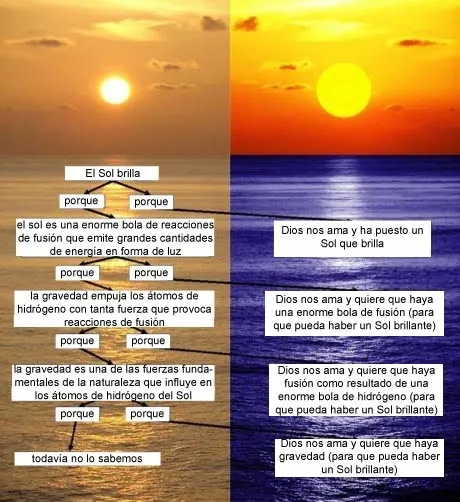
In relation to nature and its interpretation, it is possible to think that there are those who are naturalists and those who are super-naturalists. In the first case, natural explanations do not appeal to unexplained hidden forces or "supernatural" ones, while the second ones do.
This has given rise to the formation of an international group called "The brights", whose translation is not "The enlightened ones", but those guided by the "light of reason", the latter being understood as naturalists, in the previous sense.
Naturalists will not have all the answers. There will be enormous "gaps in knowledge" that they will try to fill with evidence and not with capricious claims that cannot be proven. If we are doing poorly in life, if we are doing poorly at work, we have family, economic problems, etc., instead of thinking that "someone has cast a spell on us", we should review our actions (or inactions). This seems to have more sense of reality and humility.
All our theories are probably wrong, so what?
In this scheme, it is possible to think that someone might tell us that science also postulates mysterious entities like dark matter, extra dimensions, wormholes, etc.
I would like to bring here the thinking of Flip Tanedo. We talked about him when we translated his simple explanation of "The particular Feynman diagrams" in his LHC blog.
In a new entry called "All our favorite theories are probably wrong. And that's okay" he tries to clarify some misconceptions of what I call the "ghosts of science" and which include the ideas cited earlier by Gleiser.
He tells us that the popular press is very often mistaken in expressing that scientists are married to their models, understanding the latter as plausible but speculative frameworks for explaining natural phenomena.
Journalists seem to express scientific findings as if the other ideas were wrong, and that's not how science works, he tells us.
That someone spends time developing a new idea does not mean they do it because they believe it IS true, but that it MAY be.
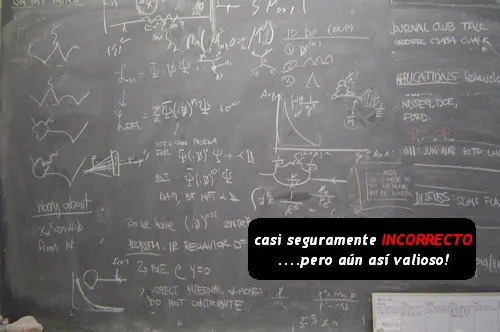
But there is also a deeper reason. The point is that good ideas have value just for being such, even the very speculative ones. Of course, what is sought, ultimately, are the "correct ideas", but how to know which ones are correct beforehand? In fact, there are often for the same problem more than one "good idea", sometimes very contrary to each other. Theoretical models will make predictions that will later be verified with experiments, as a way to advance in a given field.
Tanedo gives us a very brief tour of the so-called "Theory of everything" and "String Theory", but such stories can be found throughout the history of the sciences.
No one really knows how creative hypotheses are born. We have talked about that recently in "The logic of discovery". But certainly the previous ideas are not completely discarded. It is possible to start from the assumption that a certain idea conceived up to that point was not true and postulate an alternative, but not to believe that all previous ideas are incorrect.
The so-called steady-state theory prevailed over the Big Bang idea until the discovery of the cosmic microwave background radiation, and yet it postulated the possibility that "matter-energy was created" in proportion to the expansion of the universe that Hubble had found in 1929. Until then (and still today) it is not believed that energy can be created, but that energy transforms, but its quantity is always the same. However, those researchers assumed that it was indeed created, but at such a small rate that it was very difficult to detect.
Assuming extraordinary claims, even different from what is known so far, is not bad. But then it will have to be proven. Building a theoretical model that explains the available data and makes testable predictions, even if it takes time to obtain the technology for it.
Meanwhile, these hypotheses are just that and not laws of nature. Even the laws themselves are subject to modification.
In short, science, although sometimes researchers act differently, is not dogmatic. It is open to change, modifications, improvement.
Between Science and the Apocalypse
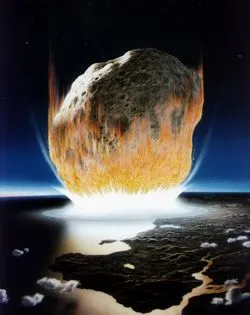
For some strange reason, a large part of societies seems to read in the press evidence of our future Armageddon.
Let's separate the wheat from the chaff. On one hand, the supposed Mayan predictions of the end of the world for 2012 are accepted as valid, on the other hand, people still think that man never reached the Moon. (Fortunately, there are those who have shed light on those "lunar shadows").
It is said that astronomers know more than they say, but that the agencies hide it. And then we read that the end of the world is coming soon and that it was discovered by a Russian astronomer who claims that an "Orange dwarf star will pass through the Solar System" causing a mess that I'd rather not say.
The press, of course, is not to blame (at least not entirely) for the consequences of its headlines, if they are well explained. But there is a responsibility to tell things within the appropriate frame of reference.
The discovery by Russian astronomer Vadim Bobylev is not new, it's a decade old: see Stellar Encounters with the Oort Cloud Based on Hipparcos Data, by Joan García-Sánchez et al, from 1999 (Astronomical Journal).
If things are not explained properly, we will have groups that will use these ideas to reaffirm extraordinary concepts in their favor. This is how we receive inquiries like this here:
Message: DEAR FRIENDS
I am wondering where Pluto is orbiting today and what its new orbit is in light of the new cosmic events in our questioned solar system where the existence of the solar system being binary as well as consisting of 12 instead of nine planets is being raised.thank you for clarifying for me by seeing the graphs that illustrate these points the panorama would be partially clarified .attentively and cordially
In my opinion, it is inevitable that this happens, with or without the press, just from the astronomer's paper, which only some experts bother to read completely. But it happens that if the press only indicates that "there is an 86 percent chance that GL 710 will cross the Oort Cloud towards us" and does not also indicate that "the chances of Gliese 710 penetrating further into the Solar System, inside the Kuiper Belt, are much lower, only 1 in 1000" we will be feeding ghosts.
The problem is not only the lack of evidence, but the lack of methodological motivation on the matter. It is perfectly plausible that there exists some "kind of energy" like the one some postulate that human beings exchange, for example. But if that were the case, it would have to be proven. And not only are there no compelling proofs on the matter, but there doesn't seem to be any interest in proving it either. It seems that postulating it in an entertaining way is enough and that's it.
I'm not saying this from a position of perfection. In this blog we have translated articles and titled them in a "catastrophic" way, if the term is valid, when they didn't remotely deserve it. Self-criticism starts at home.
So then, will the End of the world come?
Yes, we are all going to die. If not from an asteroid impact, it will be from the natural cycle of our Sun or because human beings are so idiotic as to kill each other, sometimes over ideas related to religions...
The Universe, at least the observable one, seems to be definable as...change. We are facing permanent changes, our knowledge is increasingly richer, but it remains very small in the face of the vastness of Nature.
To believe that in the face of this panorama we can adopt absolute affirmations is a fundamentalism that I do not like. I prefer to cling to facts and evidence, knowing that the method itself is fallible and therefore not absolutely conclusive, but it is a much better, healthier and more natural path than blinding one's eyes and mind to unprovable claims.
Nature is surely much richer and more complex than science has demonstrated so far. It is possible that in the future our interpretations will change and become enriched. Meanwhile, let's keep an open mind to new and creative hypotheses, but with a filter that does not allow us to naively believe in supposed ghosts.
Sources and related links
13.7: Science, Belief, And The Search For Meaning
LHC US: All of our favorite theories are probably wrong. And that’s okay., by Flip Tanedo.
Scientific American: A star buzzing through the outer solar system? Bring it on
Scientificblogging: On Blogging And Soothsaying
About the images
"Wrong" equations. Credit: Flip Tanedo
Science vs. Religion image from El Averno
Ghostbusters image. Credit: Wikipedia (English)
Illustration of impact on Earth. Scientific American.