A recently published Final Report analyzes the impact of the International Year of Astronomy 2009.
Some compare IYA2009 to the arrival of man on the Moon. In that 1969 when Armstrong and Aldrin stepped on our natural satellite, the audience would have climbed to one billion people. Four decades later, IYA2009 brought the world public together again in a number of local, regional, and global events specifically linked to astronomy.
To get a sense of the importance of such an annual event, the IYA2009 Final Report has just been published. It is a digital document (PDF) of 1336 pages (92 MB) that can be downloaded from Astronomy2009.org.
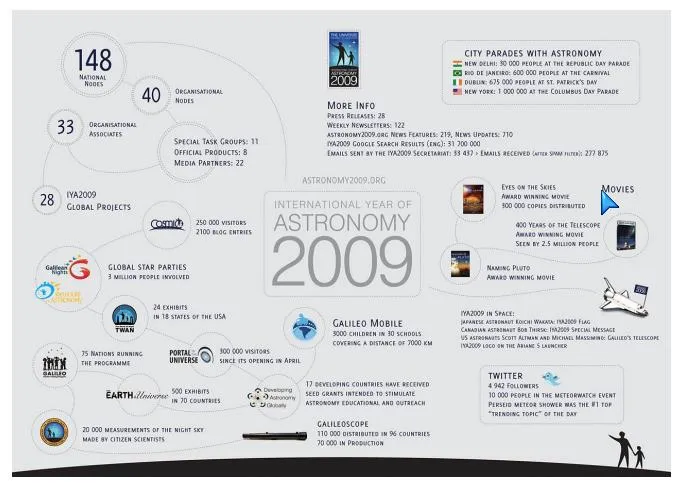
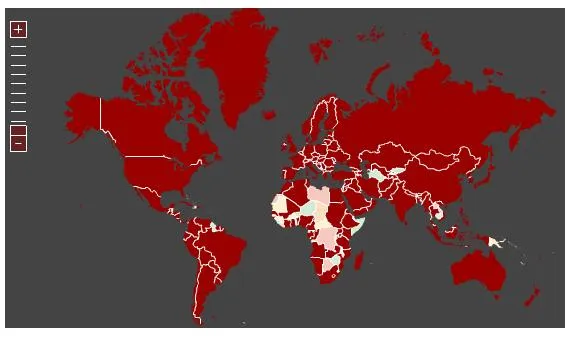
With 148 countries, the IYA2009 network is the largest in science. And the use of social networks (more than 6000 followers on Twitter), internet portals, films, events, star parties, and other activities, made IYA2009 an unparalleled event.
Analysis: what does the public want to see online?
An analysis of the most popular pages on www.astronomy2009.org was conducted using Google Analytics during the period from 01/01/2009 to 01/10/2010. In total, the site received 3 million visits. This does not take into consideration the national pages that participating countries created.
The most popular pages of that domain were, besides the homepage, the image archive, the global projects, the resources, video archive, National Nodes, Galileoscope.
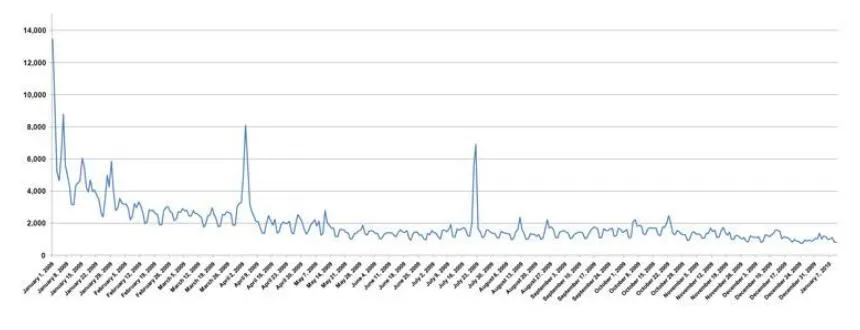
The audience peaks occurred on 1/1, at the start of IYA2009; on the 15th of the same month, for the opening ceremony; on the 29th of that first month of the year when IYA2009 was part of NASA's Astronomy Picture of the Day; on April 3rd for the 100 Hours of Astronomy event and on July 22nd, for the total solar eclipse.
The vast majority of the public accessed the page through Internet Explorer, very closely followed by the use of Firefox. The screen resolutions of the public (1024x768 and 1280x800) as well as the Operating System (Windows, by far) are not surprising.
What was the cost of the organization?
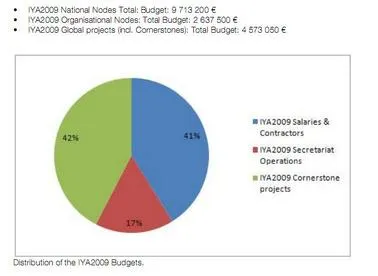
The national nodes had a budget of just under 10 million euros, the organizational nodes just over 2.5 million, and the global projects 4.5 million of the European currency.
The Galileoscope was one of the most widely publicized initiatives and allowed the sale of almost 65 thousand instruments from the website to almost 27 thousand individuals. In addition, 102 thousand instruments were sold to 180 organizations around the world. A total of almost 175 thousand Galileoscopes, of which 22 thousand were purchased for donation.
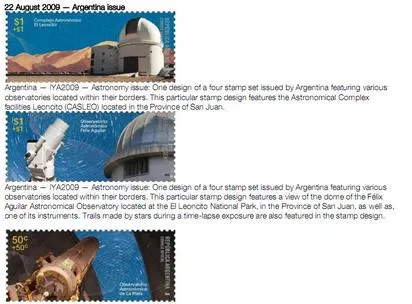
Thus, the document reviews each of the projects (Cornerstones projects) sponsored during IYA2009, which includes some mentioned here and others such as the Galileo Teacher Training Program or UNAWE, which had no echo in Argentina. On the other hand, Argentina did participate in other initiatives, as reflected in the report. For example with the stamps featuring several observatories in the country.
The activities of each node have a special space in the document. In the case of the Argentina Node, the realization of Eratosthenes 2009 is noted as the main activity.
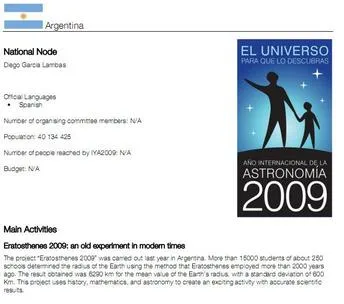
The realization of "The Universe for You to Discover" is also mentioned, the exhibition of high-quality images that was also held in Spain, Mexico, the Czech Republic, and Slovakia.
Similarly, the country's participation in the more than 100 measurements in 13 countries of the quality of the night sky in GLOBE at Night is noted.
Likewise, reference is made to the country's participation in the Second Ibero-American School of Astrobiology in Montevideo, which counted the Argentine Institute of Radio Astronomy (IAR) among its organizers.
The passage of the Galileo Mobile through our country is also mentioned. Many other activities carried out by the Argentina Node, throughout the length and breadth of the country, are not mentioned, however.
Some more numbers: an appendix indicates the budget (in euros) and the number of people reached by IYA2009, by country. For comparison, a table is presented in which Argentina does not appear. Here is an excerpt from it with Ibero-American countries marked in orange and other countries with great reach, in yellow.
In light blue, India, to highlight the more than 700 million people who were reached by IYA2009 by having a television broadcast on its Republic Day.
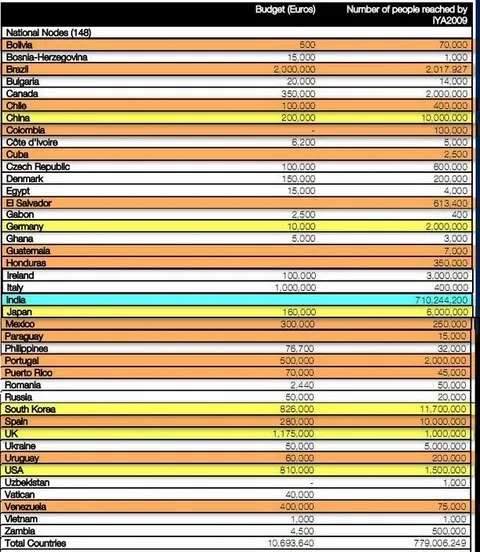
It would be good for the national nodes to carry out some kind of critical-constructive analysis of the reach achieved and the fulfillment of the objectives.
Legacy
The idea is that the materials and various resources available on the web remain there for use and that there are permissions and copyrights that enable their massive use, through a Creative Commons license.
Conclusions
The most impressive statistic is the size of the reach, so remote and diverse, which allowed 148 countries of the globe to come together. One wish is that the relationships forged between scientists, communicators, teachers, and enthusiasts remain in the future. And it is hoped that efforts like the Office for Astronomy Development or continuing to add awareness to the need for a dark night sky, will be continuators of the primary objectives.
Could it have been done better? asks Franco Pacini, former president of the International Astronomical Union (2000-2003). Pacini was one of the first to think about this worldwide celebration. He reasoned that just as mathematics had its year in 2000 and physics its own five years later, there was potential to do the same in astronomy.
Pacini thinks the problem with these initiatives is that they are temporary. Exhibitions and conferences have been held, but these are things that disappear over time. "I wish there had been more creation of science centers or museums, structures that remain and can be used by adults and children beyond the Year of Astronomy," says Pacini.
The wheel was set in motion by IYA2009, concludes the document, but this should only be the beginning. "We must know how to effectively use the moment gained to continue breaking down borders and keeping the most dynamic of sciences at the forefront of human imagination," conclude Catherine Cesarky, Pedro Russo, and Lars Lindberg Christensen, directors of IYA2009.
Sources and related links
- International Year of Astronomy 2009 Reached Hundreds of Millions of People: Final Report Released
- Argentina Node IYA2009
About the images
- Images belonging to IYA2009/IAU/Unesco.