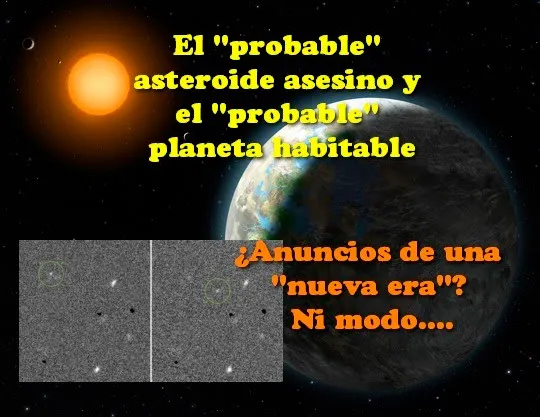
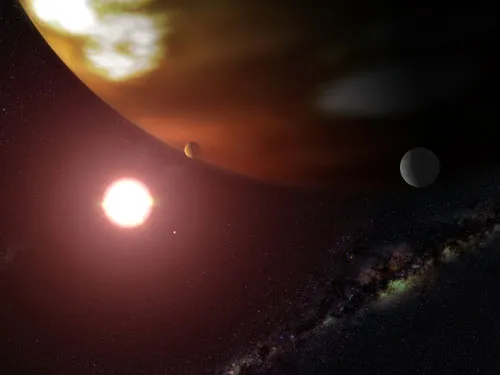
It is found that an exoplanet has a hot region difficult to explain, while the existence of the recently famous Gliese 581g is called into question.
The misunderstood warm one
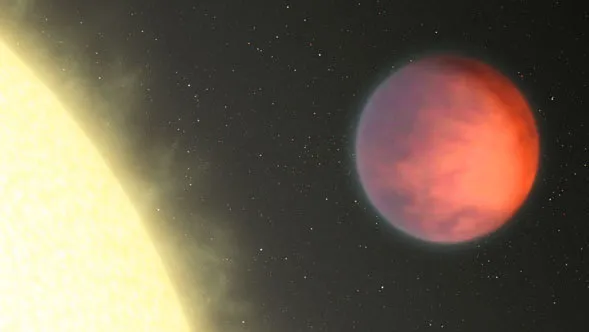
The gas giant upsilon Andromedae b orbits very close to its star, with one of its faces perpetually facing the star's heat. It is a "hot Jupiter," as gas planets similar to the giant of our solar system are commonly called, although in these cases they are usually much larger.
One might think that the hottest part of such a planet would be the region facing the star, but previous observations showed that its hot spots might be slightly shifted. Astronomers think that stellar winds could be pushing hot material a bit and that would explain that slight shift.
But a team of astronomers, using the Spitzer Space Telescope, found that on this exoplanet, the hot zone is shifted by about 80 degrees. Almost on one of its sides. "It is clear that we understand even less about the atmospheric energy of hot Jupiters than we thought," said Ian Crossfield, lead author of a new scientific paper.
The astronomers' article indicates that observations of the exoplanet were made over five days in February 2009. The planet has an orbit of 4.6 days according to radial velocity measurements, one of the techniques used to find exoplanets. It involves detecting a slight "wobble" that the planet gravitationally produces in the star.
With Spitzer, astronomers measured the combined light of the star and the planet, while the latter orbited the former. The telescope cannot see the planet directly, but it can detect variations in the total infrared light of the system that arise as the hottest part of the planet enters Earth's field of view.
Thus, it can be assumed that the system will appear brighter when the planet was directly behind the star, that is, showing one of its faces, and will appear darker as the planet moves. However, it seems that the observations indicated the opposite, that the system was brighter when the planet was shifted to one side.
The observations could be explained by invoking supersonic winds that generate shock waves that heat the material or magnetic interactions between the planet and the star. But for now they are speculations.
They are not the only ones made regarding this planetary system, as it seems it has already been giving several headaches.
However, those puzzles are not truly a problem, but rather a joy. In this system composed of a binary star Upsilon Andromedae, 44 light-years from Earth, it was one of the first in which exoplanets were discovered in 1997.
HOW TO FIND THE HOTTEST ZONE OF AN EXOPLANET
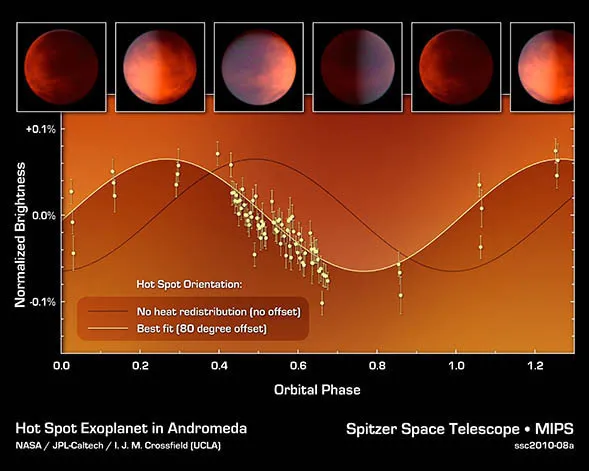
This Spitzer data graph shows how astronomers located a hot spot on a distant gas planet, upsilon Andromedae.
The planet is tidally locked, so one of its faces always looks toward the star, like the Moon with Earth.
The black line shows the light variations of the system or light curve that would be seen if the hot zone were in the middle of the exoplanet's face looking toward the star. The yellow line shows what was actually observed: the light curve is shifted by about 80 degrees, indicating that the hot zone is almost on one side.
Video: Strange hot zone on an exoplanet (Subtitled)
http://www.youtube.com/watch?v=1iNQumGfnxg
Existence of Gliese 581g called into question
Recently I was commenting here about the nonsense that is read when some scientific news is announced, to try to use them as "proof" of pseudoscientific ideas. Something like that happened when a new exoplanet was supposedly found in the Gliese 581 system, one that, perhaps, could host life.
That discovery was made by a team of American astronomers using 122 of their own measurements with the Keck telescope and 119 measurements made public by the La Silla Observatory, of ESO.
But now, at an international symposium, a member of the Harps team indicated that the planet does not appear in the (updated) La Silla data. According to Science, the European data now include 180 observations of the system. "We see no evidence of a fifth planet," snapped Francesco Pepe of the Geneva Observatory, although he also noted that the precision of the measurements was not sufficient to rule out its presence.
Butler and Vogt, the astronomers who published the paper on Gliese 581 f and g, remain confident in their data and analysis and preferred not to comment on their colleagues' work as it is not yet published.
According to Scientific American there are some comments from the researchers made by email. Pepe indicated that the planet is not found in the updated data via an email to Science and Astrobiology Magazine, while Butler and Vogt wrote to Space.com to point out that their work was responsible in extracting information that the data offered.
We will have to wait perhaps not only for Pepe's publication, but perhaps for other observations to know who is right. But even more important is to keep in mind that a published paper is not a conclusive investigation, it is a work in progress. If science itself, by its method, is fallible, even with many observations and studies and experiments on something, even more so when it comes to very sensitive and difficult measurements. That is why the dissemination of these facts must be somewhat careful, because while the possible existence of a "habitable" planet outside the solar system is certainly news, it must be strongly emphasized that the discovery is potential.
And we shouldn't worry if the exoplanet isn't there, after all. That's also how science advances.
Sources and related links
- A New 24 micron Phase Curve for upsilon Andromedae b
Ian J. Crossfield, Brad M. S. Hansen, Joseph Harrington, James Y-K. Cho, Drake Deming, Kristen Menou, Sara Seager
arXiv:1008.0393v1 - Astronomers Find Weird, Warm Spot on an Exoplanet
- European astronomers unable to confirm rival team's potentially habitable planet
About the images
- Illustrations of Upsilon Andromedae b by NASA/JPLCaltech/Ian Crossfield (UCLA).