Reality, is it digital or analog? An essay contest proposes that theme with the goal of debating and learning about new ideas on a central question in modern cosmology and physics.
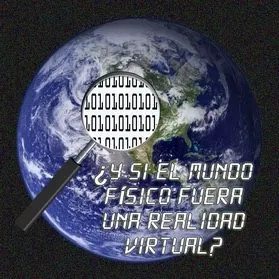
The contest by the FQXi community is promoted by the Gruber Foundation and Scientific American.
FQXi is the Foundational Questions Institute.
It is directed by Max Tegmark, from MIT, and Anthony Aguirre from UC Santa Cruz, together with an advisory board made up of other prestigious researchers including Alan Guth, Martin Rees, Lee Smolin and Frank Wilczek.
The idea is to find innovative answers on a profound topic. While classical physics is based on real numbers with a continuous set of values, quantum mechanics indicates that certain physical quantities can only take discrete values. Consequently, many current approaches to foundational questions in physics and cosmology propose a discrete or "digital" picture of nature. How can spacetime or another continuum emerge from a 'digital' description?
What is the nature of space, how would a discrete universe expand without that discreteness characteristic becoming evident? Or is it evident?
I invite you to browse the works that, until February 15, can participate in the contest. They are innovative ideas, new approaches that, although in some cases clash with our current concepts, are valid to think about.
Brian Whitworth's universe: processing reality
One of the participants is Brian Whitworth. His essay is "Exploring the Virtual Reality Conjecture".
My first contact with Brian was a few years ago, after reading a note in Universe Today.
Following that article, which references a paper written by him, I read his work and then contacted him by email.
Brian's universe is not easy to describe in a few lines. I will try, but I ask that whoever finds it interesting read his complete works and not stay with that superficial, very reduced idea.
A digital universe, not a simulation
What Brian proposes is not that we live in a Matrix or in a Thirteenth Floor. In those novels and movies there is a physical world upon which a simulation is produced. In those cases, reality is like a cartoon on a screen, created by a physical reality. As if Lara Croft were self-aware and wondered, what is reality? Evidently, Lara is part of a world simulated by us.
In Matrix there is also a single physical reality, a destroyed world, dominated by machines. What we live, in that scheme, is a simulation. We are brains in a vat.
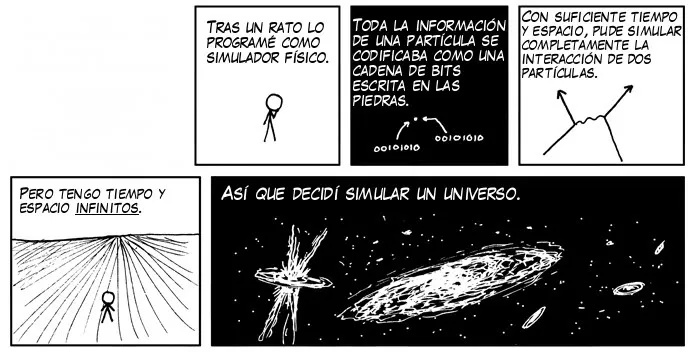
Brian's idea is different. It arises from the analogy between the world we live in and digital computer data processing.
Look: You are reading this text. But this text is not "real". It is the product or result of information processing. Electronic impulses, converted into bits. These impulses circulate from your motherboard, processor, RAM memory, video card, screen, and "create" this text.
The world, as we experience it, is real, we can touch it and we live it as such, but it would be the result of processing quantum information.
If we think about it for a second, the picture of the world may seem very similar to the one we have today, in some sense.
The Laws of Nature "produce" the reality we experience. As the basic elements (elementary particles) are "processed," the other objects of the world are formed.
This picture of the universe, however, has its problems. What exactly is spacetime? Why is there a limit to the speed of light? Why are there so many "elementary" particles?
There are also other obstacles in this current picture of the world, beyond the physical. How is it that the universe has a beginning? What was there before? What is that which was there before?
Evidently these last questions still belong more to the realm of philosophy than to that of modern physics and allow some people -including scientists- to think about concepts like superior or divine beings. The current picture of the world clearly restricts the actions of those supposed entities, but does not necessarily annul their existence, despite what Stephen Hawking says.
And I am talking about the current picture of the universe.
Perhaps the world we believe is real is the result of information processing.
In that sense, just as all the letter "a"s on this page are the same, in the same way all electrons or photons are, since they would originate from the same "code".
Being the result of algorithms presents, on one hand, a picture of the world similar to the current one, if we compare algorithms with the function of the laws of nature, but we would be looking for something more concrete.
Brian points out that it would not be valid to force this analogy. Human beings have the ability to find what we are looking for. Thus, there are people who look for divine beings everywhere...and they find them!
Therefore, according to the author, one should have few and reasonable assumptions. One might think that if we find coincidences in this digital analogy it would be coincidence. That could be different if the coincidences are many and detailed.
This approach could open new perspectives in physics if the hypothesis allows explaining many things.
For example, just as "elementary particles" would arise from a code as I noted before, the speed of light limit could be understood in computational terms, as the maximum rate of information exchange in a system. Or does your computer process without limits?
On the other hand, perhaps it will be found that this approach can explain things that the modern approach cannot.
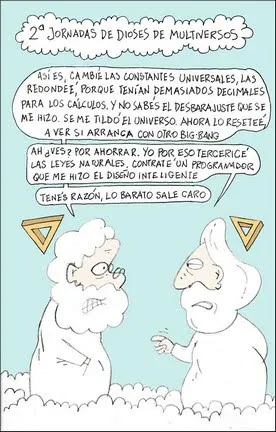
And where is the hardware?
Earlier I mentioned that the current approach has more philosophical than physical problems, for example, about the Big Bang. That is not possible to answer with current ideas. Nor with Brian's. It is inferred, however, that if there is information processing there must be "equipment" out there, something that gives origin to that processing. And one might think that that hardware is an analogy for a "mystical something". But it is the same situation with the current perspective.
Thinking about things in a different way can be useful. Do you know how we came to have the periodic table of the elements? Well, organizing the information in a different way allowed us to discover new things.
The system
Systems theory allows for very strong analogies in almost any context. Everything is a system (or subsystem). Like Russian nesting dolls.
There is, however, a quick objection. Anyone who has studied systems knows that no system can lack either input or output.
In this case, Brian proposes a single data input and the conservation of information.
Note that this conservation would be analogous to energy, mass, spin, charge, etc., but reduced to a single one.
Notice that in the history of science, the reduction of ideas to simpler ones is powerful. There we have the idea of symmetry.
In the second of his works on the subject, Brian specifically addresses the problem of space-time. Does time exist as something in itself? If all particles disappeared, would it still be there, is it an object?
I repeat that this is only a sketch of his ideas. I refer you to his articles for those who are interested. On FQXi there are other interesting works on the subject with various approaches.
Other papers
Based on the votes/ratings of each paper, besides Brian's (9.7 with 6 votes), others that stand out are:
Scales Solve the Continuous vs. Discrete Paradox, by Ray B Munroe (9.2, 14 votes)
The author's position is that Nature is fundamentally continuous and discrete and that this paradox is directly responsible for the wave-particle duality.
Fluctuation and Superposition of Digital and Analog Aspects of Spacetime, by Willard Mittelman (9.3, 8 votes)
It basically starts from the same previous idea by describing the microstructure of space-time as continuously fluctuating between discrete states and a continuous state.
Another view: the mind precedes information
In the excellent NPR 13.7 blog, Marcelo Gleiser addresses this issue in a post about the search for the essence of physical reality. There he alludes to a notion similar to, but different from, Brian's, that of "It from Bit" suggested by physicist John Archibald Wheeler. An idea also similar to Seth Lloyd's in his book Programming the Universe.
However, Marcelo points out that although he sees the appeal of these ideas, he does not fully share them. First, because they give rise to a "universal mind," bathing the cosmos with a theology that is, ultimately, a modern metaphor for divinity.
Marcelo has another point. He says that the concept that information is at the heart of physical reality confuses him because for him, it is we who give meaning to the material patterns we see in Nature. Each piece of matter has information, the "receipt" that explains how the different parts are formed to create the whole. In a way, through the physical sciences, we are decoders of this information. But he does not see how that information can precede matter, unless we call physical and chemical interactions that "information." But then, it's all a matter of semantics.
That is why he thinks that the "mind" (understood as the ability to give form and function to matter) precedes information: we create the notion of information to help us make sense of the world.
While thinking about these issues has no tangible, empirical, and utilitarian consequence, that is no reason to set them aside. On the contrary, that would be putting blinders on and "believing" that the world is exactly as we are told. Great advances (as Kuhn would say) occur when we think differently, not when we blind ourselves to a vision that has its problems. Perhaps the universe is different from what we interpret.
Although current ideas do not answer all our questions, it is clear that it is better to use logic and reasoning than to "believe" anything. There are things we know much better than others, and in that sense, not "everything" is possible. Beware: there will be those who will do stupid things next year (2012) by "assuming" anything.
Opening our minds to new ideas, yes. Letting our brains fall out, no.
"The rules of the scientific game include relativity, uncertainty, incompleteness, and undecidability. From the point of view of science, understanding these limitations can lead us to new discoveries about how the universe works. Even through this blind spot, we can see."
Carlos Castillo, Doctor of Science from the University of Chile, in Gödel's Incompleteness Theorem, Epistemowikia.
Sources and related links
- Brian Whitworth's site
- FQXi essay contest
- Searching For The Essence Of Physical Reality, by Marcelo Gleiser.
Brian's papers on VR:
- Whitworth, B., 2010, Simulating space and time, Prespacetime Journal, March 2010, Vol. 1, Issue 2, Page 218-243.arXiv:1011.5499v1 [cs.OH]
- Whitworth, B., 2010, The Light of Existence, Centre for Discrete Mathematics and Theoretical Computer Science Research Report 390. arXiv:1011.5705v1 [cs.OH]
- Whitworth, B., 2007, The physical world as a virtual reality, CDMTCS Research Report, CDMTCS-316, arXiv:0801.0337v2 [cs.OH]
- The emergence of the physical world from information processing, arXiv:1011.3436v1 [cs.OH]
- His other works, many of which are about scientific publications, are also worth reading.
About the images
- Cartoon: A pile of rocks. Credit: XKCD.
- Cartoon: Day 6: Rounding. Credit: Alejandro Tropea