In Buenos Aires
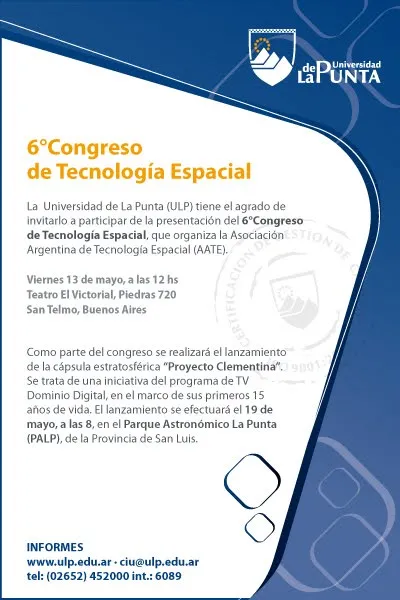
The VI Space Technology Congress will be held in San Luis next week, but it was presented today in Buenos Aires to publicize the launch of "Clementina".
The Argentine Space Technology Association (AATE) holds these congresses every two years where innovations and developments made in Latin America are presented.
The meeting will take place between the 18th and 20th of this month in San Luis, at the headquarters of the University of La Punta.
But this year there will be a special event. The launch of the stratospheric capsule of the "Clementina Project" is scheduled for the 19th.
The Clementina project arises as an educational activity aimed at awakening curiosity for science and technology in children, on the 15th anniversary of the TV program "Dominio Digital".
It involves sending a stratospheric capsule into space that records the entire flight in High Definition, transmitting its altitude, temperature and speed data via the internet so it can be followed from all over the world. It can be followed from the University of La Punta website.
Upon reaching its maximum altitude and before beginning its return to earth by parachute, it will transmit a series of messages.
What is it about?

This year marks 50 years since the arrival of Clementina (our first scientific computer) in Argentina and also 15 years of Dominio Digital.
To celebrate, the famous television program proposed launching a capsule to the Stratosphere, to more than 30km in height.
It is possible for children to participate by sending messages to other people, through the Project's Facebook page.
The capsule is small in size (30x20x25 cm) and will contain various contents: drawings of Gaturro by Nik, a map of Argentina made with Rastri, a small robot that will measure temperature, a small sculpture by Marta Minujín, and three high-definition cameras that will transmit live images. The weight is estimated not to exceed 3kg, so helium balloons will be used to lift the small device to the desired height.
At approximately 30 km in height, the threads connecting the balloons to the capsule will be cut -from Earth- so that it begins a free-fall descent. Half an hour later it is estimated that the capsule will land and, if all goes well, it can be recovered.
On the Clementina Project Facebook page there is much more information about it.
Presentation in Buenos Aires
To publicize this initiative in particular, as well as the Congress in general, a presentation was held today at noon at the Teatro El Victorial, in the San Telmo neighborhood. Attending were Eng. Pablo de León (the leading Argentine reference in space technology) and President of AATE; Dr. Alicia Bañuelos, rector of ULP; and Claudio Regis, host and driving force behind Dominio Digital.
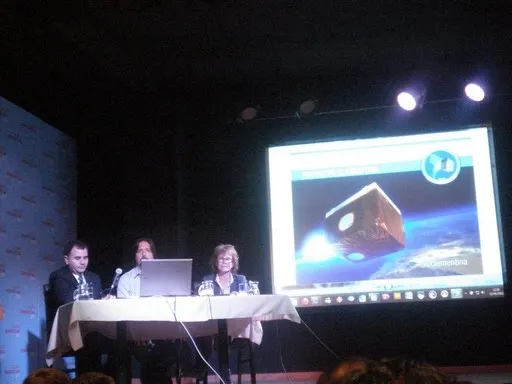
The presentation was started by Regis, who recounted how the organization of the capsule launch was carried out and the origin of the idea. He said that after visiting the La Punta Astronomical Park he was delighted and thought about holding the VI Space Technology Congress in that province. He emphasized that when contacting the rector of that university they were able to reach an agreement very quickly thanks to the university's expeditious action. He also recounted that Marta Minujín and the cartoonist Nik quickly agreed to participate in the project.
Immediately afterwards, Pablo de León provided some technical details of the device, as well as the organization of the Congress, which could be held thanks to the goodwill and prompt execution of the San Luis authorities.
Then the rector of the University of La Punta, Dr. Alicia Bañuelos, took the floor, noting that the objective of this project for the university is to foster interest in science among children (primary/secondary). She also took the opportunity to point out other university initiatives related to science, such as the images obtained with LASCO. (It was not mentioned, but other initiatives related to astronomy are San Luis Coelum and the Mega Solar System).
Video: CN23 Clementina Project: a technology capsule
http://www.youtube.com/watch?v=26tVMyAvbA0
Then a round of questions began among those present (around 50 people) who inquired about the situation of Argentina and the region in terms of space technology, job opportunities for students, the scientific value of the Clementina Project initiative, among other topics.
In this regard, De León recounted how pioneering Argentina has been in space technology and how later the country's political-economic ups and downs degraded research and development, which is gradually taking off again.
It should be said in this regard that next month, the Aquarius SAC-D satellite will be launched from NASA's Vandenberg base. This Tuesday the US Space Agency will hold a press conference on the matter.
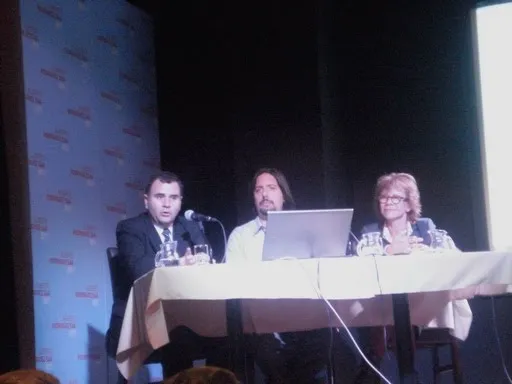
Regarding the scientific value of building, launching and recovering the capsule, Dr. Bañuelos was able to explain that the objective is to encourage scientific knowledge in young people with a technological bet for 20 years.
Reference was also made to the establishment of the Argentine Space Museum. According to De León, they do not yet have a place to establish it, but he thinks it could become a reality in a year or two. For this, he has been collecting a series of space suits (a subject in which he is a specialist), as well as various elements from different programs, both American and Russian.
After the questions ended, those present were treated to a reception. Let's toast then to a present in motion and a promising future.
Sources and related links
- AATE
- Dominio Digital
- COCAdE: Argentine capsule to the stratosphere: The Clementina Project
- ULP: Tomorrow the 6th Space Technology Congress is presented in Buenos Aires
About the images
- Clementina Project logo.