Reflections on the launch of SAC-D, journalism, and this thing we bloggers do, on the occasion of the recent Argentine Journalist's Day.
Journalist's Day was celebrated in Argentina on June 7, in honor of the "Gazeta de Buenos Ayres" created by Mariano Moreno on a day like that in 1810. I received some greetings that day, some of which I will comment on at the end, which results in a dilemma because I don't have a journalism degree (or status) and it is certainly doubtful that my task here is similar to that of those who work in a media company. Even so, I appreciate the greetings and extend them to fellow science bloggers, as well as science journalists. It occurs to me that in all kinds of journalism there are things in common related to telling, reporting on a certain topic x, where x will be an aspect of social reality: judicial, economic, political, sports, police. But in the case of science journalism one expects something more than that combination of concepts. One expects judgment, responsibility, and doubt. Actually, one could expect that in any other form of journalism and in any profession, in our daily lives. Many things are said, but which ones are true? That doubt is not just an intellectual boast, it is also a path toward an answer that surely will not be perfect, so we will have to resume doubt there as well. In a way it is like programming, with defined classes that are implemented differently, with constructors and destructors, and with loops. That is why I consider the continuous training of critical thinking so important and associate it with all tasks, but particularly with science journalists. It implies a critical view of one's own press activity and an examining view of scientific work. That we are interested in that work does not mean it is right to blind ourselves to its postulates and prostrate ourselves before its proponents. I therefore salute the Red Argentina de Periodismo Científico (RADPC) and the professionals who also carry out that task even if they are not part of that network. Also those who develop similar tasks from other spheres, like fellow bloggers and outreach organizations. I invite those who do not know the Network to visit the renewed RADPC website, as well as the videos of the talk at the last book fair, where they presented a 2010 yearbook with a series of articles written by its members. I dare to write these lines despite what was published today in El Cronista, under the pen of Mario Diament, in which he asks Who celebrates Journalist's Day? and, among other things, questions: "Bloggers, the opinionators of everything, the improvised critics, the obsessive tweeters, the illiterate forum posters, the hopeless with laptops, are they also journalists?" No Mario, bloggers are bloggers. And there are good ones, bad ones, to our liking and disliking. I am sure Diament thinks so, even though his article today is somewhat elitist. On the other hand, a 2006 note in La Nación, "The blog revolution" paints him as more inclusive. I agree that we must discern. That's what it's about. Bad examples are not lacking in El Cronista. The evolution of ideas That is why today, after the successful launch of the Argentine Satellite SAC-D/Aquarius, I thought of the famous and false "Age of Aquarius" that some New Age adherents preach. I do not believe in the never-proven and rather absurd premises of astrology. But I do believe there are "ages." That the human being evolves intellectually and that little by little the sacred cows fall. The heroes of yesteryear are now seen with other glasses, more realistic, without thereby taking away their merit. Textbooks are revised, because their statements contrast with reality. There are no magic formulas for doing things. There are diverse and changing contexts and criteria. The important thing is not to blind oneself. And not to assume that doubt is synonymous with pessimism. We must be able to scrutinize all of reality and not just the part we like or suits us best. Then we will be in a better position to form an idea, related to our personal criteria. Subjective, of course. Stinging questions I keep wondering if spending more than 300 million dollars on a satellite will bring about a true "change of era," as NASA already says. It's an analogy, I understand, referring to the data needed to evaluate the climate. Is the expenditure/investment of that money justified in this and not in something else? Does it imply an improvement in people's quality of life? Does it mean that the Argentine space industry has resurfaced and we are on the right track? Knowing if a country's science is "doing well" or not is truly complex. There are indicators that surely must be taken into account (number of researchers, patents, etc.), but it seems that the most prominent parameter always ends up being the economic one. Researchers complain when there are "cuts" as in Spain or when they are sent to wash dishes (as unfortunately happened in this country), and there are toasts when the flow of money allows sending probes or carrying out other types of works. But is the science that is needed in each country being done, to solve local problems? Does the greater flow of money have control and transparency? The most furious current events in Argentina allow for reflection on this. Here are those who "go for the handkerchiefs" and those who swallowed a sapo-klender for not wanting to see all of reality. Doubting these issues is not to bathe everything with a blanket of "it's all the same," as in some sense the Iberian indignant or those who banged their pots with "they all must go" seem to express. It implies asking and questioning oneself. And it is healthy to do so, even when the questions sting us. We cannot stop inquiring-ourselves. With science journalism something different happens than with part of the press. While some media have decidedly lost their way in the political/social aspect to enthrone themselves as the cream of sensationalism, recalcitrant to the point of implausibility, within their pages coexists a jubilation for national scientific activity. Argentina, as today's launch indicates, has improved notably in many aspects by having a greater flow of funds for science, as there is also for social plans. As in housing construction. But with the toast of satellite liftoffs there must also be inquiry, control, and transparency. We must not fear demanding and demanding honesty. It is not a matter of bureaucracy or the machine of obstruction. It aims at the common good. We must not destroy to build. We must use the good foundations to continue a higher goal. But with solid foundations, which we will know if they are such by inspecting them, not by ignoring them. Those stinging questions are the ones we should ask ourselves if we really want to leave democratic adolescence. We must question old mandates, but be cautious of new ones. The filter must always be there, without joy clouding our judgment. Without doubt making us unaware of improvement. If we want to progress we cannot disconnect social commitment from reasoning. And vice versa.
COCAdE The Casildense Space Commission (COCAdE), through its president Oscar Gambini, besides greeting on Journalist's Day, which I reciprocate because they also inform and disseminate, announces that the Commission continues with the teaching of the Astronomy Workshop at Esc. Nº 488 Carlos Casado, where students from the aforementioned institution participate. Due to weather conditions, the Municipality of the town of Chañar Ladeado had to postpone until this Friday the 10th, at 19 h, the reopening of the Astronomical Observatory where COCAdE will collaborate for the development of outreach activities. Furthermore, the Institution has been invited to offer astronomy talks and later observations in the town of Chabás on June 17 next, also on June 22 upcoming in Arequito, and on Wednesday, June 29 in San José de la Esquina. On June 15, an Astronomy and Astronautics Workshop begins for 5th grade students of the Colegio de Nuestra Señora de la Misericordia.
About the images
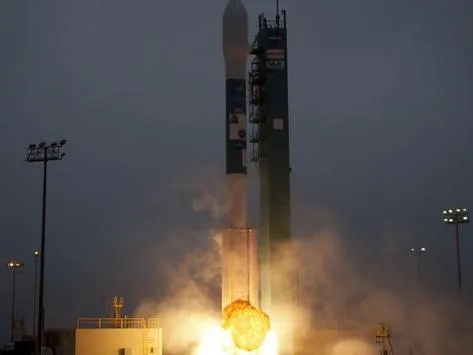
- Liftoff of SAC-D/Aquarius. Credit: NASA/Bill Ingalls.