A collection of links to music, images and videos that relate art and science. Today: The GSC II catalog and the lunar rover; dazzling NGC 634 and NGC 6744; The supernova sonata; and two VLT videos to leave you speechless.

Images of the decade
500 million celestial objects uncovered
The universe is big. Very. And classifying its objects is not a simple task. It's a never-ending job.
On June 4, 2001, ten years ago, astronomers from the Space Telescope Science Institute and the Torino Observatory, Italy, announced the Guide Star Catalog II, which replaced its predecessor.
This catalog contains a census of every star in the sky with a brightness down to magnitude 19, while the previous one went to 15.
The previous catalog, completed a year before Hubble's launch, took 8 years to make by scanning and digitizing 1,400 photographic plates. The new one required digitizing another 4,000 (for three colors) with a special scanner. Each pixel represents one arcsecond in the sky. The resulting database consists of 8 terabytes of images. It has 998,402,801 coordinate entries, most of them individual astronomical objects, as well as the positions, classifications and magnitudes of 455,851,237 objects.
GSC II began in January 2000 (version 2.0) and continued until October 2005 (version 2.3.2).
In addition, there are two other photometric catalogs. All can be accessed from:
http://gsss.stsci.edu/Catalogs/Catalogs.htm
And we can query them from http://archive.stsci.edu/cgi-bin/dss_form
I want MAST
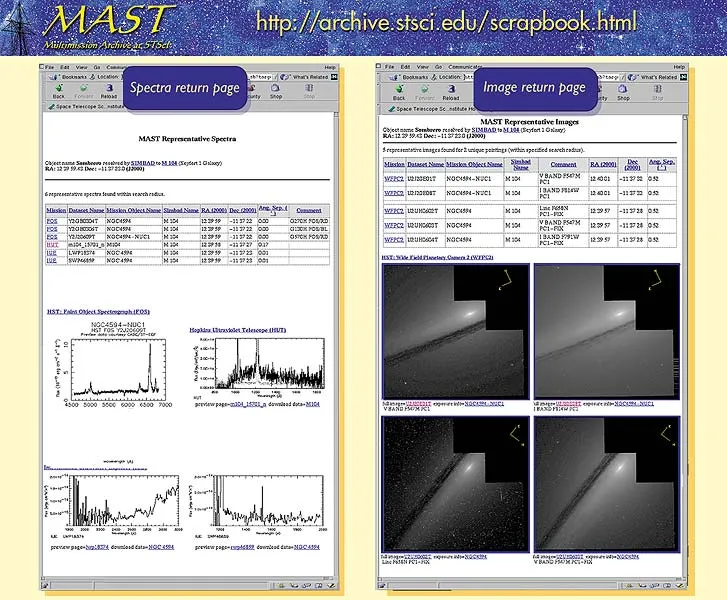
The same day the team of the Hubble Space Telescope Science Institute's Multi-Mission Archive (MAST) reported that at that day's meeting of astronomers, the first version of the space "scrapbook" would be made public. The term refers to a "scrapbook" or photo album. It was, in fact, web access to images and spectra of astronomical objects from the Hubble archives.
The site is still available at:
http://archive.stsci.edu/scrapbook.php
Credits: NASA, Myron Smith and the MAST Scrapbook Team (STScI)/Ann Feild (STScI)
The lunar rover of the Apollo 17 mission
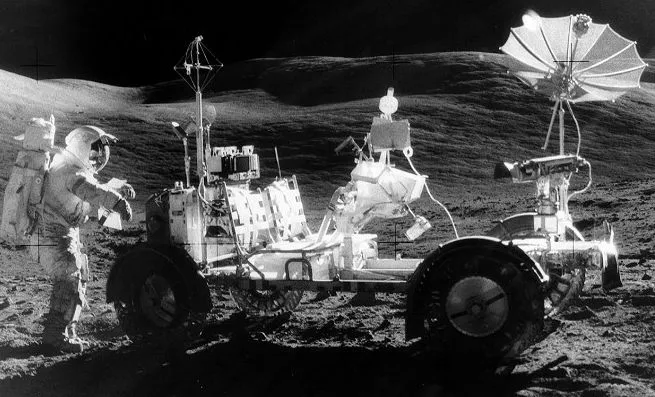
This photo shows Eugene Cernan, astronaut of the Apollo 17 mission, who together with Harrison Schmitt ("Jack" to his friends, author of the photograph) were the last humans to set foot on the Moon.
A similar image, but much larger and more detailed, is here.
Many other images can be found on the Apollo 17 multimedia site
Credit: Apollo 17, NASA (Image scanned by Kipp Teague)

It was the Astronomy Picture of the Day (APOD) for June 9, 2001.
Also on Observatorio.
Hey, this image proves it was all a fiasco! How could they have taken a buggy to the moon in the lunar module? It doesn't fit!
No doubt... about the nonsense one hears. While it's logical to think so at first (the rover was about 3 meters long), with a little information we solve the doubt. In La conspiración lunar ¡vaya timo! by Eugenio Manuel, it is explained appropriately. And on its supporting multimedia site, which I recommend as much as the book, we can see this video of the Descent of the Apollo 15 Rover
Images of the week
A perfect spiral with an explosive secret
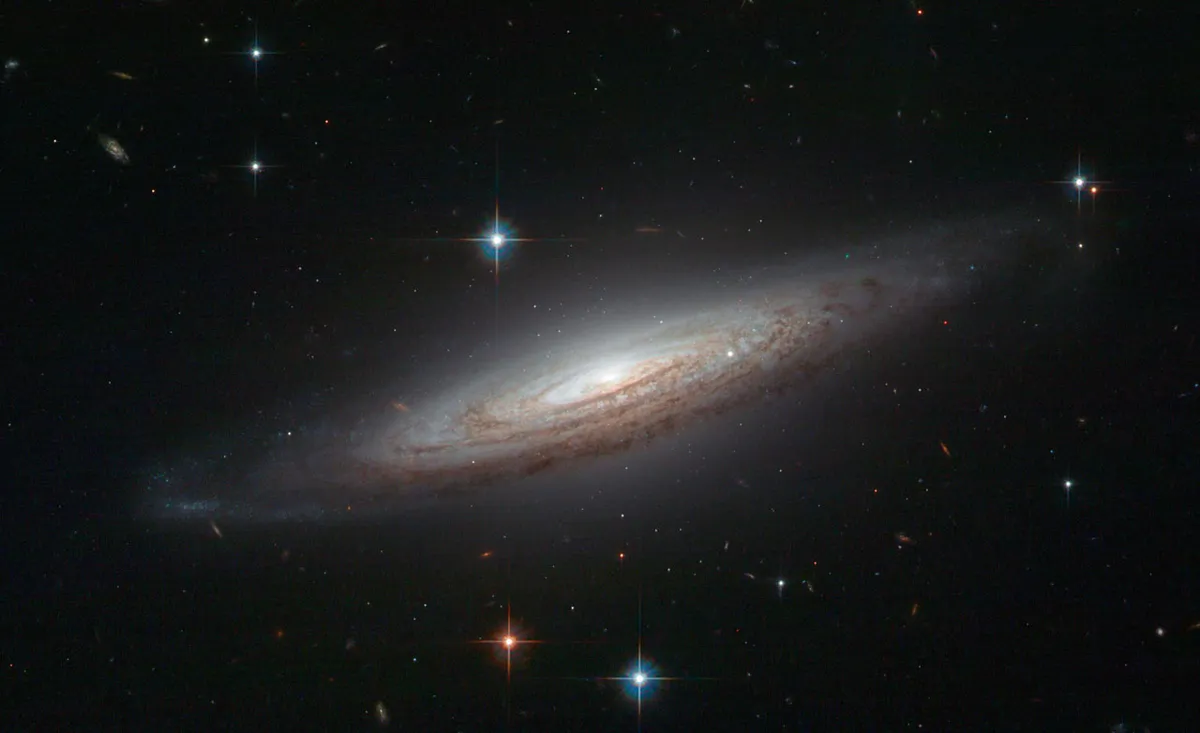
What we see here is not an illustration. The image is so perfect it doesn't look like a photograph of the cosmos, but the Hubble Space Telescope always surprises. If you click on the image, it will open separately. This is NGC 634, a spiral galaxy discovered by French astronomer Édouard Jean-Marie Stephan in the 19th century. It gained notoriety in 2008 due to the violent explosion of a white dwarf in a Type Ia supernova event known as SN2008a. The galaxy is 250 million light-years away.
It was the Hubble Space Telescope image of the week.
On the Space Telescope site, other resolutions of the same image can be obtained.
Credit: ESA/Hubble & NASA
A postcard sent from extragalactic space?
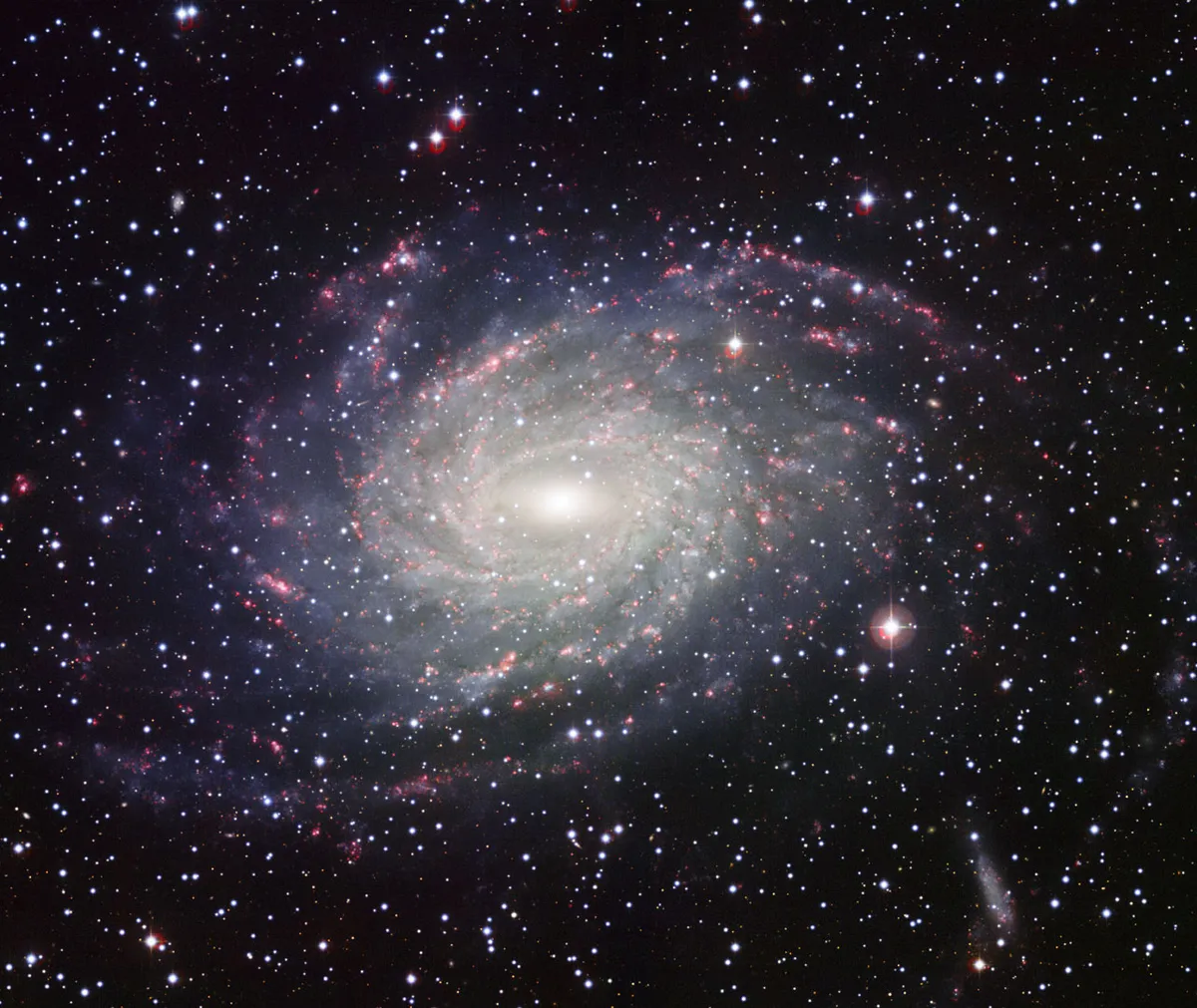
Astronomers from ESO used the Wide Field Imager instrument on the 2.2-meter MPG/ESO telescope at the La Silla Observatory in Chile to obtain this image of NGC 6744 (the image opens separately). This impressive spiral galaxy is located about 30 million light-years away, in the southern constellation of Pavo. However, it wouldn't be strange to mistake this image for a postcard of our own Milky Way, taken and sent by an extragalactic friend, due to its astonishing resemblance to our galaxy.
More in the press release eso1118es.
Credit: ESO.
Space Music
Today: Supernova sonata
Between April 2003 and August 2006, the Canada-France-Hawaii Telescope observed four parts of the sky as frequently as possible in search of Type Ia supernovae. What follows is a video of 241 supernovae of that type. The four deep fields are shown in color and the positions of the supernovae are illustrated with the progress of the music's time.
The animation is 15 frames per second (fps) and each frame corresponds to approximately one day, so one second is two weeks!
But also, each supernova was assigned a note, hence this is the Supernova Sonata.
Video: Supernova sonata
http://www.youtube.com/watch?v=9h_ZrD7axi4
The volume equals the distance: more distant, more diffuse.
The pitch is proportional to the "stretch factor" (*1), in a Phrygian scale.
The instrument on which each note is played is determined by the properties of the supernova's host galaxy. In more massive galaxies it is played with a bass and in less massive ones with a piano.
Created by Alex H. Parker (University of Victoria) and Melissa L. Graham (University of California Santa Barbara / LCOGT).
Source of images (CFHTLKS pages by Stephen Gwyn)
Data source: (Conley et al. 2011) (Sulivan et al. 2011)
Through Parker's page we can access the video on Vimeo and the sound on SoundCloud.
The brightness of the supernovae in the video is not to scale. Due to their enormous distance, even the most powerful ones appear faint when reaching Earth.
(*1) Stretch factor: The so-called stretch factor is a correction that astronomers make to the light curves of Type Ia supernovae. It is thought that these events occur when a white dwarf reaches a critical mass. If all events are generated in the same way, the light curves will be similar. But intrinsically some are brighter than others and can reach the peak of light and fade away more quickly or more slowly. The relationship between brightness and the width of the light curve allows astronomers to make corrections.
Other correction methods are also used, such as the use of multiple light curves.
See: Type Ia Supernovae
Science in motion
With images by Stephane Guisard and José Francisco Salgado, edited by Chilean Nicolás Bustos.
The music is "We Happy Few" - The Calm Blue Sea (2008)
Watch in full screen and with speakers on.
Video: VLT (Very Large Telescope) in High Definition
http://www.youtube.com/watch?v=wFpeM3fxJoQ
Wait, before you go, one for the road, a bonus.
What you just saw is how the sky is visualized, here on Earth. The sky seems to move from East to West. But we know that's not the case, rather our world spins the opposite way, right? So, watch a part of the same video, but as it really happens:
Video: Time lapse of the sky showing the Earth rotating and not the stars
http://www.youtube.com/watch?v=nkn2ZXWDl6k
To access previous editions of this section, consult the Multimedia Selection Series.