A collection of links to music, images and videos that relate art and science. Today: Images of 30 Dor, Carina Nebula, IC 755, Sagittarius. Music by Tunguska EMS. And a video-experiment.

Images of the decade
Hubble panoramic portrait of a vast star-forming region
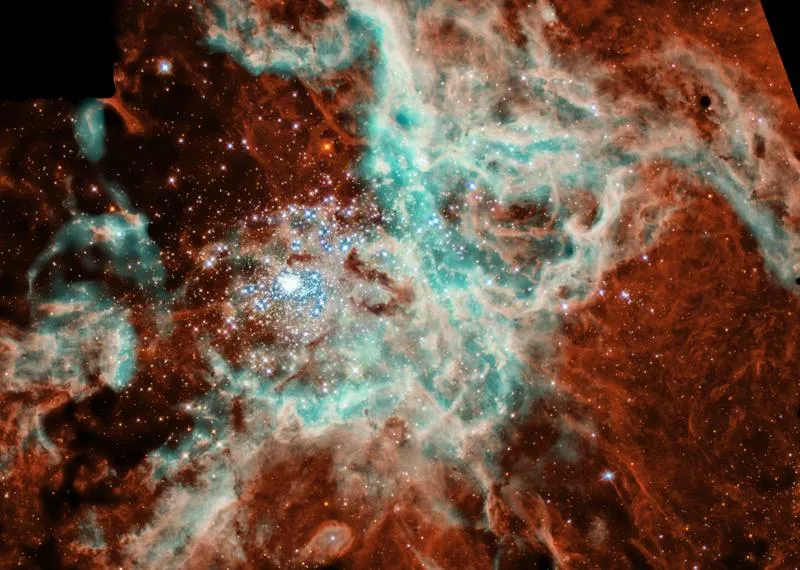
The Hubble Space Telescope took this panoramic portrait of the vast and sculpted landscape of gas and dust where thousands of stars are being born. The fertile star-forming region, nicknamed the 30 Doradus Nebula, has a brilliant center: the most massive cluster of massive stars in our cosmic neighborhood of about 25 galaxies.
30 Doradus is the largest object of its kind in the Local Group, which includes M31 (Andromeda), M33 (Triangulum), our Milky Way and several minor systems. The nebula is relatively close, in the Large Magellanic Cloud, 170,000 light-years from Earth.
These nebulae, which astronomers call "ionized hydrogen regions," are signs of recent star formation. The high ultraviolet energy from young, massive stars makes the surrounding gas glow. The most spectacular cluster of massive stars in the Local Group is R136, which contains several dozen of the most massive stars known, each about 100 times the mass of the Sun.
The image was published on HubbleSite on July 26, 2001.
The image was part of a research work carried out by Nolan Walborn and Jesús Maíz-Apellániz (from the Space Telescope Science Institute) together with Rodolfo Barbá, from the FCAyG of the Universidad de La Plata. The paper, Further Insights into the Structure of 30 Doradus from the Hubble Space Telescope Instruments, was published in The Astronomical Journal (Nolan R. Walborn et al. 2002 The Astronomical Journal 124 1601 doi: 10.1086/341955). The article is open access, so no subscription is needed to access the full text.
Credit: NASA, N. Walborn and J. Maíz-Apellániz (Space Telescope Science Institute, Baltimore, MD), R. Barbá (La Plata Observatory, La Plata, Argentina)
The Carina Nebula in three colors
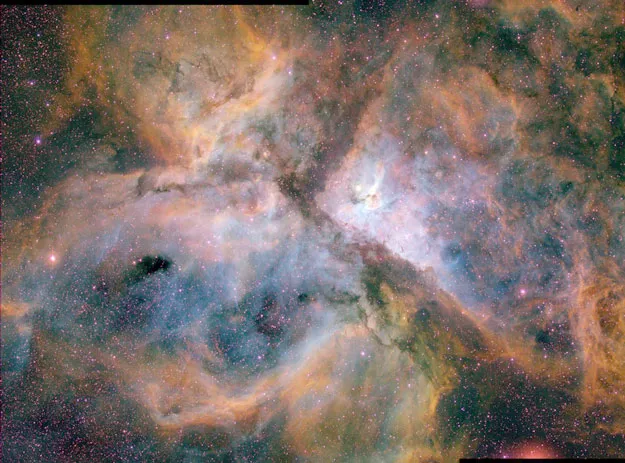
The Carina Nebula, in the image above, also known as the Keyhole Nebula and NGC 3372, is the result of dust and gas violently thrown out by the dying star Eta Carinae during its last centuries. Eta Carinae, one of the most luminous stars known, is visible as the bright star near the center of the nebula. The photograph above was taken in three different colors of light: blue light emitted by hot oxygen, green light emitted by warm hydrogen, and red light emitted by cold sulfur. Having been one of the brightest stars in the sky during the 19th century, Eta Carinae's brightness has been fading, but it is still visible, with binoculars, in the southern skies towards the constellation Carina.
Credit & Copyright: Nathan Smith (University of Minnesota), NOAO, AURA, NSF
It was the Astronomy Picture of the Day (APOD) July 17, 2001. Also on Observatorio.
Images of the week
Edge-on galaxy hosts supernova
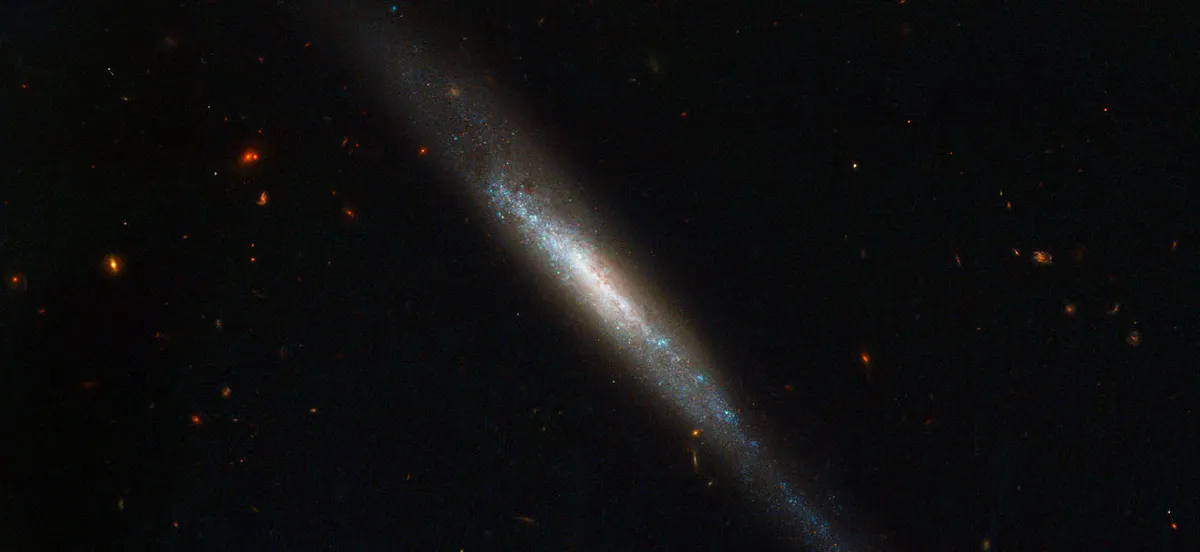
Hubble photographed this edge-on spiral galaxy, called IC 755, 70 million light-years from Earth.
In 1999, a star in that galaxy was seen exploding as a supernova, SN 1999an, a Type IIs supernova.
The image was published on July 18, 2011 as the Hubble Space Telescope Picture of the Week.
Credit: ESA/Hubble & NASA
The treasures of Sagittarius
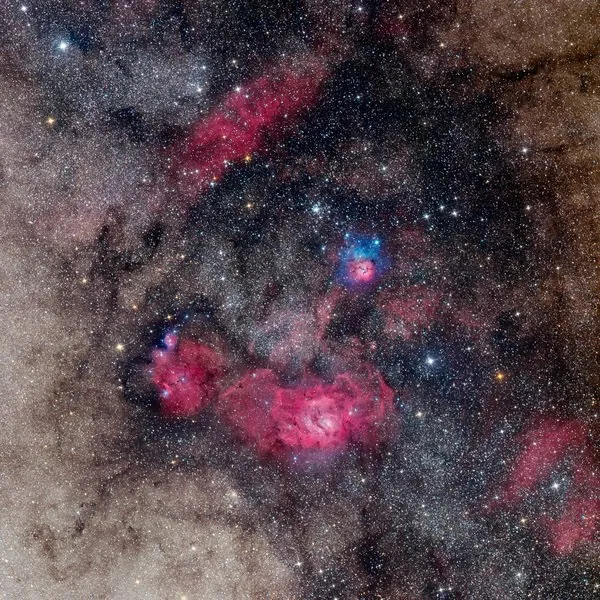
A classic view of the heart of Sagittarius with the nebulae M8, M20 and NGC 6559 dominating the image. What is less usual are the two HII regions Sh2-22 (LBN 004.60+00.29) and Sh 2-34 (RCW 149). The names of these regions come from the Sharpless Catalog.
In the center, slightly to the right we see M20, the Trifid Nebula. It is the "small" pink structure that appears divided into three zones by a dark dividing line. It is surrounded by a blue halo.
Below, the bright pink structure is M8, the Lagoon Nebula.
To the left of M8 we can see NGC 6559.
For comparison, we can see this other image, by Leonardo Julio, taken from La Pampa, of those three objects. Or a map of the Lagoon and Trifid nebulae.
The image belongs to astrophotographer Marco Lorenzi who uses a robotic observatory installed in Australia.
It was the Amateur Astronomy Picture of the Day on July 24, 2011.
Note: Between the first photo and the last we can find this relation: the Argentine astronomer Rodolfo Barbá took a photo, together with astronomer Julia Arias, of M8, recently published by the Gemini Observatory: Gemini Captures a Psychedelic Image of a Stellar Incubator.
Space Music
Tunguska Electronic Music Society
The Tunguska EMS community was created by several musicians and composers on the threshold of the centenary of the Tunguska catastrophe, to capture public attention about such an extraordinary event. It is about the Tunguska Event as the explosion of a bolide about 80 meters in diameter in the Siberia region, Russia, on June 30, 1908, is known. The event has been attributed to various causes, although the strongest hypotheses point to a comet or a small asteroid.
More about Tungunska: Lic. Mariano Ribas, from the Planetario porteño, wrote an article about The Day the Sky Exploded.
From the Tunguska EMS page we can access material distributed on social networks, as well as on Jamendo.
Among the many works, Tunguska Chillout Grooves, which has more than seven versions, and Ellipsis stand out.
Tunguska Chillout Grooves vol. 6 has a space-themed cover art, with a Hubble photograph of the Orion Nebula. Another space allusion is the first track, "The Space Wanderer". But the other works also contain tracks with titles alluding to space.
Tunguska EMS ranks second in the most listened to this week on Jamendo.
Video: Tunguska Chillout Grooves Vol.4 Promo
Tunguska Chillout Grooves Vol.4 Promo from Tunguska on Vimeo.
Science in motion
Video Experiment
Daniel Simons proposes a simple and quick experiment. We will watch a video in which there are six young women, three with black shirts, three with white shirts. There are some balls and they will pass them among themselves. The video lasts less than two minutes.
The idea is to count how many passes the girls in white shirts make. Just that. Just the passes. Just the girls in white shirts. It doesn't matter at all what the girls in black shirts do, you only have to pay attention to the white ones.
Now then: if you already know what the experiment is about, it probably won't have the same effect as on those who will see it for the first time. Even so, watch it and then we'll talk.
But if you have never seen this type of video, I ask you to understand the following: it is an experiment that tries to find out how attentive you are. In an ideal situation, you should watch the video in such a way that if you get the number of passes by the girls in white shirts right, you win a prize. That is, it is valuable to pay attention and achieve the objective, that is, to count the passes of the girls in white shirts.
This may seem absurd. Does this happen in real life? Anyone who has played any game will know that it does. Computer games are very popular. Although there are different types, it is common to have a specific objective: put balls in holes or kill aliens or anything else. And when playing, we don't want to lose, even if we don't win any prize.
When watching a video, it's not exactly the same. We can get distracted easily. It has been proven that the number of people who watch a video to the end is usually not the number that appears on video websites (like YouTube). It's easy to realize that because there are extremely long videos on that site and it's hardly believable that a huge number of people have watched such a video entirely.
But if you really want to do the experiment, do this: watch the video in full screen (with the icon on the video bar that is four little arrows) and be predisposed to achieve the objective: count the passes of the girls in white shirts only.
After the first minute, something will be pointed out to you. Since it's in English and part of the audience may not understand (although it's quite clear even without knowing that language), what you can know at the end by looking at this image.

To access previous editions of this section, consult the Multimedia Selection Series.