A collection of links to music, images and videos relating art and science. Today: Images of the 2001 Leonids, The Belly of the Cosmic Whale and Stellar Winds from a Wolf-Rayet. Music for strange moments: The vastness of the cosmos. Video: Night without stars.

Images of the decade
A field of Leonid stars
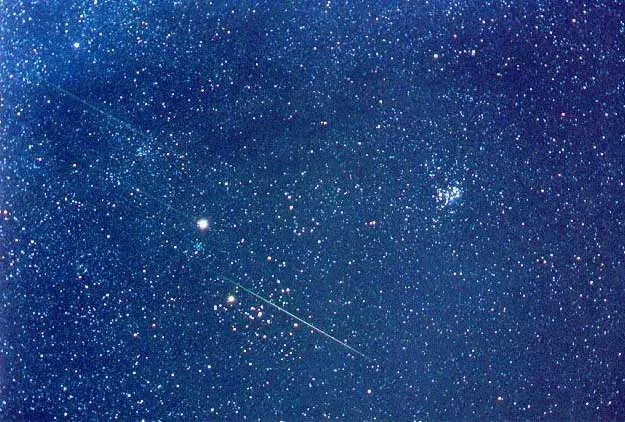
As meteor after meteor streaks across the moonless, clear sky, photographers around the world have captured the 2001 Leonid Meteor Shower.
Many have called this shower the best they have ever seen.
In fact, the 2001 Leonids were the most active meteor shower since the late 1960s.
The above photograph captures three Leonids crossing a photogenic star field.
On the right are the Pleiades, a star cluster.
The brightest meteor streaks to the right above the Hyades star cluster, located below the image center.
The bright star on the center left is Aldebaran.
This 10-minute exposure was taken in Victoria, British Columbia, Canada at 2:45 am PST on November 18, 2001 and was the Astronomy Picture of the Day (APOD) for November 20, 2001. Also on Observatorio.
Credit: Sherry Buttnor.
Images of the week
The Belly of the Cosmic Whale
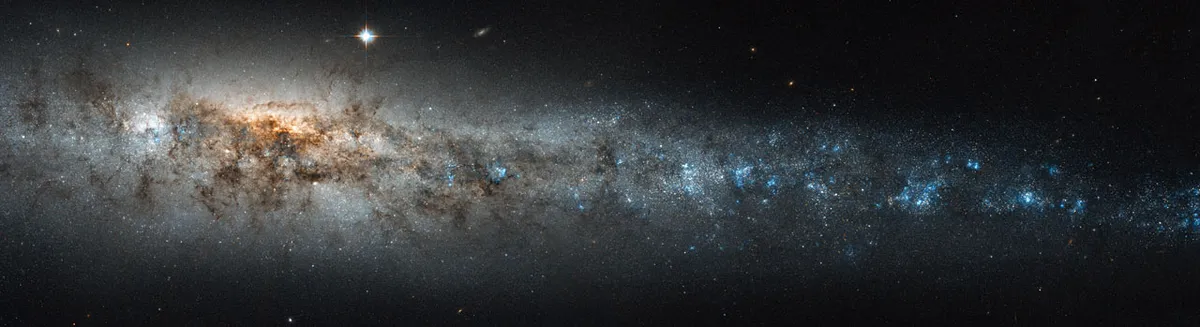
The NASA/ESA Hubble telescope peered deep into NGC 4631, better known as the Whale Galaxy. Here, a profusion of newborn stars illuminates the galactic center, revealing bands of dark material between us and the star formation.
The galaxy is located about 30 million light-years from Earth, in the constellation Canes Venatici (The Hunting Dogs) and is a spiral like the Milky Way.
It was the Hubble Space Telescope Picture of the Week.
Credit: NASA/ESA
The stellar winds of a Wolf-Rayet star
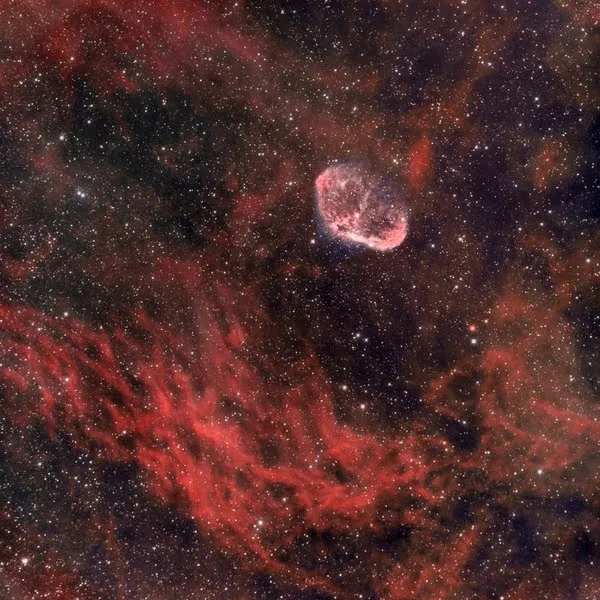
NGC 6888 is an emission nebula in Cygnus, also known as the Crescent Nebula because, they say, it resembles the "Crescent". But it is a planetary nebula with a central star (WR136).
This structure is located 6º from Sadr (γ Cygni), the second brightest star in Cygnus, after Deneb.
The star is about 1,500 light-years from home, but the nebula is a bit farther, approximately 4,500 light-years away.
The image was taken on May 14, 2010 by César Cantu from Juárez, Mexico with an Epsilon 180ED and a QSI540 camera in 2 and a half hours of exposure.
It was the Amateur Astronomy Picture of the Day (AAPOD) for November 16, 2011.
Space Music
Today: The vastness of the cosmos - Stranger's Moment's
Diego Masarotti, from Monte Maíz, Córdoba, Argentina, is the artist who calls himself Stranger's moment.
One of his latest productions, Come with me, contains a final track, titled "The vastness of the cosmos". With a melancholic and "spacey" air, it musically reflects the enormity of the universe and, in a way, how alone we are here.
We can listen to and download the complete album and his previous works on Jamendo.
Animated Astronomy
Short: A night without stars
A cat who fell in love with the stars. Watching them with pleasure, while his dog companion dozes beside him, something happens and the stars "get lost". Luckily, his faithful friend has a solution.
A tender short about the stars and the Moon, about friendship. Here on Earth, we humans, less friendly than animals many times, are also "losing stars" due to light pollution. Of course, we can't use the same solution as the dog in this animation, but we could agree not to lose so many stars in our historic sky.
The animation was made by Carl Luc Campbell, definitely. The author, also known as Don Blur (because he likes to use the "blur" effect a lot) maintained a blog until last year, still accessible: http://donblur.blogspot.com/
To access previous editions of this section, consult the Multimedia Selection Series.