A new mission to the red planet launches today, Saturday. Why do we love Mars so much?
Some initial numbers
The Mars Science Laboratory (MSL) mission will launch from Cape Canaveral on November 26 at 10:00 (UTC-5), which would be 12:00 in Argentina.
It will take eight months to travel the current distance between Earth and Mars: 205 million kilometers, meaning it would land on Martian soil between August 5 and 6, 2012, if it launches effectively today. If it cannot launch today, there will be more opportunities until December 18.
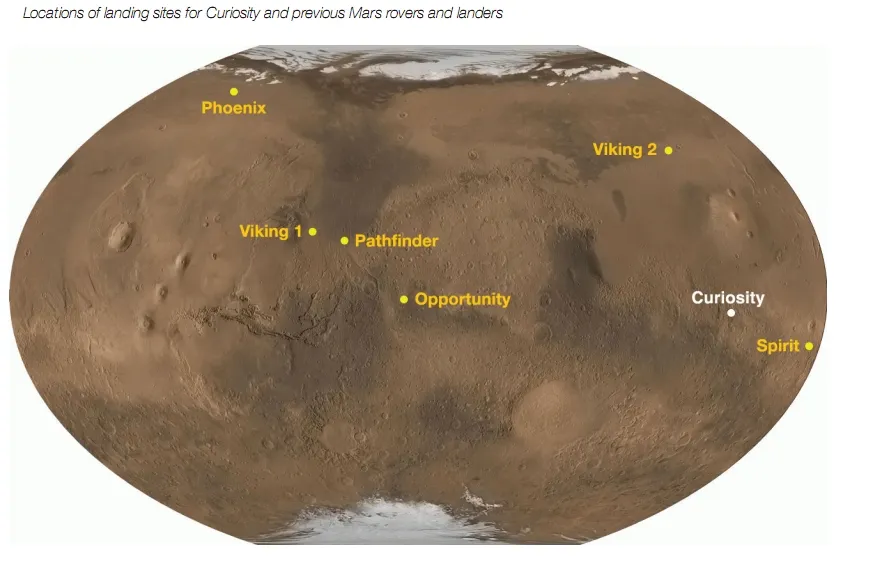
Next year the spacecraft will arrive at 4.5 degrees south latitude, 137.4 degrees east longitude on Mars, inside Gale Crater. At that moment, August 6, Mars will be 248 million kilometers from home.
The primary mission is one Martian year (98 of our weeks).
The program cost 2.5 billion dollars.
What is MSL for?
The mission will study the Gale Crater area and will be capable of detecting evidence of habitable environments in the past and present of the fourth planet. The investigation will have 10 science instruments carried by the Curiosity rover that will allow the study of the soil and atmosphere.
The mission is not designed, however, as a search for past or present Martian life, but if it finds evidence it can be used for the design of future missions and to deepen current studies on the issue. In particular, it will follow the "water trail". Every environment on Earth where there is liquid water supports microbial life. The history of our planet is long, about 4,500 million years and for most of it the only form of life on the planet were microorganisms or microbes.
Curiosity will land in a region where this very important item on the list of requirements for life has already been determined: it was wet there. Previous observations, for example with MRO, mapped the mineralogy of this and other zones and it is known from those prior studies that this is a good place to search.
In addition to collecting minerals, Curiosity will measure the ratios of different isotopes of various elements which are variants of the elements but with different atomic weight (by having a different number of neutrons).
The mission has four primary science objectives:
Assess the biological potential of at least one environment by determining the nature and making an inventory of organic carbon components and searching for the chemical building blocks of life.
Characterize the geology of the field by investigating the chemical and mineralogical composition of the surface.
Investigate planetary processes relevant to past habitability, including the role of water, and determine the present state and distribution and cycle of water and carbon dioxide.
Characterize the broad spectrum of surface radiation including cosmic and solar radiation.
Instruments
Among the most notable are:
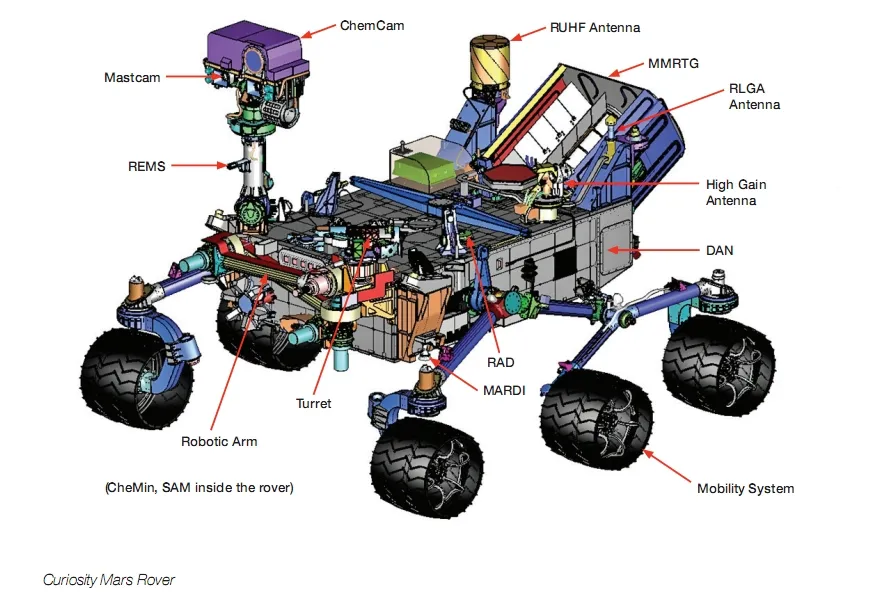
MastCam: two two-megapixel cameras are the eyes of this camera that will be able to show the rover's surroundings with exquisite detail and in motion. The right eye looks through lenses that will reveal details with high resolution. The left eye has a wider field and both can record video and take photos. By combining information from both cameras, three-dimensional views can be obtained.
The telescopic right eye is the Mastcam 100, so called for its 100-millimeter focal length lenses. Its images will cover an area about six degrees wide and five high in 1600x1200 pixels (7.4 centimeters per pixel).
The other camera is the Mastcam34 for its 34-millimeter lenses that captures scenes three times wider, about 18 degrees by 15.
ChemCam
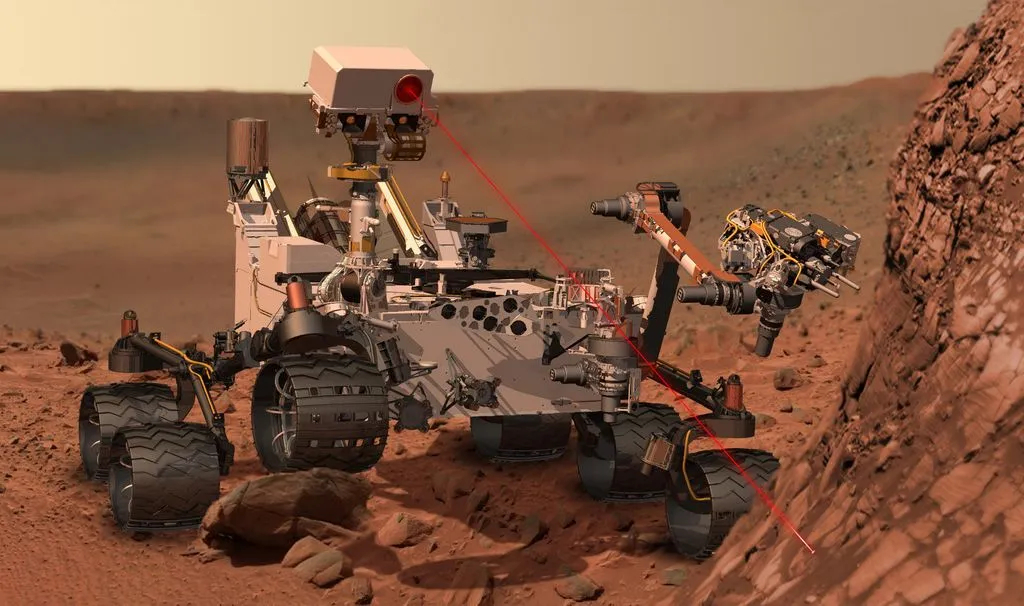
This camera contains a telescope and a laser. The laser can target rocks up to 7 meters away. What is achieved with the laser is to generate plasma, ionized gas that is immediately observed with the telescope to analyze the spectrum of the light, which will allow identifying the chemical elements in the target.
The telescope has a diameter of 4.33 inches, 110 millimeters, and can be used independently of the laser.
There is also a spectrometer (APXS), a magnifier (MAHLI), chemical and mineral analyzers (CheMin and SAM), an environmental monitor (REMS) that will record information about seasonal changes provided by Spain, a radiation detector (RAD), a Russian neutron shooter (DAN) used to measure how they scatter and thus find hydrogen up to 50 centimeters deep, a descent camera (MARDI) that will record the last minutes of Curiosity's descent in color, which will allow having much more precise information than that obtained from orbit and will give us fans the sensation of being there on the Martian surface.
The journey and the approach
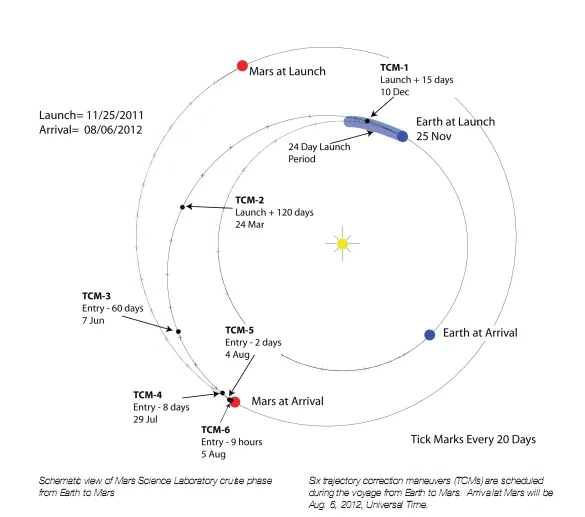
The journey will last about 36 weeks (255 days if launched at the start of the launch period that began yesterday). Most of the time (210 days if launched today) is the cruise phase and the last 45 will be the approach phase.
There will be at least three trajectory correction maneuvers (at 15, 120, 180 days after launch).
Descent
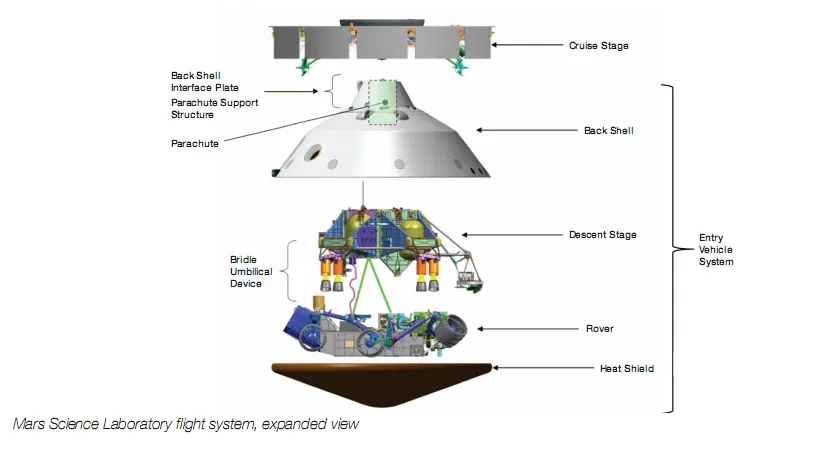
The intense period of entry, descent, and landing (EDL in English) begins when the spacecraft reaches the Martian atmosphere traveling at 5900 meters per second and ends about 7 minutes later (just enough time to cook some pasta in the meantime).
Ten minutes after entering the atmosphere, measurements begin to be taken and there will be a series of maneuvers to accommodate the spacecraft for its final descent. The parachutes will open at an altitude of 11 kilometers and a speed of 405 meters per second. The shield covering the spacecraft will separate at an altitude of 8 kilometers. There the MDI will begin recording video.
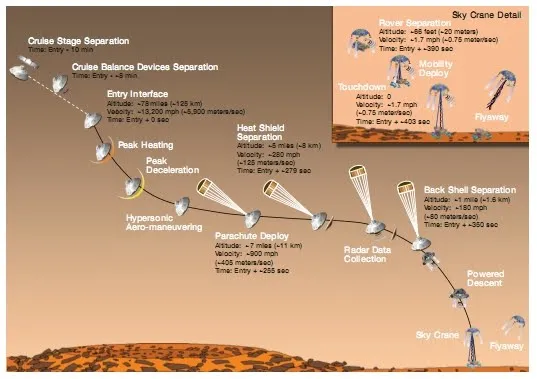
At 1.4 kilometers, the separation of the rover will occur and some retrorockets will begin to operate. And the wheels and suspension system will emerge just before touching the ground and the cables will be cut.
Surface operations
The planned operational life of MSL is one Martian year, 687 Earth days which are 669 Martian days, called sols. One sol is a Martian day equivalent to 24 hours, 39 minutes, 35 seconds. It will arrive in the Martian winter. The descent day will be Sol 0 (unlike past missions which were assigned Sol 1=).
Energy is generated by an MMRTG radioisotope generator, a nuclear battery that converts heat into electricity through two components: a heat source containing plutonium-238 and a set of thermocouples that convert the plutonium's heat into electricity. In total it carries 4.8 kilograms of plutonium dioxide. It must be said that this material is properly protected considering various scenarios, including accidents.
Computers
It has two, redundant, with a PowerPC 750 processor: BAE RAD 750 that operates at 200 megahertz speed. Each computer has 2 gigs of flash memory, 256 mb of RAM and 256 km of EEPROM memory.
There are two sets of engineering cameras for navigation: Navcams and Hazcams that generate grayscale images, similar to those of Spirit and Opportunity. In total it has 12 engineering cameras, each weighing...250 grams! The Navcams capture a 45-degree square field and are near the MastCam.
The Hazcams are four pairs: two redundant pairs in the front and two in the back. The rover can go "in reverse" and these cameras have 124-degree square lenses.
Fobos-Grunt
On November 22, ESA's antenna in Australia established contact with the Russian spacecraft Phobos-Grunt. Contact had been lost shortly after separation from the launch vehicle. After launching the spacecraft into a low orbit in preparation for its departure to Mars.
In coordination with Russian engineers, ESA made attempts almost daily since November 9 to contact Fobos-Grunt. The main problem seems to have been not knowing the spacecraft's orbit with much precision. To achieve this, the Perth antenna was modified so it could transmit low-power but very broad signals.
On the 22nd, the signals reached the 15-meter antenna and from there to the Russian controllers.
The name of the Russian spacecraft indicates its destination: the small satellite Phobos, of Mars. Grunt alludes to soil or earth.
What will become of the spacecraft? If the mission is recovered, it does not seem possible that it can be sent to Mars since the launch window would not allow it and perhaps it could be used to be sent to the Moon or an asteroid, but the chances seem much closer to zero.
Since 1960 Russia has failed in its 17 attempts to study the soil of the red planet. Among the Russian missions are Marsnik 1 and 2, Sputnik 22 and 24, Mars 1 to 7, Zond 2, Mars 1969, Kosmos 419, Phobos 1 and 2 and Mars 96.
Japan also tried with Nozomi and Europe with Mars Express/Beagle.
The United States had its failed attempts too, such as Mariner 3 and 8, Mars Observer, and others.
However, the American power also had its achievements on the red planet with Viking, Global Surveyor, Pathfinder, Odyssey, Spirit, Opportunity, MRO, Phoenix.
Why do we love Mars so much?

When we speak vulgarly of "little green men" we think of Martians, from Mars. Those who think like that are sometimes called "lunatics," but we don't hear much about "Venusians" or "Mercurians" and less about "Jupiterians," although yes, with another connotation, "Saturnians."
It is logical that some of this occurs: the inner planets (up to Earth) are rocky, while the outer ones are not all like that, except precisely Mars and Pluto.
Mercury is too close to the Sun, so if we fly in one fell swoop to the gas planets, to Pluto for being very far away and to Mercury, Venus and Mars remain, two rocky planets and both neighbors of home.
Fig.6: Venus and Mars in El Prado.
The question about the possibility of life on other worlds becomes more evident, then, for these two close "brothers." There are those who think that Venus is the future of Earth (through the greenhouse effect), and present-day Mars may be similar to the past of the world we inhabit.
In both cases, studying these neighbors is much more possible than doing so with exoplanets because they are much closer. Thus, the research will also allow us to know more about our world. The possibility of sending humans to Mars is still standing, as demonstrated by the Mars500 experiment.
From Mars we have received the meteorite ALH 84001, famous for the controversy that arose due to the supposed discovery of microbes inside it.
Our past ignorance led us to write pages about the supposed existence of life on these two worlds, and the sum of these factors, added to the names of these linked with classical myths and legends, has generated an idea between romantic and heroic around the nearby planets.

In some way, science also contributes to this. It is heroic to build a spacecraft and have it manage to descend on another planet. The enumeration of the failed missions indicated above proves it.
And there is passion for discovery and exploration, which is love, in other words.
We also say that men are from Mars (God of War) and women from Venus (Goddess of love), but that's another story...of amorous epic.
Watch it on the web: the launch of MSL can be seen from http://www.nasa.gov/ntv
Sources and related links
- Launch Press Kit (5.2 Mb) and MSL Fact Sheet
- MSL at JPL
- ESA Tracking Station Contacts Russia's Missing Mars Mission
- Last chance to send Russian Mars moon probe expires Monday
- An ESA station maintains contact with the Russian Mars mission
- Mars and Venus, our neighbors
About the images
- Initial image: Illustration by NASA/JPL-Caltech
- Fig. 1 to 5: NASA.
- Fig. 6: Botticelli
- Fig. 7: Venus and Mars in El Prado