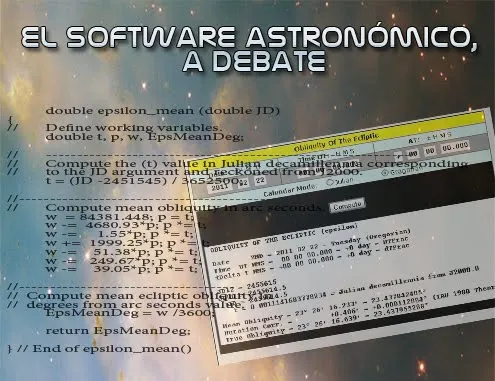
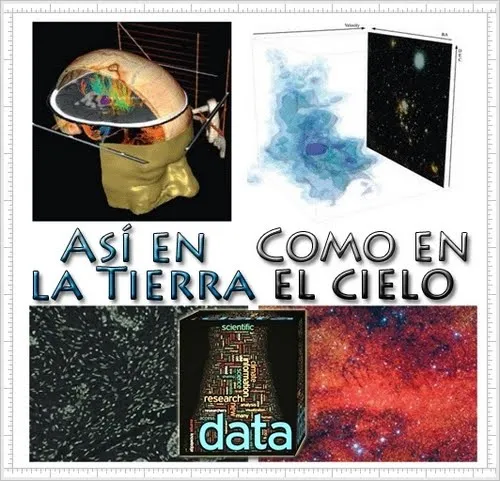
An analysis of scientific communications related to astronomy shows a certain invisibilization of astronomers.
Gilles Deleuze's essay titled "Postscript on the Societies of Control" is well known. (#1)
Let's review that essay. Deleuze takes the concept of disciplinary societies (DS) from Foucault to account for social bonds until the mid-20th century. The individual passes from one enclosed space to another: home, barracks, factory, hospital, prison. These places, he points out, are in crisis and the old DS are being replaced by Societies of Control (SC), a name taken from Burroughs.
DS are analog, mechanical. At the same time they are associated with States, they are societies of sovereignty. There, machines with levers and pulleys are handled to produce manufactures, tangible products. Each time one passes from one enclosed place to another, one starts over, they are, let's say, interrupted societies.
In contrast, SC are digital, virtual, permanent. We move from the factory to the company, which no longer produces tangible materials, but services. Even computing, which is virtual in itself, has been re-virtualized in the form of a service, be it IaaS, SaaS, etc.
We are increasingly close to replacing our ID card with our password and username. We live in a globalized world, without borders, in which work never ceases thanks to mobile digital devices, be they phones, tablets, notebooks. We are always available and online.
Towards a post-modern astronomy?
I allow myself to wonder if it is not possible to think of astronomy in that context. The astronomical observatory, as a place of confinement where photographic plates and spectra were produced, is giving way to other forms of producing astronomical science.
We speak here of the so-called New paradigm of the sciences, particularly astronomy, due to the deluge of data from large observatories.
Data, in science, has always existed. Data as empirical observation necessary to build science could date back four centuries, but data have existed since ancient times. What exists today in the sciences, in astronomy, are also binary data recorded in huge relational databases. Data that, in some cases, sleep there the sleep of the just.
That, in itself, implies certain possible problems: the obsolescence of the information, the backup of a huge amount of information, its corresponding archiving and documentation. It also means that this data can now be acquired remotely. They are no longer handled in a tangible form, they are virtual. And many of these tasks have been automated.
I wonder what the fate of the astronomer is in this becoming. I also wonder if there is a certain fetishism of the instrument, in this case, the telescope. And then I ask myself again: if that is the case, are we not on the threshold of a new fetishism, in this case of binary data?
Astronomical fetishes
Fetishism is not a topic independent of Deleuze's analysis. That forms of production produce alienations was already addressed by Karl Marx in the first chapter of Capital, in which the author speaks of "commodity fetishism".
What is the astronomer's commodity?
I think that in both professional and amateur astronomy there is a certain devotion towards telescopes as the key instruments. And there is also, in some way, a fetishistic modality regarding photography. But while before the record was made on plates coated with a photosensitive emulsion, today the light from distant objects is recorded in pixels stored in databases.
Proposition: current astronomical communication
Here I want to stop, on these particular issues: the instrument and photography in astronomy, to point out something I have been pondering for a long time, even if it is nothing more than the outline of an idea.
The very productive process in astronomy has distanced astronomers from direct observation. These researchers can observe remotely and even with automatic mechanisms. And the product of these observations are no longer tangible, manipulable data, like the old plates, but binary data. This virtual astronomy is here to stay. These forms of production deserve a historical and sociological analysis. What I wonder is how the communication of the professional astronomer's work plays out in this context.
What I would like to address here is how objects (instruments, observatories, data, images) are, in some cases, the subjects of communications. For this I will take examples from the websites of NASA, ESO, HubbleSite, SpaceTelescope and Chandra. And I will differentiate between scientific communications (press releases) and image publication. In the former, astronomers are present in the discourse, although in many titles the emphasis is placed on the instruments. In image publication, on the other hand, astronomers virtually disappear.
The object is the subject
1. NASA
Let's review some recent NASA communications. The examples were chosen from the latest releases of the U.S. agency. They are not part of a systematic study. They are notes of ideas. (#2)
Let's see:
a) "NASA's Hubble Spots Rare Gravitational Arc from Distant, Hefty Galaxy Cluster" is the title NASA gave to a June 26, 2012 release. In Spanish: "NASA's Hubble detects rare gravitational arc from distant, hefty galaxy cluster".
http://www.nasa.gov/mission_pages/hubble/science/gravitation-arc.html
b) "Space Telescope Opens Its X-Ray Eyes", that is "Space Telescope opens its X-ray eyes", NASA indicated on June 28 in relation to NuSTAR (Nuclear Spectroscopic Telescope Array).
http://www.nasa.gov/mission_pages/nustar/news/nustar20120628.html
c) On the same day, also published on the same site: "Hubble, Swift Detect First-Ever Changes in an Exoplanet Atmosphere" to report that "Hubble and Swift detect for the first time changes in an exoplanet's atmosphere".
http://www.nasa.gov/topics/universe/features/exoplanet-atmosphere.html
Let the reader perform a syntactic analysis of those titles and indicate the subject of those sentences. It is common that to detect the sentence subject we ask who/what? because we link the subject with that, animated or inanimate, that does things, that acts, the agent. In these cases, the what (or who?) is "NASA's Hubble", "Space Telescope", "Hubble, Swift".
These "things" are the subjects. They are inanimate, we know, not people. But the verbs, which tell us about the actions, indicate that these objects detect, open their eyes, look. The verb "to spot" in English can be understood as to notice, recognize, see, as well as discover, detect.
It is not the only area where we find similar statements. Among users of the BOINC platform, used to run distributed computing programs, it is said that 'the computer finished a job'. It is not a verbatim quote, but an example. And it is logical. Both in astronomical instruments and in computers, the machines ultimately, can perform tasks automatically. The human being creates these devices, programs them, also uses them, but at the same time they are mechanically and computationally independent at some point. The place of man/woman is somehow relegated in the face of automation.
But at the same time those statements can be thought of as false. What is stated are conclusions of analyses carried out by flesh-and-blood beings, researchers, not machines. Here I wondered if someday discoveries will be "automatic".
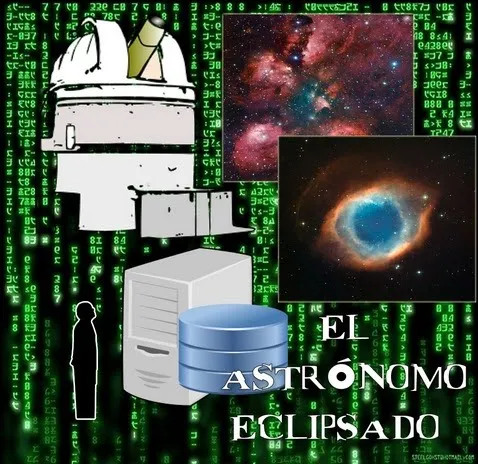
But I want to focus on communication. Statements construct meaning and reality. I am not saying that just because of the wording of those titles the reader will think that human beings are unnecessary, but somehow the experts are invisibilized. Or to put it another way: instruments and images, in astronomical communication, have eclipsed the professionals. A "binary eclipse" if you allow me the idea.(#3)
By the way, taking examples out of context is a risk. Anyone interested in these topics will find that the people involved are indeed made known. One only needs to read those same press releases to notice the discursive presence of people who speak and research, who analyze and draw conclusions, despite the titles emphasizing the telescopes.
For example, in c) the text indicates, among other phrases:
*International team of astronomers -> using Hubble data
->made an observation
->detecting significant changes
*The scientists ->concluded
*Researcher Alain Lecavelier->said
->Hubble and swift coverage->gave us
This type of analysis breaks down important elements in a discourse, such as agents and processes, and allows us to account for who are the actors, the beneficiaries or patients, the actions.
The political issue
But also there is probably, at least in some cases, some conscious intention. Instruments (satellites, telescopes, observatories) require money to be built and maintained. Communicating their existence as flags of a country, personifying them so that these objects are the important ones, may be related to obtaining a budget. And they also build national identities: it is the Hubble "of NASA".
A recent example: on July 2 (two days before the commemoration of American independence) NASA published: "Fireworks Over Mars - The Spirit of 76 Pyrotechnics", that is: "Fireworks on Mars - The Spirit of 76 explosive charges"
http://www.nasa.gov/mission_pages/msl/news/msl20120702.html
If we stop to read from this perspective the press releases on HubbleSite, SpaceTelescope, ESO, Chandra, to name a few important examples, we will find the same thing. But there is a clear distinction between two major forms of communication:
On one hand, the press releases: there the focus is on the instruments, but the researchers are not invisibilized. It is those people who use the objects and analyze the data. Although also on many occasions the importance of such an instrument or how it has changed our view of the cosmos is reported.
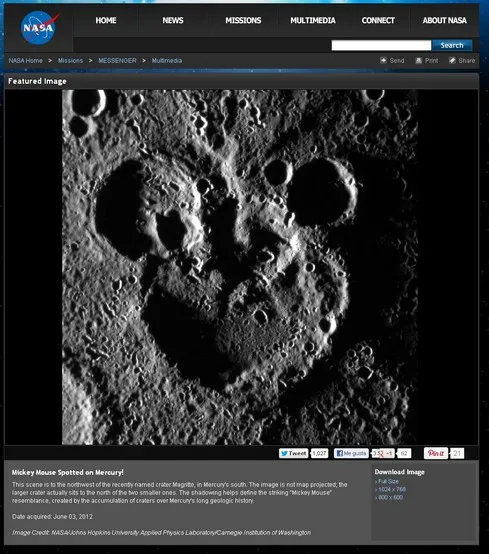
On the other hand, on many of these sites images, photographs are also released. It is a different form of communication, because unlike press releases they ignore the existence of people, of research, to focus on the binary data. Let's see:
"Mickey Mouse Spotted on Mercury!" is the title given by NASA to a photograph published on June 15, 2012 in which the silhouette of the famous mouse's head "seems to be seen" on Mercury.
If we take the time to examine the entire page, we will notice that the image is part of the Messenger mission. The date of image acquisition and a credit associated with three institutions are shown. No person. This example serves both to analyze how from scientific communication they also seek to generate nationalist empathies (also related to a certain "cultural colonialism"), as well as to analyze the following point: photographic data.
The continuation of this entry will be published in a second part.
Sources and related links
- #1: Gilles Deleuze: "Postscript on the Societies of Control", in Christian Ferrer (Comp.) El lenguaje literario, Tº 2, Ed. Nordan, Montevideo, 1991. Translation: Martín Caparrós. It is also advisable to read "El hombre post-orgánico" by Paula Sibila, FCE, 2005.
- # 2: It will be noted that I am using some concepts from M. Halliday's systemic-functional linguistics. With that basis it is possible to do a more detailed analysis of agents and processes in a discourse. There is a manual by Elsa Ghio and M. D. Fernández.
- #3: I have used in this entry the non-existent verb "invisibilizar". I thought that verbs like "ocultar", "enmascarar", "camuflar", implied a nuance of a deliberate, conscious act. The DRAE does include the verb eclipsar, which by the way alludes to the astronomical, but it is also used as a pronominal verb to indicate absence, disappearance. Needless to say, the concept of "binary eclipse" does not exist, although certain variable stars are called "eclipsing binaries". The term "binary" alludes to binary code in this text, it is a play on words.
About the images
- The initial image was created with drawings from OpenClipArt.
- The final image is a screenshot of the Nasa.gov site.