Since the discovery of the first exoplanet, around the star 51 Pegasi, more than 400 planets around other stars have been discovered. But these objects, unlike others, do not have a name, but a scientific designation.
An astronomer proposes to give exoplanets a name.
Wladimir Lyra is Brazilian. He studied at the Federal University of Rio de Janeiro. In 2002 he was selected for a 10-week summer job at the Hubble Space Telescope Science Institute in Baltimore. He was in Chile with the CTIO project. In 2004 he began his doctorate at Uppsala University, Sweden. After 4 turbulent years, 11 papers and countless nights coding and running simulations on protoplanetary disks, they started calling him "Doctor". He is now a postdoctoral researcher at the Max Planck Institute in Heidelberg. Besides having a passport full of stamps, he speaks his native Portuguese fluently, as well as Spanish, French and Swedish.
In a recent essay, a paper not submitted to any publication, he suggests "appropriate" names for the 403 exoplanets known to date.
Scientific nomenclature vs. "human" names
Certainly, naming an exoplanet MOA-2008-BLG-310-L b does not seem very fitting, but it is the label that a recent planet with a mass lower than Saturn's, detected in the Galactic Bulge, has received so far.
The IAU maintains that it is not practical to give them a name. It is argued that discoveries will increase exponentially and it would not be possible to name them all. Of course, stars are also discovered and it is viable, at least so far, to give them a friendlier designation. Even asteroids have their names. Even some galaxies, at least the closest ones, have them. The IAU is analyzing the creation of a system, which will be less romantic than what Lyra proposes, but more orderly.
Currently, the name of the star to which the exoplanet belongs (according to a catalog) is used, followed by a letter (starting with b), if there are several planets in the system.
Naming the stars
The brightest stars usually have proper names that come from ancient times. The vast majority come from Greek (like Castor) or Arabic (like Aldebaran), but even those of magnitude 6 can be named systematically in two ways:
The Bayer method consists of giving it a letter, Greek or Latin, before the name of its constellation in the genitive; for example: a Virginis.
The Flamsteed method consists of giving it a number before the name of its constellation in the genitive; for example: 67 Virginis.
More information in Nombre de las estrellas, by Antonio Herrera.
But not only constellations are used. Astronomers assign names to stars according to the catalogs to which they belong. Throughout history, many catalogs have been made: Johannes Bayer in Uranometria made an atlas of the sky using Greek letters. There are also others: Flamsteed (1712), Lacaille (1742), Bradley (1760), Piazzi (1800) and Lalande (1801). The latter gave the number, magnitude and position of 47,390 stars.
Today the Henry Draper catalog is widely used to name exoplanets. For example, the HD 155358 system has at least two planets, b and c.
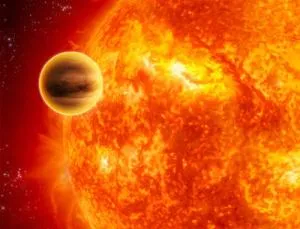
Why name exoplanets? Lyra argues that the Copernican Principle is a main reason. Our place in the cosmos is not special, so there is no reason why only the planets in our solar system should have names. An extrapolation of this idea is known as the Principle of mediocrity.
Some planets have a suggested name. For example, the author thought that 51 Pegasi b would suit the nickname "Bellerophon". This is how he came across the website "Extrasolar planet naming society" on the web, which suggests exactly that name.
Another page, by Devon Moore, has suggestions for naming more than 40 planets, some that seem appropriate to him, others that he would reject.
The three planets discovered around Upsilon Andromedae have been nicknamed "Fourpiter", "Twopiter" and "Dinky" by fourth graders. Clearly the first two have references to their size in relation to Jupiter. No offense to the creative children, says Lyra, these are no longer the times when Venitia Burney, the 11-year-old girl, suggested the name Pluto (the Roman god of the underworld, not Disney's dog!) for the distant and cold ex-planet, in 1930. By the way, "Naming Pluto" is a documentary on the subject that tells the story.
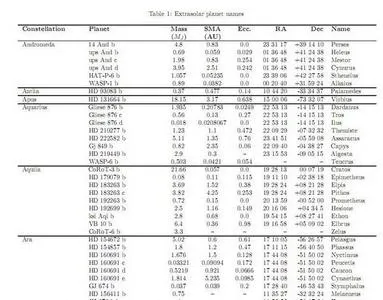
How to do it then? Lyra suggests returning to the classic tradition of using Greco-Roman mythology. The article contains a table with the exoplanets found so far and Lyra's suggestions. Method? Jean Schneider's Encyclopedia of Exoplanets (which contains the 32 recently discovered exoplanets), a dictionary of Mythology and some online sources. To find an appropriate name, a way that seems reasonable to him is association with the constellation in which it is located. For example, the Gliese 581 system, in Libra, could be called Themis, the goddess of justice.
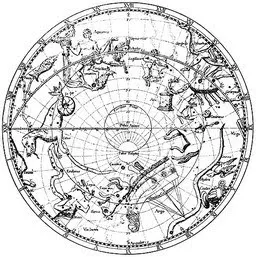
And the southern constellations? The classical constellations described in the Almagest were, of course, drawn on the stars visible only from the northern hemisphere. And they used myths to find appropriate names. But the southern constellations defined during the Age of Navigation are not associated with mythological figures.
For that, Lyra credits Moore with the merit of knowing what to do. Simply associate them with classical mythology: Horologium (the hourglass) could be Cronos, the god of Time. In the same way, the names in Uranometria, by Bayer, can be associated with classical mythology.
Next, the author mentions the navigation myths -The Iliad, the Odyssey, the Aeneid- as sources of classical references. And he also proposes, from Portuguese literature, "Os Lusíadas", a Renaissance epic by Luís de Camões, from 1572. The title means "the sons of Luso". According to legend, the Portuguese descend from Luso, son of the god Bacchus, who conquered by arms a territory that later would be Lusitania, that is, Portugal.
This suggestion opens the door to the inclusion of other myths and literary associations: The Song of Roland, The Nibelungenlied, The Divine Comedy, Don Quixote, etc. And he also cites "The Columbiad", by Joel Barlow (1807).
In the following pages, Lyra proposes classical mythological associations with the constellations to, finally, suggest names for the 403 exoplanets discovered as of October 2009.
The criticisms
I'm not saying the proposal is bad or good, I'm just asking questions:
With so many different objects existing (stars, planets, asteroids) the naming could be cumbersome and the list to choose from, finite. Perhaps the best thing is indeed to name stars in a friendly way and, from them, the planets and asteroids. In our solar system, these objects, with their current names, would be "special" because we found them first. Having a system arbitrated by the IAU would generate fewer complications and detours.
The idea of naming exoplanets in a more friendly way is not without its appeal: it would attract the general public. But, in the case of stars that host planets and are located in a constellation of the Southern Hemisphere, wouldn't it be much more appropriate to use the mythology of pre-Columbian civilizations, for example? Mayans, Incas, Aztecs -we would have to add those who inhabited Australia, South Africa, etc- had their deities and studied the celestial movements with great precision. The "New World" also deserves a "New Sky", don't you think? And to be truly new, we should include other mythologies like Japanese, African, and Chinese.
However, as the author points out, this also creates problems since a word can be offensive in one language and not in others. The example given is "Uranus" for English speakers.
But this brings us back to the beginning, to the also called "Principle of Mediocrity", the idea that we are not special. The universe would be a representative cross-section of humanity (much better than until now, more inclusive). But, at the same time, that would be indicating that we do believe we are special.
Of course, you will say, there is no other way. Whether we use Latin/Greek, Aztec, African, Anglo-Saxon or Asian names; or even numbers (which currently come from catalogs created by people, like the mentioned HD catalog), we are making reference to our "Earthly" culture. It's inevitable.
What if we use a random number generator, much less romantic and literary, much less "human", less anthropic? We would be facing a universe of "mediocre exoplanets". Like us.
Sources and related links
- Technology Review: Naming the Exoplanets
- Naming the extrasolar planets
W. Lyra
arXiv:0910.3989v2 - The classical constellations
- List of exoplanets
- Meteor showers will have their names
About the images
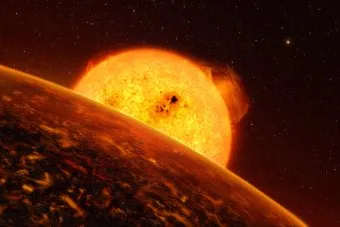
- WASP-17b. Illustration: ESA/C. Carreau
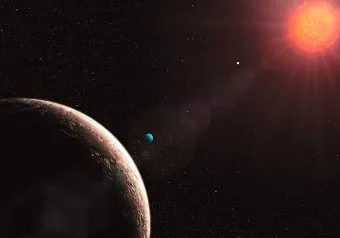
- Gliese 581. Credit: ESO.
- The classical constellations based on "The Phaenomena" by Aratus according to Johann Buhle (18th century)