Reflections on the "wisdom of the crowds" in relation to the pseudoscientific and the media.

Warning: This is a long post. But you can print it or convert it to PDF to read it at your leisure. Scroll to the bottom of the page and press the "Print" button and you will have the options there to save (with or without images) and print.
1-Distributed collaboration
I read in Página/12 an article by Dr. Adrián Paenza titled "The Weight of a Bull".
What Paenza does, in that article and in general, is tell stories. That stories are told in journalism is not new, although in part such a habit is associated with the so-called "New Journalism". Note that in such a "genre" information is provided, but fundamentally what is sought is to move through emotions.
And although it is tempting to do so and may seem intellectual, inspiring, exciting, human, elegant, literary, some care must be taken with the use of these rhetorical resources.
First of all, I make one idea clear: every discourse contains rhetoric. Scientific discourse is not exempt. The "hardest" science journalism isn't either. This post, even less.
In the article, the Argentine mathematician, journalist, and science communicator tells us about an experience conducted at TED. I invite you to read the article, but I summarize what is told there with details: a bull (actually an ox) is brought onto a stage in front of an audience. The idea is for the audience to "guess" the animal's weight and send it via text message. The result, which collected 500 responses, indicated that the average of them was very similar to the real weight of the ox. The average of the responses was 813.5 kg and the real weight was 815 kg. (Actually the weight was given in pounds).
And after the story, Paenza points out: "What does this teach? There are many examples about the wisdom of the crowd or popular wisdom. In fact, many people take advantage of what happens on social networks to know which topics interest people and incorporate them into their agenda".
Towards the end he quotes Ben Lillie, TED editor and blogger: "Great minds think alike. Creative minds think together". And Paenza concludes: "Isn't that what it's about? Isn't it about improving ourselves as a society by contributing together for the common good? Now, in the plural: you, what do you think?"
James Surowiecki is the author of the book; "The Wisdom of Crowds: Why the Many Are Smarter Than the Few and How Collective Wisdom Shapes Business, Economies, Societies and Nations" (2004). You can see a talk by him at TED.
Towards the end of that talk, Surowiecki points out what he considers to be "the dark side" of the internet: "One of the fundamental characteristics of a network is that once you are linked into a network, the network begins to shape your views and begins to shape your interactions with others".
In the related links I indicate at least two sources in which other ideas of Surowiecki linked to the following question are pointed out: Is it possible to be too connected?
And I immediately connect such a question with the dichotomy of ideas of Huxley and Orwell established by Neil Postman in his book "Amusing Ourselves to Death".
I found an excellent infographic translated into Spanish that is illustrative, but the basic ideas are as follows:
For George Orwell (author of "1984") the problem was censorship, that they would forbid us to read.
For Aldous Huxley (author of "Brave New World") the problem is that there would be no reason to forbid reading because there would be no people who wanted to read. (Which does not mean he agrees with censorship).
Orwell feared the concealment of information, while Huxley feared that too much information would reach us.
Appeal to the emotional:
The group The Police had a big hit titled "Too Much Information":
"Too much information running through my brain/
too much information driving me insane"/
As in Poe's story The Purloined Letter, sometimes the obvious is invisible.
2-Wisdom of crowds and formation of ideas
I want to say two apparently contradictory things. I hope the interested reader will follow me.
2A) Words (not to say texts, discourses) do not have ONE meaning. They are not repositories of meaning, they do not "contain" anything in themselves. The word alone "says" nothing.
I say /red/.
Juan is a fan of Independiente. When we ask him what the word /red/ means to him, he will tell me something different than what Marcelo, who is a fan of Racing, will say. Verónica cut herself while cutting potatoes and bled. If we ask her (if we could read her mind) her "sense" of /red/ will be different.
For some, /red/ is a "symbol" of heat. For others, of cold.
The "sense" that Juan forms will change according to the circumstance (that is, the space-time configuration).
The sense of /red/ is not in the word (image, sound, etc.), but is formed in each one of us. How, why?
Well, if /red/ for Juan is, among other things, /Independiente/, after watching a match of that team, it is because the sense that is formed is in relation to something he did, to something he saw, that he read, that he heard. That is, it is in relation to other discourses.
This is how we form sense: through the relationship that each one of us establishes (connotatively) with the discourses THAT REACH US. It could be said, with some twists, that the discourses THAT DO NOT REACH US also have their influence. Absences communicate as much as presences, if you'll allow me a vulgar expression.
But if what I say is true, then, how do we communicate?
Because what I said before is basically that the sense each of us forms is different, unique and unrepeatable, like fingerprints.
If for each of the readers the sense is different, then how do I "transmit an idea"?
Ideas are born and die in our brain. The world is not like in Harry Potter.
We cannot send each other ideas, but messages. But we cannot avoid exchanging messages. We do it even without intention.
2B-But when we analyze mass discourses, we do not find the same thing. It is like what happens with color palettes. For example, observe this combined image:
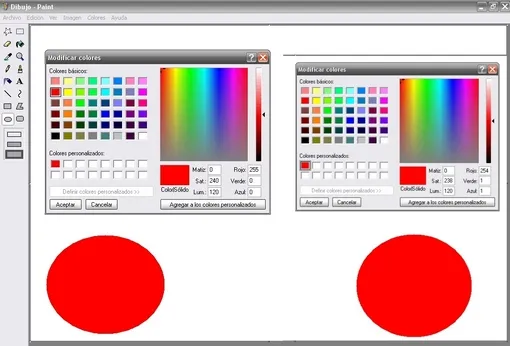
What we see is the use of Paint to draw two red circles. For the first case I use a red with RGB encoding, that is, a combination of red, green and blue, which in that case is 255,0,0. In the second case, I do the same but choose a red 254,1,1. They are two different reds, that is clear. And yet, we don't notice any difference.
In public (or published) discourse the same thing happens. There seem to be different ideas. Logically, due to what was stated in point a, each person forms different meanings about reality. But since that happens in relation to the different discourses that reach each one, and since the discourses that "circulate" the most are very similar, then, the differences in public discourse are minimal. Some call that "single or hegemonic discourse".
3-Emotion as a mobilizing argument
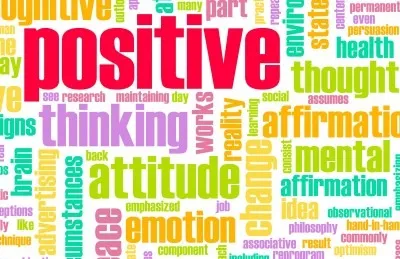
I want to focus here on a characteristic of the discourse that reaches the most: that of the mass media. It is not a single discourse, true, there are differences, and at the same time, those differences are superficial. Not always, not in all cases, but it is possible, I dare here, to say that those discourses have some characteristics in common. One in particular on which I want to dwell after all this detour: the emotional resource.
We have known since Aristotle (in the West at least) that arguments contain logic, but also emotion. Roberto Marafioti, an Argentine semiotician, wrote in Página/12 about this in relation to the presidential discourse that was objected to for being emotional. And he said: "it is necessary to take into account that this component is irrefutable and the only thing that can be accounted for is its existence, but not as a manipulative mechanism, but as an ingredient of social discourses".
The same Marafioti in his book Los patrones de la argumentación establishes, however, a distinction between persuading and convincing.
"The persuasive proposal appeals to a range of psychological mechanisms without any mediation of reason. Persuasions have to do with emotions. Persuasion, if it includes action, does so without the protagonistic mediation of reason. Whereas the attempt to convince, although it may have as its goal the action of the other, is mediated by the critical review of the matter. The attempt to convince is mediated by reason".
In a previous paragraph of the same work, he indicates "It can also be affirmed that conviction implies an active, rational and reflective process, on the part of the patient participant, while persuasion implies a passive, irrational and unreflective process, on the part of the patient participant".
4-Emotion as justification for unreason
The discourse of a few "charlatans" who have an unusual space in the mass media responds to persuasion and not to conviction. They try to mobilize the masses through arguments that appeal almost exclusively to the emotional, even masking arguments as apparently rational, which ultimately are fallacies.
Do such discourses only belong to a small group of sensationalist, yellow journalism media? It is possible to assume such a thing, but if we analyze other discourses, apparently more solid, we find again the same mechanics.
Of course, I myself have fallen into such use. Examples can be found in this blog. Paenza's discourse is another. It appeals to the emotional aspect of the community, ignoring that the so-called "wisdom of the masses" must be critically reviewed, since it is not enough just with the opinion of apparent majorities. For what was said before, public discourses are different, but not that much and that is so for some reason. We do not form ideas out of nothing. We do not form discourses out of nothing. Therein lies the power of communication.
I am not saying that every discourse that appeals to the emotional will inevitably be pseudoscientific or irrational. Human beings are irrational. Even more than rational, evolutionarily speaking. Emotion is part of each one of us and we cannot (nor do we want to) get rid of the sensitive. We would cease to be what we are.
But to what extent are those emotional resources the only argument to support an idea?
This question deserves to be thought about in relation to public discourses. And for that it is good to look for an example. In what I have been thinking, searching for information, reading different types of analysis, is about a custom of the print media, in newspapers in particular: the publication of the horoscope.
5-The horoscope is a sign
There is much to say about the horoscope. But precisely that there is much to say puts us face to face with some basic questions, also linked to the Orwell-Huxley dichotomy. We cannot ask for the publication of horoscopes to be banned, but to what extent is their publication valid? Can it be justified with rational, logical arguments or is it only justified through emotional arguments?
It seems like a silly, insignificant topic. It seems so because it has become naturalized. The horoscope is a metaphor, they say out there. Of course, what discourse isn't. But, such a metaphor seems to justify everything. It is neither real nor not real, it is a metaphor, a "joke", an entertainment. It seems to be part of a genre of "neither fiction nor non-fiction", which for Eliseo Verón is a "game show", as he has written about Expedición Robinson.
One might ask, however, if such a genre is consumed more as fiction than as non-fiction. And Verón says, in the article linked above: "If Expedición Robinson had been assimilated to a fiction, it would never have had good ratings. (...) As fiction: zero."
In the horoscope published by newspapers there are elements that indicate its belonging to fiction. Its "place" in the layout (that's why I take the horoscope of printed newspapers as an object of study and not others) which includes a content classification, as well as other discourses generated because of the horoscope, among them journalistic articles that "defend" such a custom by virtue of it being an entertainment.
They tell us about the horoscope that we "need" it so as not to feel tied to schematic reality, to oppose the rational structures of science that suffocate us.
You cannot question the horoscope with astronomical arguments, because the horoscope is something else, another metaphor related to other non-astronomical conventions. Nor from a statistical standpoint (there are many examples) precisely because the horoscope does not indicate how reality is, but rather it is...a metaphor.
The horoscope is harmless, it is indicated. It is a pastime that connects us with others, identifies us. It is also a kind of riddle (like transgender) that invites us to decode an encrypted message (like the I-Ching). The horoscope, some exclaim, makes us feel free.
Of course, I hold exactly the opposite view. The freedom of publishing the horoscope, which NO ONE QUESTIONS, ties us down, restricts us to the most basic aspects of human beings. It is there, certainly. And it is there because...it is a metaphor.
But, is it?
Can the reader say what sign they are? And can they say what it "means" to be of such a sign and why?, or to ask it another way: Why is a person born on September 10 a Virgo?
When the reader encounters a horoscope in the newspaper, do they understand what it means for them or for them and others?
When I encounter a crossword puzzle for the first time, do I know what I must do?
How do we make sense of the horoscope? What meaning do we give it? Does it have anything to do with the astrological? And with the astronomical?
For me (and this is something that will need to be investigated) most people (the newspaper reaches a multitude of heterogeneous people) do not have specific knowledge, not even interest, in either astronomy or astrology. And if there is no interest, what knowledge is there about it? Probably little, which generates doubt. And doubt allows everything if at the same time a message makes us feel better, happier. It is the new hedonism.
Let's review the discourses of the mass media and we will see this type of construction everywhere. Whether we cover our right eye or cover our left eye, this type of idea bathes everything. Establishing a relationship between these ideas and capitalism is too much for this post and would exceed my initial intention. The goal of this post is, first, to plant a flag. The second, to plant seeds.
If a part of public discourse has changed in recent decades (gender, ethnic, health issues, etc.) it is because a counter-discourse has opposed the inertia of the dominant discourse. That alone is not enough, but without a counter-discourse no change is possible. Such changes take time. They are established customs so deeply rooted that it would be naive and disproportionate to have many expectations of immediate change.
I keep wondering what ideas specialized science journalists have about this, particularly those who work in mass media.
The "manufacture" of the horoscope
The word manufacture comes from Latin and the original meaning was "made by hand".
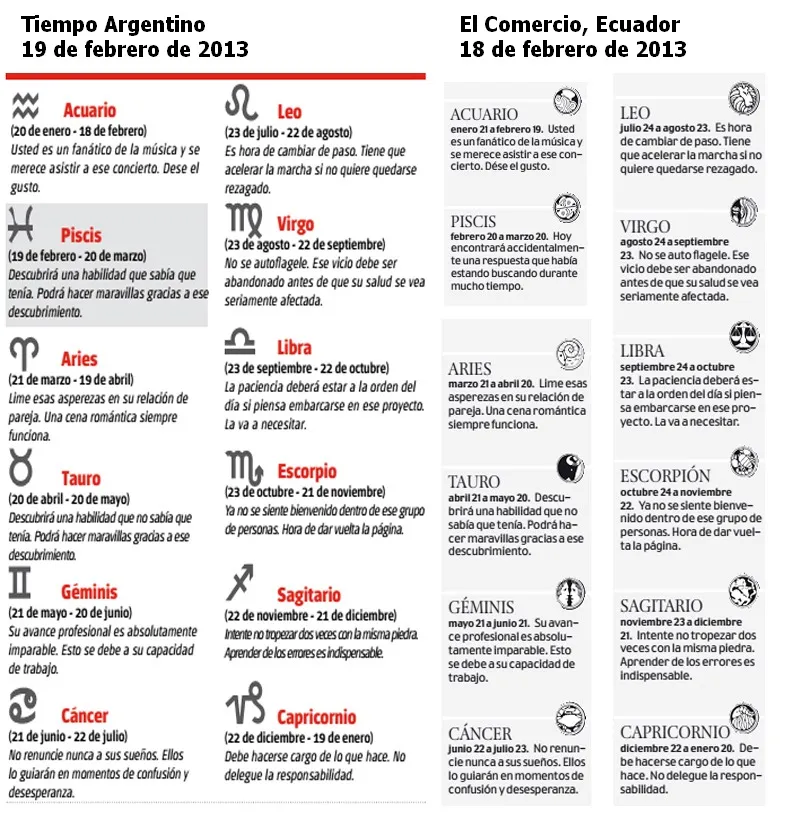
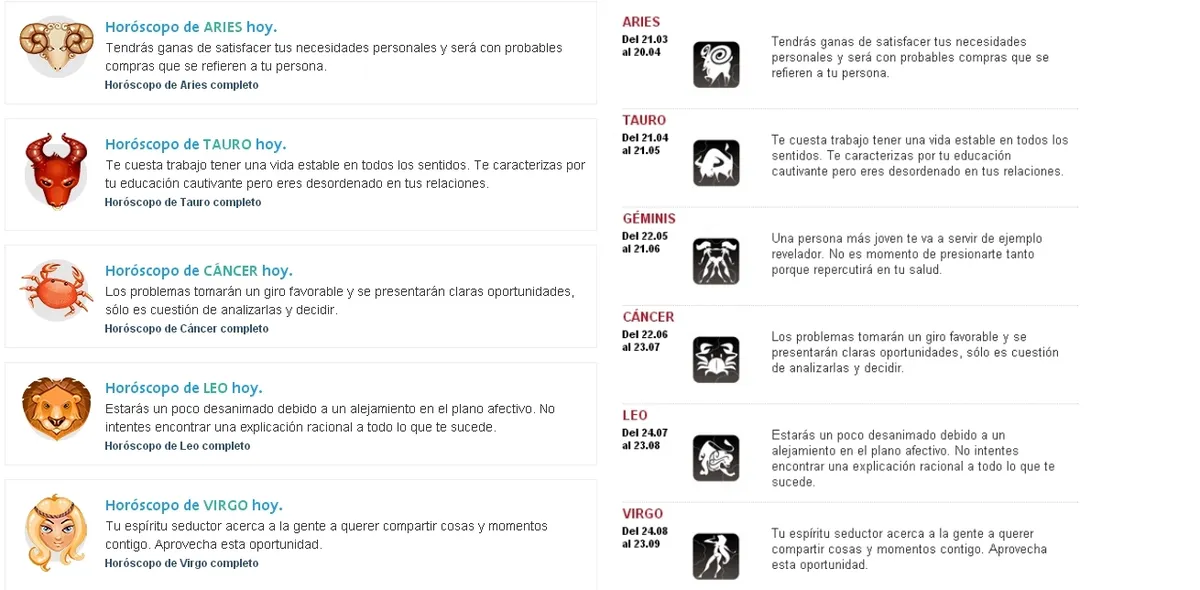
Something I encountered in my study of the horoscope is that the same text (I refer to the language) is repeated in different horoscopes published by different newspapers from various provinces of our country. Fig. 3 illustrates that coincidence on the websites of Clarín and La Nación. Could it be the same author? It's possible.
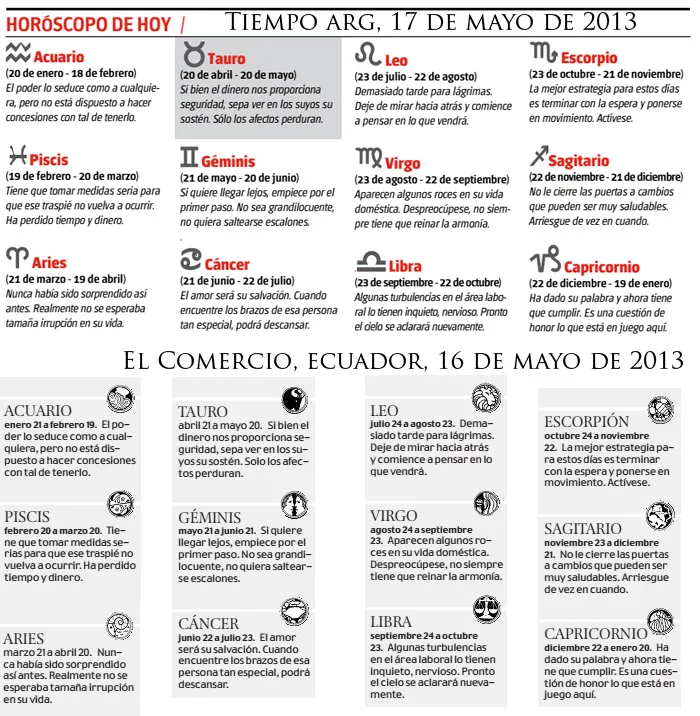
But the strangest thing is that the same text is published, for the same supposed sign, in different newspapers, but on different days. This is the case reflected in Fig. 1 and 2 with the horoscopes published by the newspapers Tiempo Argentino and El Comercio of Ecuador. The latter publishes a horoscope one day and, the next day, the same text is published in the Argentine newspaper. It is anonymous in both cases. There are, however, some differences, for example in the date range for each sign, as well as differences in layout, but the text is identical, although for different days.
What I am showing is NOT an argument, although it is possible that for part of the public this "disappoints" and is more mobilizing than all the solid arguments that can be pointed out.
Although this repetition-copying of texts for the same signs but on different days is not the core of the issue, it is worth asking: how are horoscopes constructed and what expectation does the public have about it? Does it matter or does it not matter at all?
Perhaps we must resort to the wisdom of the masses to determine it. Although public opinion IS important, is it enough?
Perhaps it is appropriate to ask the population to vote on whether they prefer the Moon to have craters or not. Ultimately, it seems that reality is what the majority perceives through the senses. If the public decided that our natural satellite should have no craters, we could say it is a perfect object, because it is in Heaven, where reason does not reign but spirit does. That and a little Prozac and we can live in A Brave New World.
Sources and related links
- TED: James Surowiecki at the moment of change for social media
- Thought and Passion, by Roberto Marafioti, in Página/12, 11/09/2011.
- The Patterns of Argumentation, Roberto Marafioti, Editorial Biblos, Buenos Aires, 2005, pp 18-21.
- Human-based computation: Wisdom of Web2.0?
- MIT TR: Is It Possible to Be Too Connected?
- Neither Reality, Nor Fiction, by Eliseo Verón in Clarín, 01/05/2001.
- Qmunty.com: Amusing Ourselves to Death or Huxley Was Right
About the images
- Torero photo from Wikimedia.
- Words image. I took it from the Category Management blog, which develops ideas about the emotional link in the act of purchase.