A collection of links to music, images and videos relating art and science. Today: Images of NGC 604; NGC 660. Music: "Before your very eyes", by Atoms for peace. Video: Under the Same Sky - GalileoMobile Documentary.

Images of the decade
A star factory in a nearby galaxy
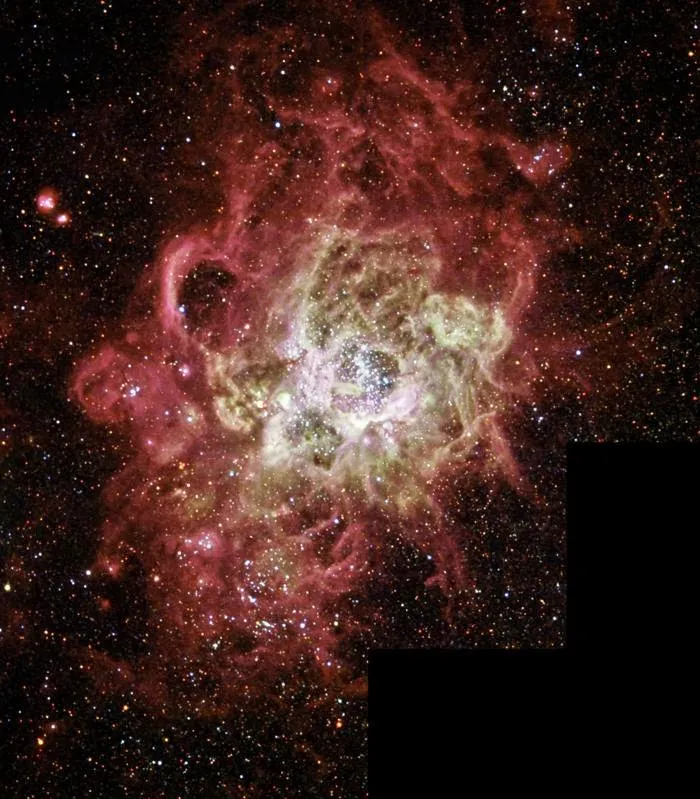
The image shows us NGC 604, one of the largest star "factories" in a neighboring galaxy. This nebula is similar to others in the Milky Way, like the Orion Nebula, but it is about 100 times larger in size, as NGC 604 is 1300 light-years in diameter.
Located in an arm of the neighboring spiral M33, this nebula lies 2.7 million light-years away. M33 is one of the galaxies that make up the so-called "Local Group" which includes the Milky Way and Andromeda.
In this "factory" the stars do what they want, but the "boss" is a "matron": gravity.
Stars are not all the same: although they are all formed from the same elements, basically hydrogen, some are more massive than others.
However, there is a big difference with human factories: the product of those stellar factories is distributed more homogeneously, although ultimately what still prevails is gravity (which accumulates). But, in the history of stars, mass is not inherited nor accumulated indefinitely, perhaps because it is true that "everything that is established evaporates".
How is the product of human factories distributed? Answer: 99.3 vs 0.7.
Image credit: NASA and The Hubble Heritage Team (AURA/STScI)
Acknowledgement: D. Garnett (U. Arizona), J. Hester (ASU), and J. Westphal (Caltech)
The image was published on HubbleSite on December 4, 2003.
Images of the week
A cosmic rarity: NGC 660
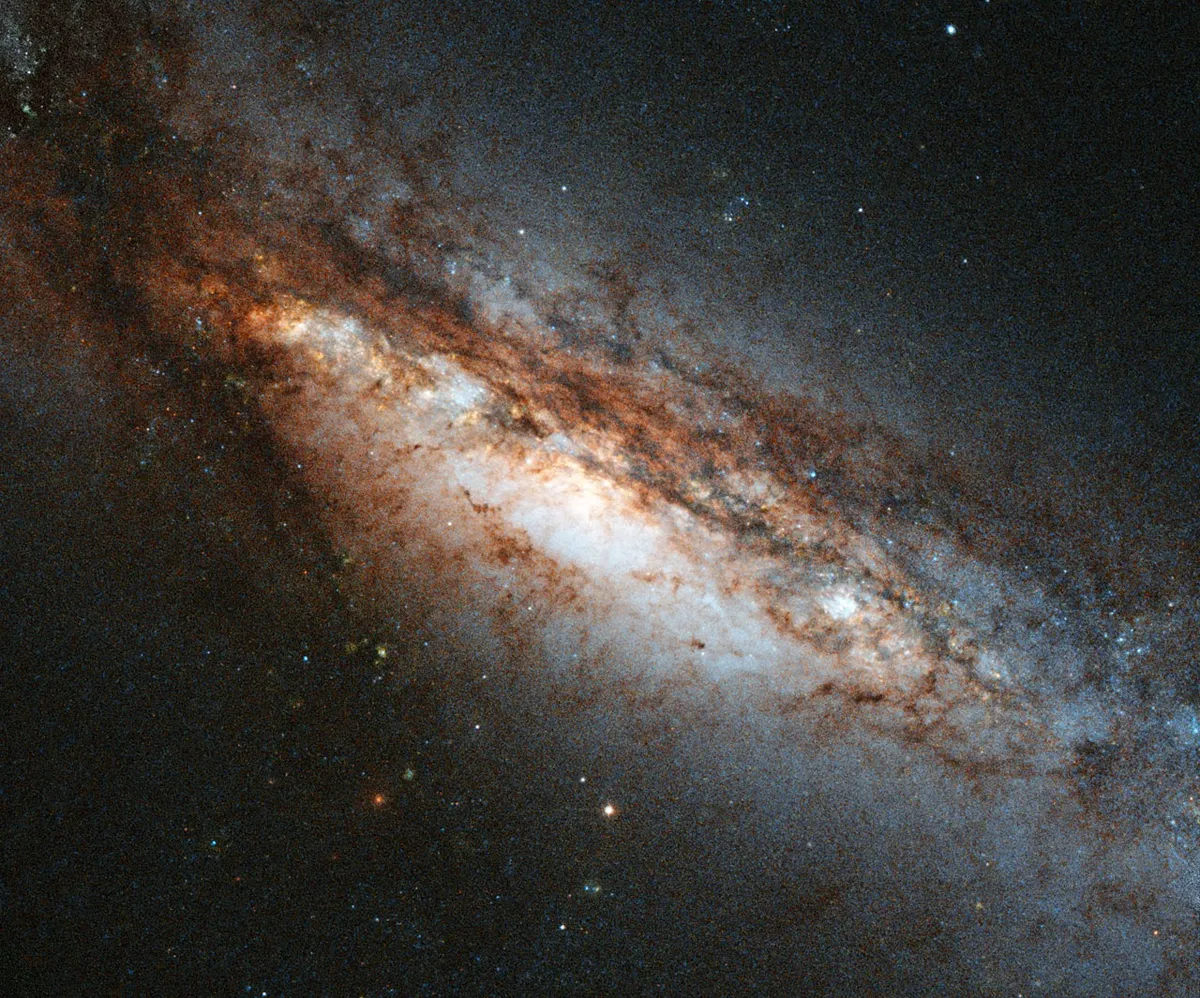
This image taken with Hubble shows us the peculiar galaxy known as NGC 660, located about 45 million light-years away.
It is classified as a "polar ring galaxy" because it has a belt of gas and stars around its center, probably the product of an interaction with another galaxy.
Galaxies of this type were identified in S0s or lenticular galaxies. The Argentine astronomer José Luis Sérsic identified the lenticular galaxy NGC 4650A in 1967. The first elliptical galaxy of this type was observed in 1978 and since then only a dozen have been discovered.
Why are these galaxies "rare"? We could say that those objects that are infrequent are called that. However, it is worth asking whether they "are" infrequent or what happens is that we have not detected most of them. Extrasolar planets were considered infrequent objects because few had been detected. But that does not mean there are few.
"Rarities" are human perspectives. Not long ago, Mandela was seen as a "weirdo". The same people who in the recent past condemned him as a "terrorist", yesterday paid tribute to him.
If stars could think, the "weird ones" would be us, not only because we are infrequent, but because we differentiate ourselves.
Credit: ESA/Hubble & NASA.
It was the Image of the week from SpaceTelescope.
Space Music
Atoms for peace: Before your very eyes
Today, instead of sharing only music in this space, I recommend watching and listening to this video clip made by Andrew Thomas Huang for the rock band called "Atoms for peace". It is an audiovisual created for the song "Before your very eyes" which is part of the album Amok (2013).
What does this music video have to do with astronomy, science and everything else? Although the answer could be "42", it is actually another.
The name of the band and the song have some relations with science. The group is called "Atoms for peace" and I believe that science (implied in the first word) should be a science for peace and not for war, commerce, economic accumulation.
The song's title has some relation to astronomy: "Before your very eyes". The objects of the solar system and some from deep space are within everyone's reach, gathered under the same sky, before our eyes. And they pass by there unnoticed, like the years of our life.
The song has been given several meanings and the audiovisual work adds others through the talented director and his team. In the video, buildings are created from a kind of magma or soup and then return to it. What is created, is destroyed.
Some think the song is a call to action. Surely, but also to awareness, to think about how our life is and the reality that surrounds us. The sciences (both natural and exact as well as social) bring us similar questions.
Atoms for Peace - "Before Your Very Eyes" from Andrew Thomas Huang on Vimeo.
Animated Science
Under the Same Sky - GalileoMobile Documentary
"Under the same sky" tells the story of the journey carried out in 2009 by the GalileoMobile project. For two months and traveling by road approximately seven thousand kilometers, GalileoMobile visited schools and communities in Chile, Bolivia and Peru to carry out scientific activities and organize astronomical observations.
Through the prism of the children who crossed paths with GalileoMobile's trail and using astronomy as a common thread, an encounter between different visions and interpretations of the sky is narrated, showing the impact of the activities carried out in the visited communities, as well as the exploration of the human cultural richness projected in the astronomical tradition of the peoples of the Andean Altiplano.
Bajo un Mismo Cielo (Under the Same Sky) - GalileoMobile documentary from galileomobile on Vimeo.
To access previous editions of this section, consult the Multimedia Selection Series. The series attempts to show that the immensity of the universe can be perceived in different ways. I choose some images from a decade ago -so they don't fall into oblivion- and from the current week that ends, as well as sounds/music and videos that are artistic forms of expression with content related to astronomy and related sciences. I am also collecting these materials in the Pinterest account