A collection of links to music, images and videos relating art and science. Today: Images from Venera 13 on Venus; NGC 2035. Music: Saravan, A Comet's Tale. Video: The comet and the records.

Images of the decade
Descending on Venus
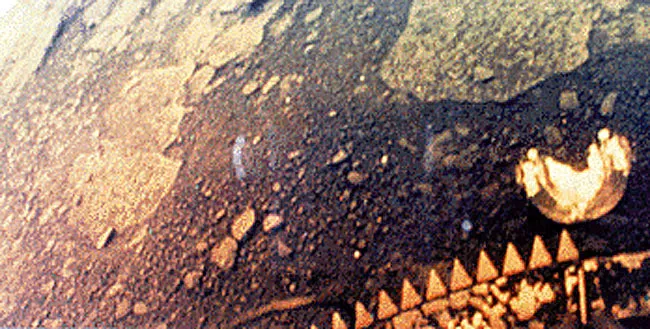
This image is the first panoramic color view of Venus.
A TV camera on the Soviet probe Venera 13 transmitted it on March 1, 1982, after the craft was parachuted to the planet's surface.
The clouds of Venus are composed of sulfuric acid, its surface temperature is 482 degrees Celsius, with an atmospheric pressure that is 92 times that of Earth, at sea level.
Despite these conditions, the Venera 13 probe survived long enough to send a series of images and carry out an analysis of the Venusian soil.
A part of the probe is seen in the lower right corner of the photo.
A previous Soviet probe sent to Venus, Venera 7 (1970), was the first spacecraft to send data from the surface of another planet.
Credit: Soviet Planetary Exploration Program, NSSDC.
It was the Astronomy Picture of the Day (APOD) for November 30, 2003.
In Spanish at Observatorio.
Images of the week
NGC 2035
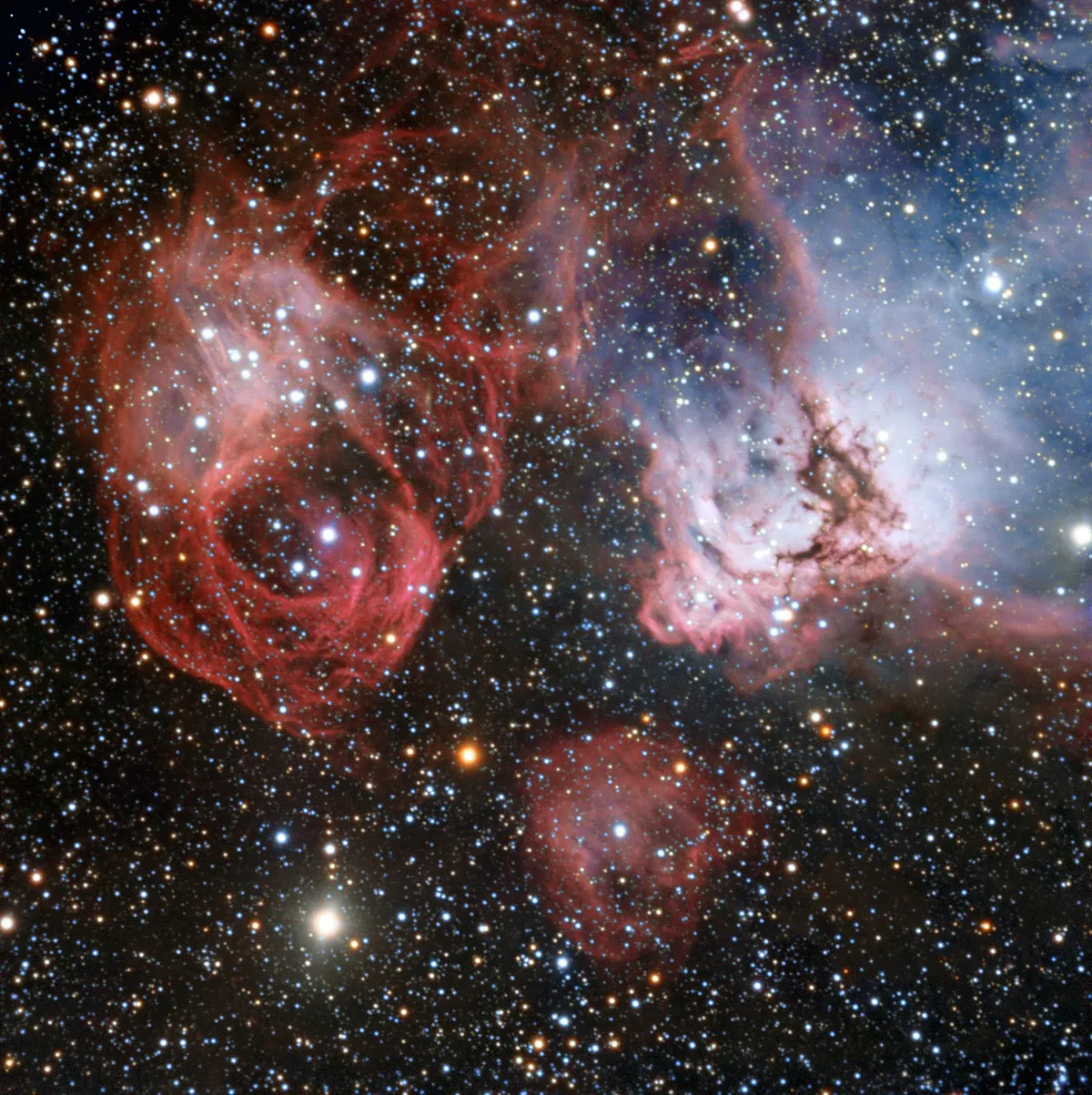
The Large Magellanic Cloud is one of the galaxies closest to our own. Exploiting the capabilities of ESO's VLT (Very Large Telescope), astronomers have explored one of its least known regions. In this new image we can see clouds of gas and dust where new hot stars are being born, sculpting their surroundings with strange shapes. But the image also shows the effects of stellar death — filaments created by a supernova explosion.
Located only about 160,000 light-years away from us in the constellation of Dorado (The Swordfish), the Large Magellanic Cloud is one of our closest galactic neighbors. It is actively forming new stars in regions so bright that some can even be seen from Earth with the naked eye, like the Tarantula Nebula. This new image, obtained with ESO's VLT (Very Large Telescope) at the Paranal Observatory (Chile), explores an area called NGC 2035 (on the right), sometimes nicknamed the Dragon's Head Nebula.
More at ESO.
Space Music
Savaran: A Comet's Tale
Saravan is Mark Walters, from Wales. He is a musician and archaeologist. In July of this year he released the work A comet's tale, based on his interest in astronomy and comets. In its fourth track appears the term "sungrazer" which is used to indicate comets that "graze the Sun", passing very close to the star. Both on the BandCamp page and on the Subterranean Tide label site, the artist makes reference to C/2012_S1 (ISON).
The album title can be translated as "Story of a Comet", but the word "tale" besides the meaning as "story" can be understood as "tale, legend".
Animated Science
The comet and the records
The now ultra-famous comet was not visible during its closest approach to the Sun, so many thought it had disintegrated, but images like these from ESA/NASA's Solar and Heliospheric Observatory suggest a small nucleus might be intact.
The comet has been the subject of multiple comments for its surprising "behavior", increasing and decreasing its brightness in an unexpected way.
And just as this relic of the solar system was presented, somewhat unjustifiably, as "the comet of the century", it was also buried in its fatal solar destiny upon its apparent disappearance.
Which goes to show that we are somewhat success-oriented. It's good to be prepared, to know in advance the passages of comets by the Sun. But it's best not to be alarmists.
Jean Marie Brohm in "Sociologie politique du sport" indicates that the record is the fetish of sport, it is the ideological symbol of a capitalist or state bureaucratic society, oriented towards performance and productivity.
And sometimes in astronomy we fall into something similar: the brightest supernova, the most distant galaxy...
Note: Look down to the left of the viewer to see if a particular planet is noticeable.
Image credit: NASA, ESA, SOHO - Video Editing: Babak Tafreshi (TWAN).
Comet ISON Dives Toward the Sun from Babak Tafreshi on Vimeo.
More at NASA
To access previous editions of this section, consult the Multimedia Selection Series. The series attempts to show that the immensity of the universe can be perceived in different ways. I choose some images from a decade ago -so they don't fall into oblivion- and from the current week that ends, as well as sounds/music and videos that are artistic forms of expression with content related to astronomy and related sciences. I am also collecting these materials on the Pinterest account