A collection of links to music, images and videos relating art and science. Today: Images of HCG22; NGC 1190. Music: Science, by Utopia Now. Video: Scientists for a Day at UBA.

Images of the decade
Arp 81: Force makes the union
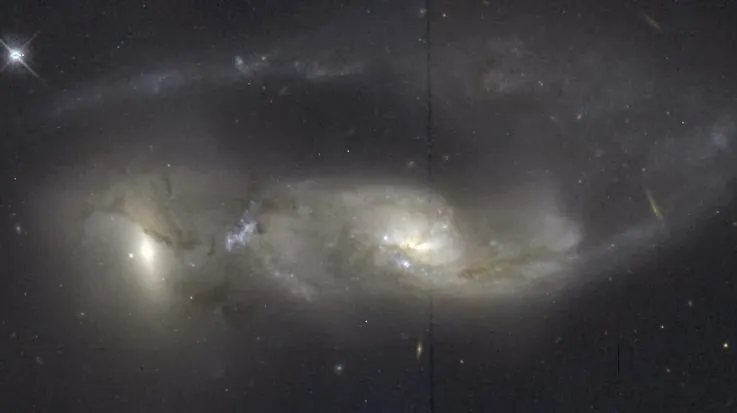
From planet Earth, we see this pair of strongly interacting galaxies, cataloged as Arp 81. Astronomers consider that their closest approach occurred about 100 million years ago.
The havoc caused by gravity during their encounter is detailed in this mosaic taken with the Hubble Space Telescope, showing twisted waves of gas and dust, a chaos of massive star formation, and a final tidal tail stretching 200 thousand light-years.
Also known as NGC 6622 (on the left) and NGC 6621, the galaxies are approximately equal in size, but are destined to merge into a single larger galaxy in the distant future, after repeated approaches until they finally merge into one.
Located in the constellation Draco, the galaxies are 280 million light-years away.
Credit: W. Keel (Univ. Alabama), K. Borne (George Mason Univ.), NASA
It was the Astronomy Picture of the Day (APOD) on December 11, 2003.
In Spanish at Observatorio.
Images of the week
Union makes the force
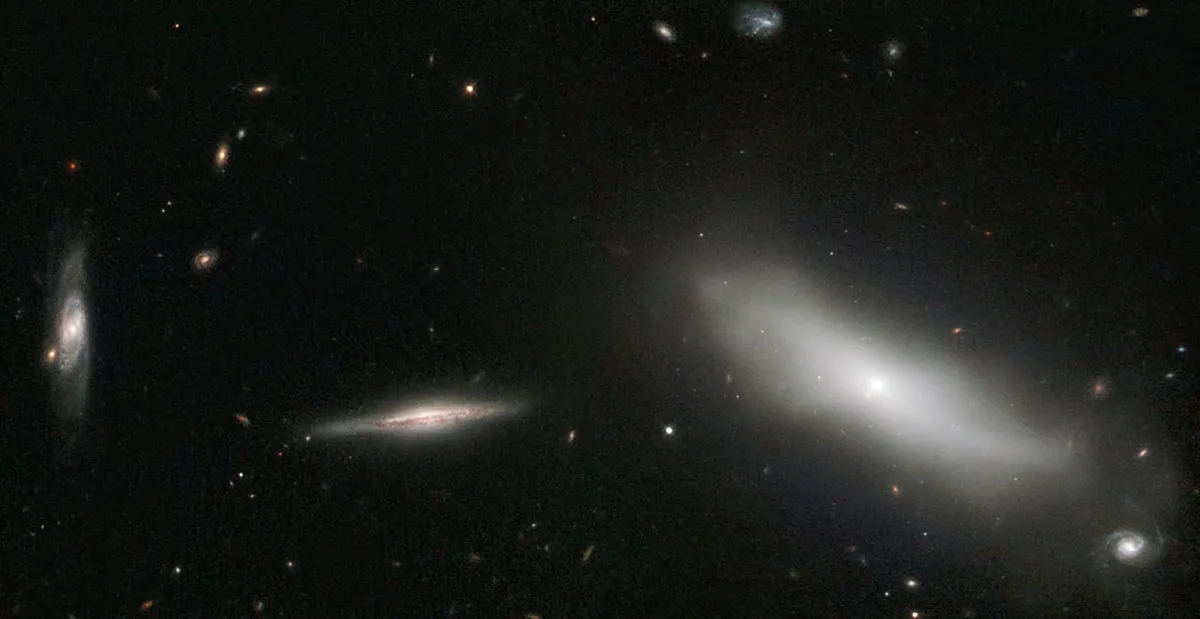
This image taken with Hubble places us in the constellation Eridanus (The River). NGC 1190 (shown here on the right of the image) stands out from the rest: it belongs to an "exclusive club" known as Hickson Compact Group 22 (HCG 22).
The group comprises four other members (NGC 1189, NGC 1191, NGC 1192, and NGC 1199) which are not seen in the image. The other galaxies in the shot are nearby but are not part of the group.
HCGs are very compact groups of galaxies. They were discovered by Paul Hickson in the 1980s. For galaxies to be cataloged in this way there must be at least four members in the group. Astronomers have concluded that these galaxies, over time, merge to form a large giant elliptical.
The members of these groups interact, orbit each other, and strip material from each other until they finally merge, marking the "death" of the group and the "birth" of a single large galaxy.
Will something similar happen with human beings? Do we have this destructive tendency? Perhaps the reader thinks so, by virtue of wars, for example.
But it is possible to say exactly the opposite. The tendency (especially in the last century and a half) has been to differentiate ourselves and not to unite, which is ultimately what happens with galaxies. That union "destroys" something: differentiation. Among people the opposite occurs: we differentiate ourselves, which is destructive.
Credit: ESA/Hubble & NASA /Acknowledgement: Luca Limatola.
It was the Image of the Week from SpaceTelescope.
Space Music
Science, by Utopia Now
Utopia Now emerged from the Berlin-based punk band called Indigo in 2002 until 2006 when singer Stephan Serowy went independent to form Utopia Now, whose musical life was ephemeral: a year later it disbanded, but Stephan continues the legacy as an individual and online project.
On the album To the Awoken we are told of an "awakening," linked to "realism."
On BandCamp you can read the lyrics of the songs in which Serowy denounces: "Look at those laboratory mice/ in the Festinger experiment that is our life/" (in The power of a desperate mind).
Here I share the track "Science" in which the author says (translation):
"Science,/ you trust it every day/ when you go from A to B,/ when you defy gravity,/ when you face an illness./
It is elegant and light,/ but sober and direct/ not comforting like the night/ where ignorance can hide.
Animated Science
Cx1D
Scientists for a Day (Cx1D) is a simulation game in which middle school students take on the role of scientists for a day, run by UBA.
What is it to be a scientist, a researcher? The mass media have stereotyped the scientist and their work.
However, "being a scientist" should first and foremost be about being aware of the potential of science, which includes the possibility of serving us to understand the world and giving us tools for action and for modifying reality; but it is also the possibility of using that knowledge against our interests.
There is no science without morality. Without morality, it is not science, it is an infamy.
Scientists for a Day. 2013 from EXACTAS UBA on Vimeo.
To access previous editions of this section, consult the Multimedia Selection Series. The series attempts to show that the immensity of the universe can be perceived in different ways. I choose some images from a decade ago -so they are not forgotten- and from the current week that ends, as well as sounds/music and videos that are artistic forms of expression with content related to astronomy and related sciences. I am also collecting these materials on the Pinterest account