Producer and director Chris Riley together with graphic designer Antony Buonomo began an audiovisual series about the human arrival on the Moon. They have already made the first episode and started a collective funding campaign to obtain funds for the rest.
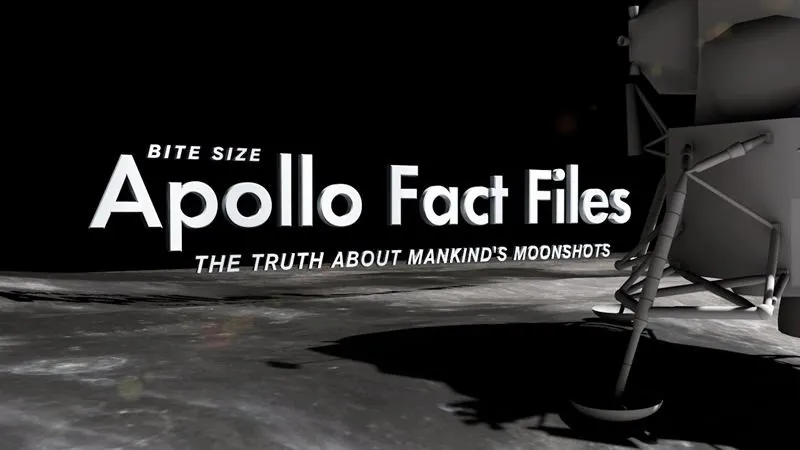
Prof. Chris Riley -winner of Sundance for In the Shadow of the Moon- joined designer Antony Buonomo to create a series of animated shorts to dispel doubts about the Apollo Program that arose from the already famous lunar conspiracy theory.
It will be 45 years since the first manned flight that escaped Earth's gravity and orbited our natural satellite, on December 21, 1968 (Apollo 8).
As they indicate on the Kickstarter site, where they started a fundraising campaign to continue the series, recent surveys indicate that more than 25% of young people between 18 and 25 years old doubt that the astronauts of the Apollo missions ever visited the Moon.
That is why the series, titled "Apollo Fact Files" is designed to be easily understood and shared with the goal of spreading the facts of the missions through concrete data that refute the conspiracy theories.
The idea is to mix animation with film archives in three-minute-long chapters, each of which will be dedicated to a different topic of lunar conspiracy theories with simple scientific explanations to understand.
The first episode addresses the question Why does the flag flutter?. For now it is only in English, but it should be cited as a precedent that First Orbit, by the same creator, was a documentary translated into multiple languages collaboratively after its release.
Chapter 2 will be Where are all the stars?, the next one will be titled What about those strange shadows?. Episode 4 will ask How did the astronauts film themselves while leaving the Moon?. And the fifth will be about why radiation didn't kill the astronauts on their way to the Moon?
However the conspiracy theory topics are many more, so they hope -if successful in their collective fundraising- to continue the series later.
Chris Riley has made other audiovisual works related to science communication such as the documentary First Orbit, the series Moon Machines, as well as the recent BBC biographies of Richard Feynman and Neil Armstrong. He is also a professor at the University of Lincoln's School of Media.
Antony Buonomo is a graphic designer, winner of an Emmy in 2005 for a Discovery Channel documentary about the conspiracy to kill Hitler and made the opening titles for several productions, among them "The Fantastic Mr. Feynman" (2013).
The series is produced by The Attic Room, Riley's company based in London, which received production support from YouTube Creator Space UK.
The campaign on Kickstarter plans to raise £5000 to make the next four episodes. To have an idea of currency conversion, 1 British pound is equivalent to about $10 Argentine pesos (£1=AR$10) so contributing £25 implies a donation of AR$ 250, approximately. However on Kickstarter it is possible to contribute from £1. For higher donations there are some rewards, such as pins, the film in HD on a memory stick, poster, etc. However the value of the contribution is given, according to the creators, in "keeping the truth and restoring sanity". And they remind us that "400,000 brilliant and dedicated people were behind NASA's Apollo missions. They sent 24 people to explore the Moon from 1968 to 1972".
Information, interest, knowledge, lucidity
Since the explosion of the internet, information comes to us and not the other way around, unless we have a genuine interest. We let ourselves be bombarded by a tsunami of data that in many cases is insignificant and sometimes also false. That information generates a mundane, superficial interest in us, linked to morbid curiosity or passing curiosity. And because it is shocking, the information stays with us, although we do not verify it.
However that happens because we do not have a genuine interest in those topics. When we do have that level of interest, we are not so trusting, we look for more information (which becomes knowledge). And this happens to all of us, to a greater or lesser extent.
Someone can be very trusting about what they read in a forum about "the lunar conspiracy" and at the same time not be so trusting in other topics about which -because they have greater interest- they have greater knowledge.
And that can only be countered with the elaboration of counter-discourses that reach the public and are simple to understand, like the book "La conspiración lunar ¡vaya timo!" that I commented on in due time.
However there are those who assume that all this I say implies naively trusting NASA or science in general. But it is not so. We know that we did reach the Moon on several occasions and not because of that we overvalue NASA or the U.S. governments. And in the same way we recognize the enormous effort and work carried out by the USSR in the space race. And we understand the historical context on which, it must be said, it is possible and necessary to be critical.
It is no different from what is narrated in a recent article in Revista Ñ, based on a personal experience with medicine. It is about having lucid confidence, based on reliable data. And I don't think that for having that view one can say that the writer of that article is "scientistic" or "positivist" (in a negative sense). And in fact, the few audience comments on that note (compare with the number of comments recorded in notes of another caliber) seem to agree that it is necessary to distrust in order to find out or investigate, instead of staying with rumors.
Sources and related links
About the images
- Images from The Attic Room. Thanks to Rufus Stone for sending me the press release.