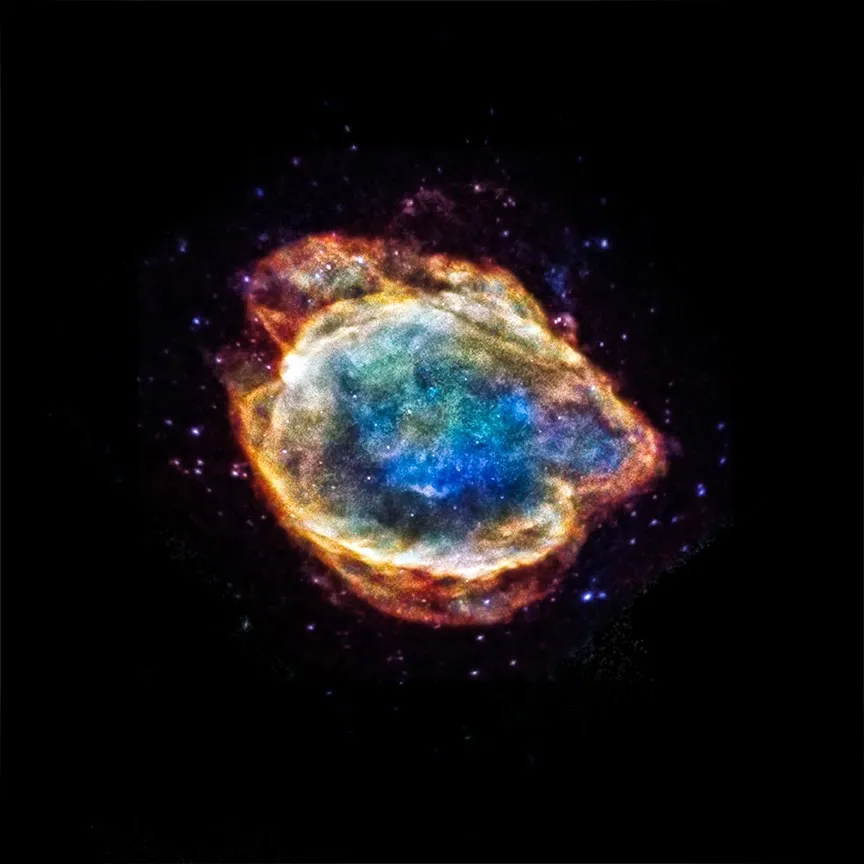
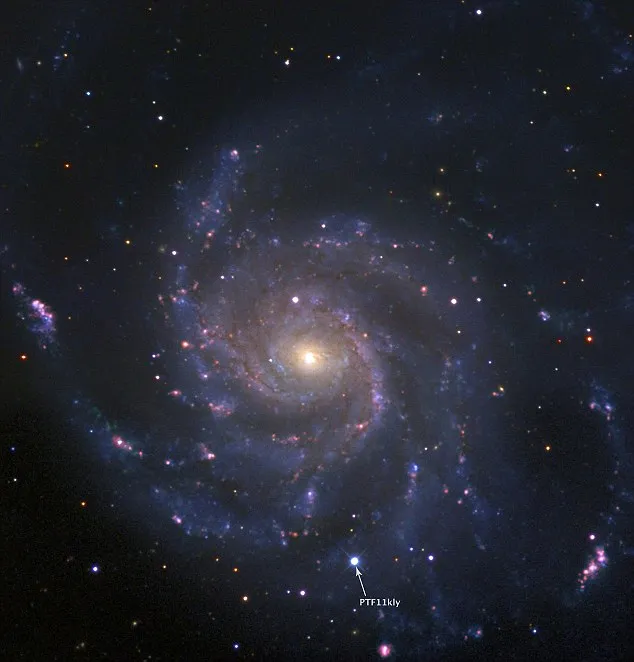
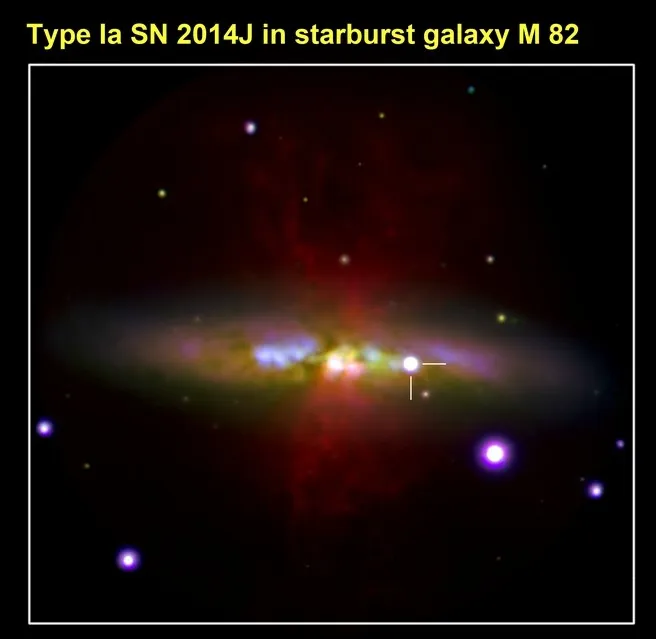
The instrument, operated and designed by national experts, is at Cerro Tololo and studies 300 galaxies each night. It has already detected its first supernova.
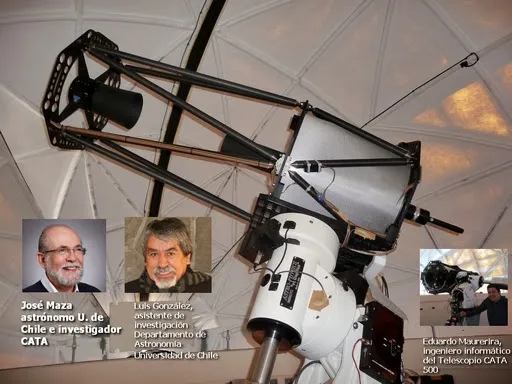
On December 7 of last year with the robotic telescope of the Astronomy Department (DAS) of the University of Chile, called "Cata500," a group of Chilean astronomers detected a supernova in the galaxy ESO 365-G16, located 370 million light-years from our planet.
The detected supernova is of type II, which indicates that this phenomenon corresponds to "a massive star of more than eight solar masses, where its core collapses and explodes when it can no longer generate more energy through fusion, gravity winning," explains Santiago González, a researcher at DAS and a team member.
For the scientists, this is an early or "young" supernova because it has been possible to see its brightness for no more than a week, although González clarifies that "in reality it exploded 370 million years ago, but its light is reaching us now."
The astronomers will continue observing this supernova hoping to learn its characteristics. "What interests us about this phenomenon is that it is early, because that's when you can get the most information. A supernova can last months and even years, which allows you to follow them photometrically or with images, in addition to spectra to know the chemical elements it is forming," he states.
The phenomenon was designated as SN 2013hf by CBAT (CBET 3752 / ATEL 5650).
The National Prize for Exact Sciences of Chile and academic at DAS, José Maza, points out that this finding is very relevant "because it corresponds to a new search with an instrument we have been preparing for years and that has proven to be working very well. Supernovae evolve very quickly and that's why the interest in detecting them as soon as possible. The main objective of Cata500 is to find them and follow them using different color filters of the traditional photometric bands to see how their light evolves."
The main advantage offered by "Cata500," located at Cerro Tololo (IV Region), is that it is a one hundred percent robotic telescope, which means it can be operated from Santiago through a computer or cell phone with Internet access. "If a night shift system were implemented, with astronomers and engineers, the costs of the supernova search project would rise to an unviable level. Furthermore, the actions performed by the telescope are overwhelmingly routine for a 21st-century person to have to perform manually, and exactly there is where robotics comes in to facilitate these tasks," indicates Eduardo Maureira, the engineer in charge of the project.
THE TELESCOPE
CATA is an acronym that means Center for Astrophysics and Related Technologies.
The Cata500 is a 50-centimeter telescope, installed at the Cerro Tololo International Observatory, Coquimbo Region. It is operated remotely, from Santiago, by Eduardo Maureira, the project's computer engineer, who can even control it through his cell phone.
"It is part of the international Gloria robotic telescope project, a community of free-use robotic telescopes, which will allow, for example, a person from the Northern Hemisphere to request to search for data from telescopes installed in the South," he says.
Cata500 can make some decisions autonomously, depending on weather conditions. If the wind is over 30 km/h or the humidity exceeds 80%, it cannot work until conditions change.
It was designed by Chilean researchers -although the instruments were purchased from international companies- and installed two years ago. Until now it has been operating in a test phase, says Maza, but from now on, the idea is for it to detect between 20 and 30 supernovae per year. It can also follow the transit of extrasolar planets or other variable objects. "Astronomy is moving in the direction of introducing more and more robotics and data processing, and that can serve as a training field for other areas," he says.
This instrument currently observes about 300 galaxies per night out of a total of 1,500 candidates in search of these magnificent stellar explosions. Then, the telescope sends the captured images along with previous images of the same field. "We look for the differences between both photographs. If we find a supernova candidate we send the information so they can confirm the finding," explains Luis González, research assistant and the one who detected this first supernova.
Cata500 is already operating, and by 2014 it should produce between 20 to 30 supernovae per year.
Robotic rhetoric
In the press release being circulated, as well as on the CATA site, the event is titled as "Chilean telescope captures its first supernova." As I have pointed out before in this space, I consider that type of wording unfortunate, although it is frequent and I have used it in the past. The thing is, grammatically the subject of the sentence is "The telescope" and it is that "subject" that "captures a supernova." In my view, it is incorrect. In reality, the instrument (which is an object and not a subject) takes CCD images and then, thanks to people's actions, the discovery is made. In this case, Luis González, research assistant at the U. de Chile, was the one who discovered that between one shot and another there was a difference in light. And he notified astronomer José Maza. It is the astronomers who realize that this change in brightness is not a defect or error but a supernova. At least for now...
Sources and related links
- CATA: Chilean telescope captures its first supernova
- La Tercera: Chilean telescope captures its first supernova
- AstronomíaCATA on YouTube
About the images
- Image credit: Depto. Astronomía Universidad de Chile/CATA.