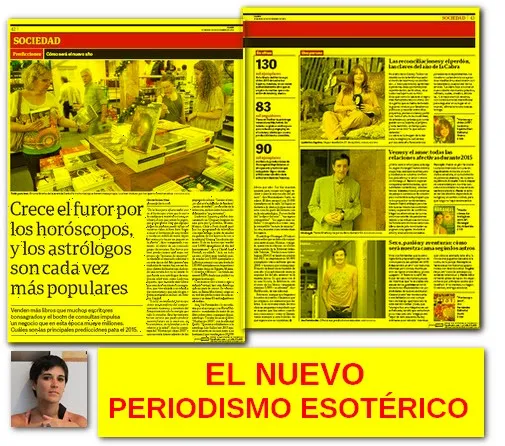
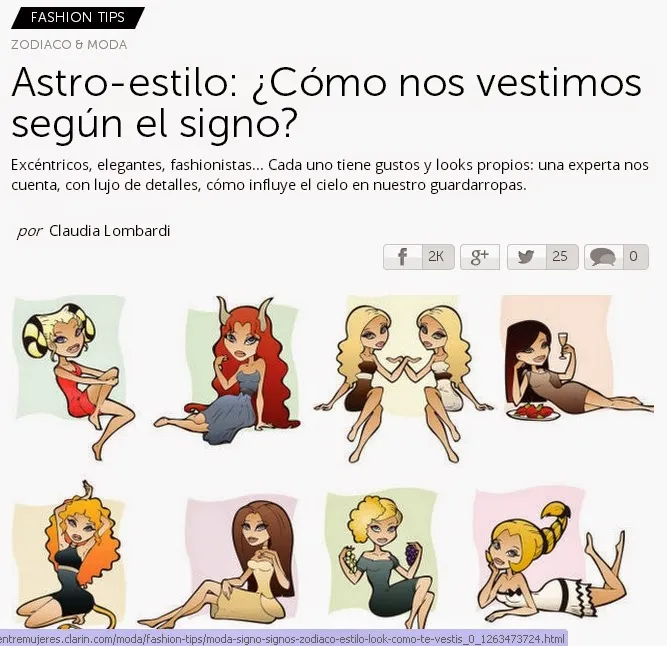
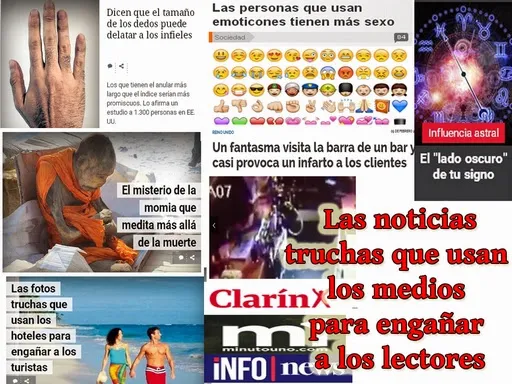
In today's print edition, La Nación gives a masterclass in how NOT to do good journalism.
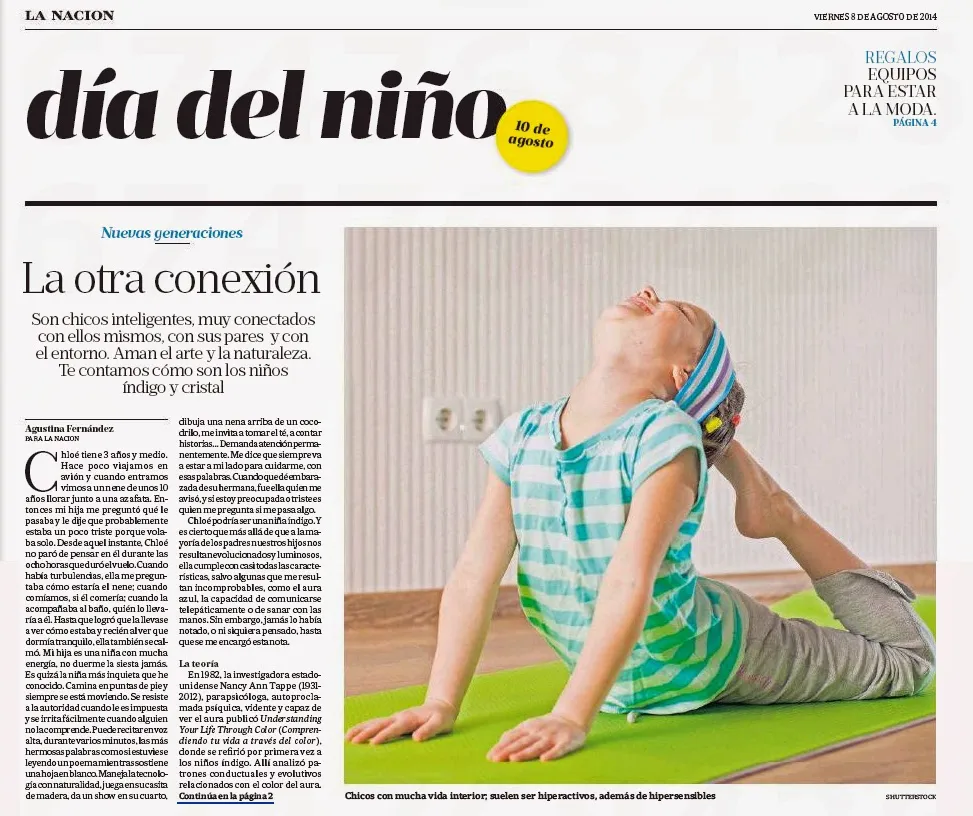
Children's Day is approaching and publications need to create space to print direct and covert advertisements. The relationship between journalism and the search for some truth is, at those times, as distant as the size of Pinocchio's nose. It's true: those who write in newspapers are not usually philosophers nor do they wish to be. And in times of liquid modernity, in troubled waters, fisherman's gain.
So we give space to a journalist. She must be a woman, preferably. Not because women have less capacity than men, but because historically they were assigned a role from which many do not want to escape. Comfort is like that. As a consequence, there are gender biases produced by women themselves. In the vast majority of women's magazines, the horoscope is published. Against the grain, there are almost as many women as men in professional astronomy in our country. Which indicates it is not a difference in capacity, but in role.
Agustina Fernández, a regular writer for the Moda & Belleza supplement, must like being the way she is. Irrational, naive, fallacious. What is important for her is perhaps what one feels, more than what one thinks. If all the evidence goes in the opposite direction of the feeling, it doesn't matter, the emotion is valid. If for some, wallet beats handsome guy, for others, esotericism beats science.
It turns out that the supposed journalist, in the Children's Day supplement published today by the morning paper, writes an article titled "The Other Connection." Let's look at the subheading: "They are intelligent kids, very connected with themselves, with their peers and with the environment. They love art and nature. We tell you what indigo and crystal children are like."
It fulfills what is explained in the academies, since we already know what the article is about: indigo and crystal children. These kids "are" intelligent. It doesn't say "would be," "it is said they are," "perhaps."
Young Agustina begins by telling us about Cloé, her daughter. And she states: "Chloé could be an indigo child. And it's true that beyond the fact that to most parents our children seem evolved and luminous to us, she meets almost all the characteristics, except for some that I find unverifiable, like the blue aura, the ability to communicate telepathically or to heal with hands. However, I had never noticed it, or even thought about it, until I was assigned this article."
Then, she introduces us to the topic with great precision:
"In 1982, American researcher Nancy Ann Tappe (1931-2012), a parapsychologist, self-proclaimed psychic, clairvoyant and capable of seeing the aura (...), where she referred for the first time to indigo children. There she analyzed behavioral and evolutionary patterns related to the color of the aura. (...) And she reached the conclusion that many children were being born with indigo-colored auras towards the end of the 1970s and that this coincided with a new consciousness."
So far, everything is taken for granted. The aforementioned "is capable of seeing the aura." Look at that.

After citing supposed experts (women continue to parade), she will say: But the truth is that outside the New Age sphere, this phenomenon is considered almost a myth because it lacks scientific evidence. (The bold is mine to highlight what the journalist considers a myth).
And this is endorsed by pediatrician and child and adolescent psychiatry specialist Virginia Martínez: "In the field of mental health, as well as in pediatrics, there is nothing that endorses and recognizes indigo children as a nosological entity if one works seriously."
I point this out. In the subheading, the journalist does not doubt the existence of these supposed indigo and crystal children.
Later she launches a comment worthy of the Pulitzer Prize for stupidity: "The topic of indigo children can be treated in an esoteric, pseudoscientific or scientific way, although the truth is that children of the new generations, with the characteristics that are applied to indigo children for those who like it or not, are more evolved. And isn't it natural that this happens?"
That is to say that the writer perhaps thinks: the topic can be treated in any way, after all, it's all the same. That it is published in a newspaper is the least of it. Communication produces no effect whatsoever. It is as harmless as homeopathy. But, as long as it makes you feel happy, everything is valid.
For this, Cloé's mom looks for accomplices: (...) María de las Mercedes Etchepare, who has dedicated her life to the little ones, relates several magical experiences she has lived with her students, children who tell her that they play and talk with winged beings, with subtle colors, sounds that only they hear.
And she also relies on another woman, creator of a fan page on the topic, who enlightens us: "Some can be very extroverted and independent, and others on the contrary very introverted and extremely dependent." In other words, they can be one way or another. That's evolution! And she adds so we can learn, about between indigos and crystal: "The main difference between them is their temperament. Indigos have a bolder spirit because their collective purpose is to bring a new way of acting. They challenge all systems, health, cultural, social, educational, legislative and governmental."
Will anyone propose leaving capitalism or is being indigo-crystal being capitalist?
The wonderful part is the end of this article, written on assignment, as she says. "I believe in special children. But I also believe that when we put a label on them they stop being so." Which is like saying that one doesn't believe in witches, but that they exist.
Before, the supposed journalist quotes another woman, another mother: "I believe that today parents are much more aware of the importance of everything we do for and by our children in the first years of life."
Of course. Therefore, shamelessly lying in a media outlet I don't think is a good example for Cloé.
It must be that thing by Zigmunt Bauman: liquid modernity that, taken to an extreme, is almost the same as dogmatism. It is no longer about thinking how reality is, but about desiring reality, molding it to our wishes. Thus, we are happier, even if the world is disgusting. One no longer seeks to know, but to be happy. In any way. Lying to oneself is easier than trying to interpret reality. That requires effort, brings headaches and the worst thing is that it does not guarantee happiness.
It's not a problem of this girl who must know a lot about cosmetics, but not about other matters. The same newspaper has published in recent years other articles on the same topic, as can be verified using the internal search engine of lanacion.com.
One "effect" of this type of thinking is that things should be left as they are. Since reality is wonderful, it should not be changed. The kids are more "evolved." They are hyperactive because... they belong to a New Age, more harmonious and "elevated." So why worry?
The world is going great. That diagnosis is reached because... it doesn't say. Could it be that they use tablets and the computer (for playing)?
Well then, we should ask Cloé to use a tablet and paint her mom's article. Surely she would choose the color yellow.
MEANWHILE, IN ANOTHER PART OF THE CITY
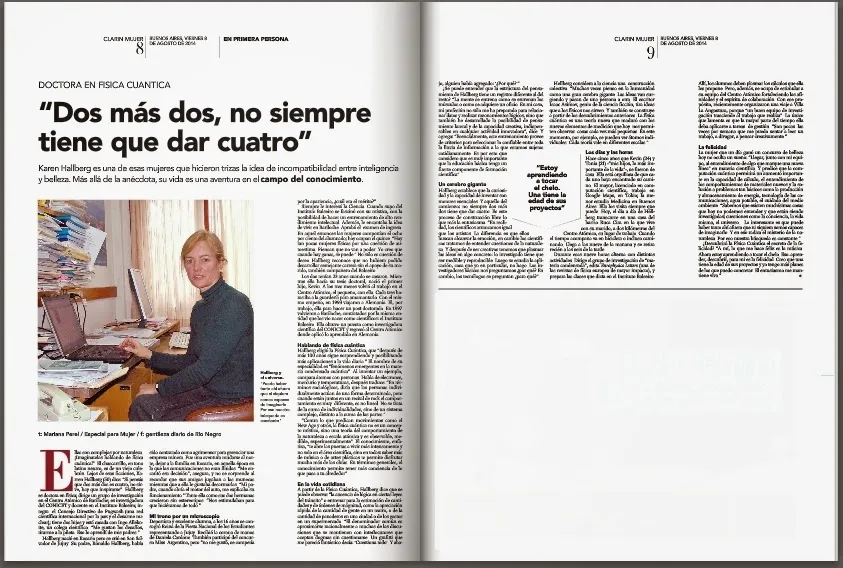
In a certain counterpart, the Clarín Mujer supplement of the date contains an interview with Karen Hallberg, doctor of physics. I quote from the article: "Contrary to what movements like New Age and others preach, quantum physics is not a mystical concept, but a theory of the behavior of nature at the atomic scale and it is observable, measurable, experimental." Knowledge, she emphasizes, "opens the doors for you to live more intensely and not only in the scientific area, but in all of them: knowing more about music or visual arts allows you to enjoy the works much more. In general terms, knowledge allows you to have more awareness of what happens around you".
The thing is, as I said before, having more awareness of reality implies a certain commitment. It assumes that you are going to have to deal with a world that will not adjust to your desires. Fernández, it seems to me, like many other people without distinctions, does not want to see reality, but to imagine it.
For Karen, as indicated in that article, happiness is: "That: learning, discovering, for me that is happiness".
PS: On the cover of the Clarin.com site there is a link to an article on the Entremujeres.com site (from the same Group) about... What do the stars say about your age?
Sources and related links
- La Nación, Día del Niño supplement, print edition, "La otra conexión," by Agustina Fernández. Pages 1-2.
- Clarín Mujer: “Two plus two doesn't always have to equal four,” by Mariana Perel, pages 8-9. It can also be viewed in the electronic magazine format: http://contenidos2.clarin.com/edicion-electronica/20140808/MUJ/#/8/
About the images
- Screenshots of the Clarin.com and Lanacion.com sites