Findings from the S5 survey reveal the disruptive habits of our galaxy.
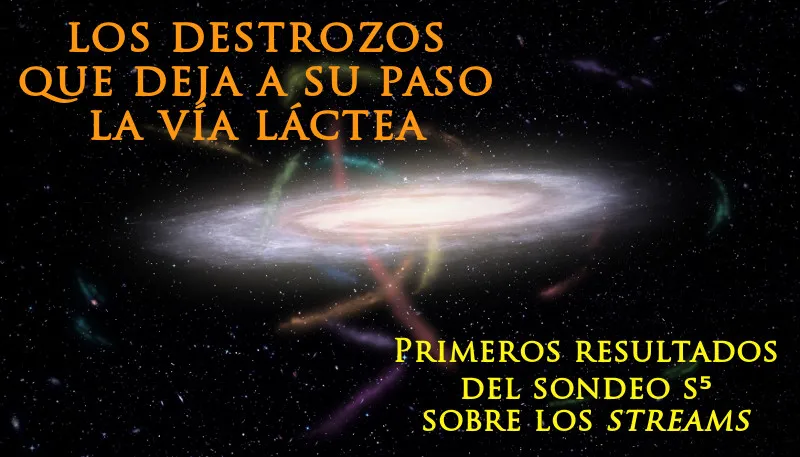
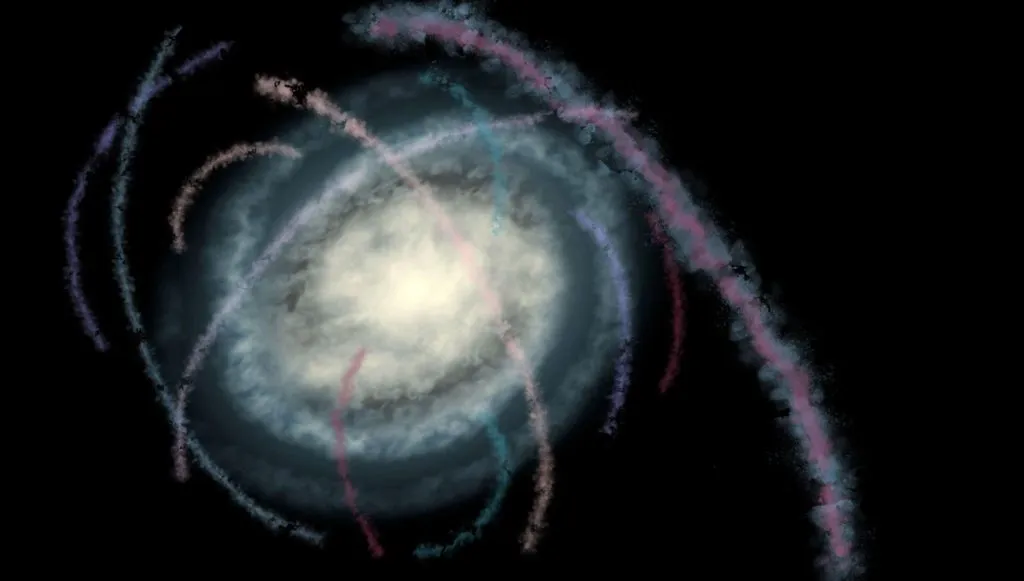
A recently published study reports the first results of the S5 survey, Southern Stellar Stream Spectroscopic Survey, in Spanish: Southern Stellar Stream Spectroscopic Survey. The "streams" or "stellar streams" are the result of the interaction of the Milky Way with other galaxies and globular clusters. As a consequence of our galaxy's gravity, the other objects are torn apart into streams or flows of stars, in English called "streams".
The work published by Ting Li, from the University of Toronto, and her team, managed to characterize a dozen of those "streams" generated by our galaxy, which allows knowing their chemical composition and the velocity of their stars. For this purpose, they use the 4-meter Anglo-Australian Telescope (AAT) to determine their radial velocity by the Doppler effect.
The properties of these stellar streams reveal the presence of dark matter: "Think of a Christmas tree", says co-author Geraint F. Lewis, from the University of Sydney. "On a dark night, we see the lights of the tree, not the tree itself. However, the lights reveal the shape of the tree. It's the same with stellar streams: their orbits reveal the dark matter", he explained.

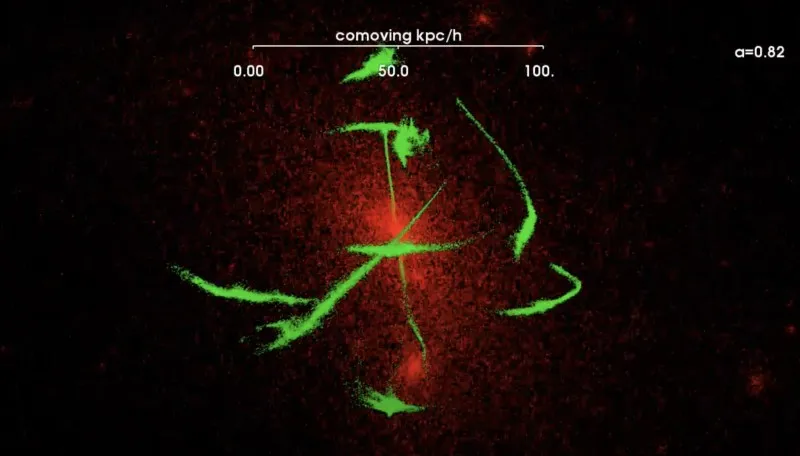
In a simulation, of which an image is shown above, dark matter is seen as red particles and the streams or currents of stars from globular clusters that interacted with the galaxy. By studying the streams or currents of stars, characteristics of dark matter can be inferred.
A crucial ingredient for S5's success were the observations from Gaia, a European mission that provided astronomers with highly precise data on the positions and motions of stars, essential for identifying members of the stellar streams.
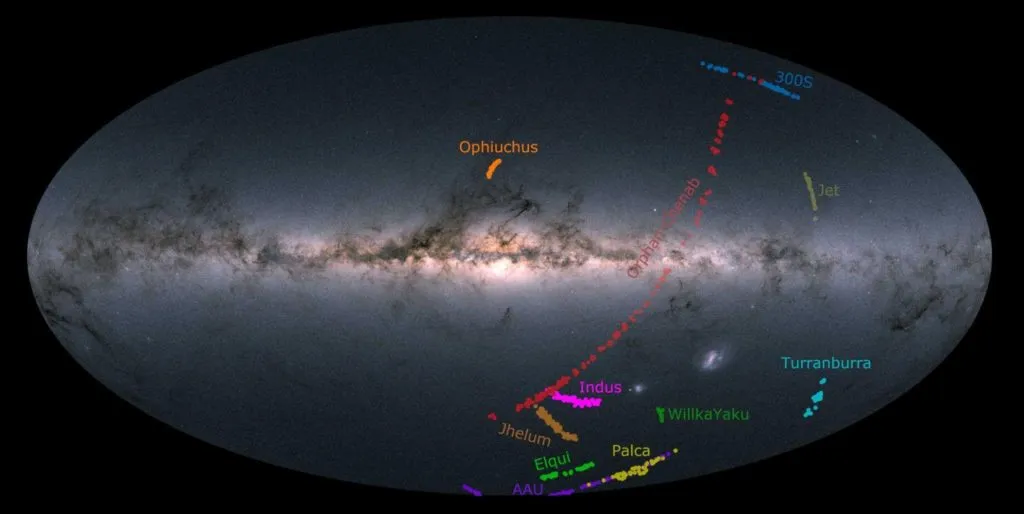
The chemical composition also provides valuable information about the origin of these streams. Stellar streams can come from perturbed galaxies or globular clusters. "These two types of streams provide different clues about the nature of dark matter", said Alex Ji, from the University of Chicago.
With this type of research, knowledge about the dynamic process of galactic evolution deepens, key to understanding why the current universe is as we see it. Ultimately, astronomers are filled with the same feeling as Rubén Darío.
"Blessed is the tree that is barely sensitive", wrote the poet. Like trees or rocks, galaxies do not wonder about their origin or their destiny, but human beings do. And, despite the uncertainties, we want to know where we are going and where we come from.☉
Sources and related links
- Twelve for dinner: How the Milky Way ‘ate’ smaller star clusters and galaxies
https://news.uchicago.edu/story/twelve-dinner-how-milky-way-ate-smaller-star-clusters-and-galaxies - PRESS RELEASE: TWELVE FOR DINNER: THE MILKY WAY’S FEEDING HABITS SHINE A LIGHT ON DARK MATTER
https://lowell.edu/press-release-twelve-for-dinner-the-milky-ways-feeding-habits-shine-a-light-on-dark-matter/ - Twelve for dinner: The Milky Way’s feeding habits shine a light on dark matter
https://www.dunlap.utoronto.ca/dozen_stellar_stream/ - S5
https://s5collab.github.io/ - S5: The Orbital and Chemical Properties of One Dozen Stellar Streams
Ting S. Li et al (2022)
https://arxiv.org/abs/2110.06950 - Twelve streams video
https://www.youtube.com/watch?v=IivPfuskhFg - Ten streams in a Milky Way-like halo
https://www.youtube.com/watch?v=CcE0gMyTbZY
About the images
Credits: Ting Li, S5 Collaboration and European Space Agency.
James Josephides; Geraint F. Lewis, Denis Erkal, S5 Collaboration.
Christmas tree. /Photo: Isaac Muñoz