This is not a work of science fiction: Michael Brown postulates the existence of a ninth planet in the solar system.
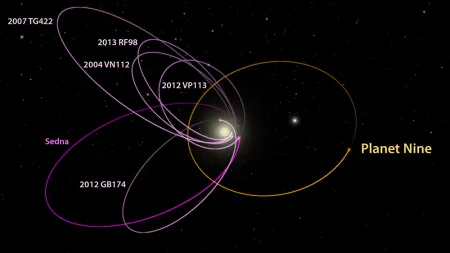
Konstantin Batygin and Michael E. Brown, from the California Institute of Technology, published (for free) in The Astronomical Journal a paper addressing the problem of "KBO clustering". [1]
The work -which extends a dozen pages- introduces us to the problem by pointing out that the recent discovery of 2012VP113, a Sedna-type object and potential additional member of the inner Oort cloud, led Trujillo & Sheppard in 2014 to note that a set of Kuiper Belt Objects (KBOs) in the distant solar system exhibit an unexplained clustering in orbital elements.
The orbital elements of a celestial body's orbit are six quantities that allow its orbit around the Sun or any other body to be defined:
Longitude of the ascending node (Ω, uppercase Omega)
Inclination of the orbit (i)
Argument of perihelion (ω, lowercase Omega).
Semi-major axis of the orbit (a)
Eccentricity of the orbit (e)
Mean anomaly (M0)
The argument of perihelion (or of periastron if it is not our Sun) -according to the Oxford-Complutense dictionary by Ian Ridpath (first reprint 2004)- is the angle that defines the direction of the major axis of an orbit around the Sun. It is the angle between the ascending node and the perihelion of an orbit, measured in the plane of the orbit and in the direction of orbital motion (pp. 49-50).
Resuming: according to Trujillo & Sheppard [2] objects with a perihelion distance greater than Neptune's orbit and a semi-major axis above 150 AU -including the aforementioned one and Sedna- have arguments of perihelion, ω, clustered approximately at zero. A value of ω=0 requires that the object's perihelion falls precisely on the ecliptic and that when crossing it, it moves from south to north (intersects the ascending node). There could be an observational bias in this, but they rule it out based on the work of the Spanish astronomers Carlos and Raúl de la Fuente Marcos.
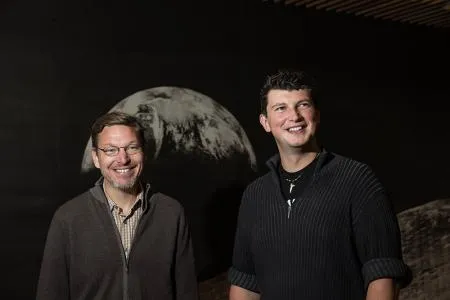
The Caltech press release accounts for the origin of the research:
In 2014, a former postdoctoral researcher of Brown's, Chad Trujillo, and his colleague Scott Sheppard published a paper noting that 13 of the most distant objects in the Kuiper Belt had similar characteristics and, to explain this similarity, suggested the presence of a small planet. Brown thought the solution was unlikely, but the topic piqued his interest.
Brown showed the problem to Batygin and they collaborated for a year and a half to study the distant objects. As one is an observer and the other a theorist, respectively, they both approached the research from very different perspectives: Brown as someone who looks at the sky and tries to anchor everything in the context of what he sees, and Batygin, from the context of dynamics and physics.
In relatively short time the two scientists realized that the six most distant objects from Trujillo and Sheppard's original collection follow elliptical orbits that point in the same direction in space. This is surprising because the extreme points of their orbits move at different speeds.
"It's like having six hands on a clock moving each at a different rate, and when you look up, they're all in the same place. The odds of that happening are something like one in 100", says Brown.
But in addition to that –he adds–, the orbits of the six objects are also all tilted the same way, pointing downward about 30 degrees in the same direction relative to the plane of the eight known planets. The probability of that occurring is about 0.007%. "Basically, it shouldn't happen randomly. So we thought something else must be shaping these orbits," he highlights.
One possibility investigated but ruled out is that there are enough KBOs to exert the necessary gravity to keep a subset clustered. But many more objects than estimated would be needed.
By running simulations and through trial and error they found a configuration that could explain the problem: a massive planet with an orbit whose closest approach to the Sun or perihelion is 180 degrees from the subset.
"Your first answer is 'This orbital geometry cannot be right. It cannot be stable long-term because it would eventually cause the objects to collide'", said Batygin. But through a mechanism called mean-motion resonance, there would be no collision.
Like a parent pushing a child's swing, Planet Nine pushes the orbits of the Kuiper Belt objects, so that their configuration relative to the planet is preserved, says the CalTech press release.
The so far called "Planet 9" would have 10 times Earth's mass and orbit 20 times farther from the Sun than Neptune
Predictions subject to verification
If something characterizes modern sciences, it is their predictive capacity, linked to the possibility of verifying or not such predictions. Besides providing an explanatory model for what is already known (the KBO clustering problem), the theoretical framework would allow explaining other "mysteries" linked to the two objects cited at the beginning, Sedna -discovered by Brown in 2003 and 2012 VP113, discovered by Trujillo and Shepard in 2014.
Just as Neptune was discovered, perhaps in contemporary times astronomers will be able to do what they have always done: discover worlds. But for now, even though it is considered a beautiful model, it requires empirical verification. Only when that happens can we speak of a true discovery. However, if that finally happens, such a finding will only exist thanks to theoretical research like this, which, as glimpsed in the note, is a long chain of studies by different professionals.
A true science-non-fiction novel.
The name of the undiscovered

Rumors circulate that Michael Brown would like to call the presumed planet 9 "George" [3] due to the history of Uranus's name and William Herschel (see on Wikipedia).
One might wonder if planets could have feminine names, instead of masculine ones, as we usually use them. We not only use masculine names because we say they are "los" planets, a masculine noun, but also because their names refer to Greco-Roman male gods.
In the cited reference about this rumor, Time, a poll is being conducted on the possible name of the presumed celestial body and the majority are masculine names, except Fortune (Fortuna).
Although it is somewhat inopportune, just because it is an unverified possibility, I dare to make a non-traditional suggestion: Glenda.
I base this on the famous film Plan 9 from Outer Space (directed by Ed Wood) that inspired the name of a not very well-known operating system, Plan 9 from Bell Labs, whose mascot was called Glenda, after the film Glen or Glenda, also by Ed Wood.
Furthermore, to be bolder and without implications about my personal tastes, it could be called Glen-da and would be the first "transvestite" planet.
On the other hand, Glenda, the mascot of that O.S., was a rabbit, that is, it was jumpy, and an explanation for the formation of this object is that it formed with the others, but then "jumped", or to put it better, was ejected by collision, to the outskirts of the Solar System.
The name Glen-da, half masculine and half feminine, would account for the strange contemporaneity and the odd loves we have with rogue planets.
Sources and related links
- [1] Konstantin Batygin and Michael E. Brown 2016 The Astronomical Journal 151 22
http://dx.doi.org/10.3847/0004-6256/151/2/22 - [2] Nature, Volume 507, Issue 7493, pp. 471-474 (2014).
http://dx.doi.org/10.1038/nature13156 - [3] New ‘Planet 9’ May Be Next to Join Our Solar System
http://time.com/4184942/planet-9-new-pluto-solar-system/ - SINC: Does a Planet Nine Really Exist in the Solar System?
http://www.agenciasinc.es/Noticias/Existe-realmente-un-Planeta-Nueve-en-el-sistema-solar - Caltech Researchers Find Evidence of a Real Ninth Planet
http://www.caltech.edu/news/caltech-researchers-find-evidence-real-ninth-planet-49523
About the images
Initial image, Credit: Caltech/R. Hurt (IPAC); Diagram created using WorldWide Telescope.
Photograph of the astronomers, credit: Lance Hayashida/Caltech
Glenda, by Renée French, taken from Wikipedia.