When did astronomy turn into a stupidity?

About six years ago, a person approached me to ask the previous question. Although I am not a professional astronomer, but merely an amateur, I still felt insulted. The person who questioned me made himself understood by telling me he was an engineer, father of a 16-year-old son. His son would meet with other kids at his house and they would talk about different things, among them: whether man had reached the Moon, if it was possible that there was something before the Big Bang, if it was true that the universe was expanding, and also if one could travel to the past, if there were multiple dimensions, parallel universes in which other people identical to us lived but who made different decisions than ours, etc.
I understood that what he was asking me could be divided into two parts: On one hand it is true that some topics in astronomy, particularly in cosmology, are highly speculative, to the point that there are those who consider such approaches should not be considered scientific as they have no possibility of being verified. That is, pure abstraction.
On the other hand, one must distinguish between the scientific proposals made by professionals through papers published in journals, that is, the scientific discourse within the astronomical community and the media repercussions that simplify and exaggerate those same topics.
In that way I considered the engineer's question answered. But, metaphorically, a woodpecker started growing in my brain, one that started pecking at my conscience and told me: "That person had some reason." And I began to feel co-responsible for this phenomenon either by action or by inaction.
I tried to amend that with a note published in 2011 titled: A crater in common sense (see link below).
From then until now it is possible to find other examples that go in a similar direction: the discourse about the supermoon is often constructed without the opinion of astronomers, but in some cases a professional does "collaborate" or "feed" an excessive expectation under the argument that, after all, they are giving objective data. Indeed, from that data, one can state that sometimes the Moon is closer to Earth, which is why it should look a little larger and a little brighter. True. But given that the variation is small, the change is imperceptible even at the natural satellite's closest approach to the planet. And this last point is also a not insignificant objective fact.
In these years there was also a number of "nonsense" linked to the LHC, wrongly called "The God Machine" even by some professional researchers.
Now a person writes to me to ask why I am hiding that astronomers have found evidence of an extraterrestrial civilization that built a "Dyson Sphere." The person is referring to the well-known "Tabby's Star" named after the diminutive of its discoverer's name. The scientific designation is KIC 8462852.
The star was discovered a long time ago, but around 2013 a strange variation in its brightness was detected. There are different reasons why stars can vary their brightness, either intrinsically or extrinsically. In the first case it is about astrophysical processes "inside" the stars. In this case, the detected variations do not match any type of intrinsic variable star. Extrinsic variations are due to it being binary or multiple systems that eclipse each other or some other object that comes between the star and terrestrial observers. That would be the case of Tabby's. But the type of variation detected was very high (almost 20%) to be a planet.
The discoverer of the planet contacted astronomer Jason Wright who published in 2015 a work on ways to search for intelligent ET life considering the concept of "Dyson Spheres" and using Tabby's star as a possible example. But also, he indicated that in an interview with The Atlantic and from there there was an enormous circulation of discourse about "the planet that has an alien megastructure around it, according to professional astronomers" or forms similar to that.
It is no longer about the actions of the mass media that exaggerate to get an audience by any means, but about the professionals themselves who let that transcend to the media.
The topic returns these days to "trigger" nonsense by virtue of a recent brightness change. With the new data perhaps a pattern can be found with greater certainty.
FUNCTIONALISM
Already by 2011 with that work on impact craters on Earth, I thought of the concept of functionalism, whether conscious or unconscious, to address the topic, but the problem is that the concept is highly questionable. I will explain:
I call functionalism being functional to a discourse of another pre-existing one, whether on purpose or unintentionally, with which the sender does not agree.
This functionalism can be carried out by saying something or by not saying it. Examples:
Until recently, the website of a prestigious Argentine astronomical Observatory published an almanac that contained "astrological" data. The creator of that almanac, in response to my inquiry, however, said he was against astrology. His discourse, however, was "functional" to enthusiasts of that pseudoscience and on top of that with scientific "endorsement." The website I allude to is currently under renovation. Perhaps someone understood that it made no sense and in the new site it will no longer be included.
On the website of the State News Agency Telam the horoscope was published, with which the State was "functional" to those who have a pseudoscientific discourse. Currently that publication is not found on the site.
Wright's discourse to The Atlantic was "functional" to those who believe that ETs are responsible for everything. In a note published on the site ABC.es, a commentator says:
"I invoke the Fourth Amendment of the Internet User Debate Law: If it has no explanation, it's extraterrestrials. If they don't want to admit it, it's because they're hiding it. If they're hiding it, it's the Illuminati. It was very clear that this was the alien sphere under construction. We were already happily imagining millions of retirees leaning on a fence with a telescope watching the construction of the space sphere. But of course...they want to delay retirement...this didn't fit their plans for world domination, and now they come with this. It doesn't wash. Another one, invoking the Fermi Paradox: If they started building the sphere 1,300 million years ago, they should already have a technology ready for interstellar travel in hyperspace or near-light speeds. They are already...as they say, just about to arrive. Peace and good vibes."
Tabby's Star is 1400 light-years away, so what astronomers observe now happened 1400 years ago. The commentator uses a much larger figure. However, there is a maxim in internet times (in times of stupidity) that seems to be this: If it has no explanation for now, then it's ET.
Phil Plait, an astronomer known for his blog BadAstronomer, said in 2015 that obviously it wouldn't be aliens, but that the discovery was "cool" and in his post he added the following image:
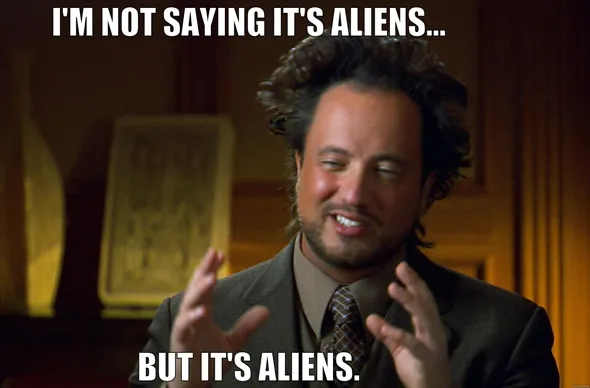
The image is of a ufologist (Giorgio Tsoukalos) who became known on the History Channel series titled Ancient Aliens and his speech can be summarized as follows:
"I'm not saying it's aliens, but it's aliens".
Therefore, although Wright's speech is different, it is functional to the speech of Tsoukalos and the ufologists.
I have said on other occasions that when Neil de Grasse Tyson says that "everything is related to everything, we are stardust" it is "functional" to those who consider the "Law of Correspondence" which is of a spiritualist-religious nature.
From what the astronomer says in that video, he believes he can transform religious feeling into a scientific feeling. What happens in reality is that instead of changing their ideas, people now reinforce them with supposed scientific evidence. The scientific discourse is then functional to the religious one.
But...
THE PROBLEMS OF FUNCTIONALISM
Functionalism is, therefore, a form of consequentialism, that is, a philosophy, current, or stance by which we decide what is right based on consequences. The problem with this is that we don't have a crystal ball and we cannot know the consequences of an act or speech. Therefore, if just because a speech could have negative consequences we must remain silent, then the only thing that leads to is censorship.
Another symptom that functionalism is not adequate is that one can be functional not only by speaking, but also by remaining silent. For example, in cases of scientific fraud, plagiarism, discrimination, many scientists prefer to say nothing, perhaps under the premise that if they said something they would be "functional" to those who criticize the sciences and thus would be causing harm.
Taking functionalism in this way is certainly harmful.
FUNCTIONALISM AS ECHOLOCATION OF DISCOURSE
Despite this, functionalism has some validity. First, because consequences matter to us, otherwise we would have idealistic thinking, only abstract, nothing concrete. Second, because although it is true that we cannot foresee all the consequences of a discourse, if we realize that it could indeed have some consequence, then we have to do something about it. What must be done will not be the same in each case. In some circumstances it will be necessary to remain silent and in others not.
The echolocation of discourse designates the fact that when communicating we already know in advance how messages circulate in a society. It is a conditioning we cannot avoid, but with which we have to deal somehow. If we know that saying "one possibility about Tabby's Star is that it is a Dyson sphere" will cause THAT and no other hypothesis to have greater circulation and generate only senseless ideas, then it might be best not to say it.
However, there is a north we should never lose, no matter how much functionalism we use: to tell the truth, I don't mean absolute truth, but at least to be honest.
Does Wright honestly think there is an ET megastructure around KIC 8462852? Does he honestly think that is a scientific hypothesis? If the answer is affirmative, what priority would such a hypothesis have?
THE DOGMATIC
Can it be completely ruled out that such a megastructure exists around the star? If the answer is no, then it is fine to uphold it, in which case, what Wright did/does is fine.
I believe the Dyson sphere hypothesis should be flatly denied and discarded outright, even if there is some possibility. Isn't that dogmatism? Let's see if it is with some examples:
1-If hoofprints of an equine are found on a plain and for kilometers around there is no evidence of the existence of any horse, would we think that perhaps there are unicorns in that area?
2-If dead cows are found in a region and no predator is found in the surroundings, would we think that the chupacabras or vampires exist? (Well, there are those who believe the chupacabras exists...)
3-If someone takes photos of "something" in Loch Ness, would we think it is a huge, very ancient and unknown creature, a monster?
(Note: in the video from which I took the initial image, physicist Michio Kaku compares the Tabby case with that of Loch Ness).
4-If we don't know exactly how the Egyptians built the pyramids, do we think it was ET?
5-If we don't know well how the universe began, do we think it was a god?
In all five cases, thinking in those ways PREVENTS scientific knowledge, because in each case it would be impossible to know if such hypotheses are true and because by doing so we would be discarding all the others (which are knowable).
If there were a FIXED megastructure around Tabby's star, by which I mean permanent, constant, then the star's brightness change should be regular. Let me explain better: If we cut an irregularly shaped figure out of paper or cardboard and put it in front of a small lamp and then move around it, we will see an irregular amount of light reaching us. At some moments the amount of light reaching us decreases. Over a period of time, we will notice that the star's light goes up and down several times. Let's use fictitious numbers: the area around the lamp without paper emits an amount of light of 10, in the regions where there is paper the light reaching us is less than 10, say 1-3-5-6-2-8 because the shape of the cardboard is irregular.
By going around the lamp we will then see this pattern: 10-1-3-5-6-2-8-10-1-3-5-6-2-8-10-1-3-5-6-2-8-10-1-3-5-6-2-8-10-1-3-5-6-2-8...
This pattern is irregular...but it is a pattern.
Therefore, after several observations over several years, if this is what is around the star we should know it.
In the case of finding a pattern, it can well be explained naturally: perhaps a swarm of asteroids in a region around the star.
But the data so far indicate something else: there is no regular pattern. Therefore, if it were an ET megastructure it would be a structure changing at the whim of the aliens, that is, the Dyson sphere hypothesis is equal to that of unicorns.
That no pattern is found can be considered as:
a-There is not yet enough data, in which case, it makes no sense to risk any hypothesis with confidence until then.
b-There is enough data, but there is no pattern, then, it was a one-off event: something passed in front of the star that stopped happening. Whether a giant planet collided with the star, or another natural phenomenon.
In short: there are enough reasons to carefully investigate the star with different instruments at different wavelengths and various techniques. And for this there is no need to resort to the ET megastructure hypothesis. It is not only unnecessary, it is counterproductive.
In fact, it is "functional" for those who still have qualms about science communication, considering that it only generates oversimplification. It happens that that is a bad example of communication, but there are also many very good ones.
Could it be that professional astronomers were bitten by the fame bug? Perhaps they think that by having a lot of "publicity" they will get more funding? Perhaps they are right and that happens. Perhaps it is not the only consequence. Maybe they are collaborating to turn astronomy into a stupidity.
AND AGAIN WITH THE ETs
I will not tire of saying that the discovery of some ET civilization would be extraordinary, incredible, great. I hope such a discovery is made before I die. I am not "against" possible ETs, it is not a possibility I dislike, on the contrary. But assuming we have discovered something like that when we haven't, turns the incredible into the un-credible.
Sources and related links
- A crater in common sense
http://www.noticiasdelcosmos.com/2011/08/un-crater-en-el-sentido-comun.html - Planet Hunters X. KIC 8462852 - Where's the Flux?
Tabetha Boyajian (Tabby)
arXiv:1509.03622 [astro-ph.SR]
https://arxiv.org/abs/1509.03622v1 - The Most Mysterious Star in Our Galaxy
https://www.theatlantic.com/science/archive/2015/10/the-most-interesting-star-in-our-galaxy/410023/ - The Ĝ Search for Extraterrestrial Civilizations with Large Energy Supplies. IV. The Signatures and Information Content of Transiting Megastructures
Jason T. Wright et al.
arXiv:1510.04606 [astro-ph.EP]
https://arxiv.org/abs/1510.04606 - Jason Wright's website
https://sites.psu.edu/astrowright/
Phil Plait: Did Astronomers Find Evidence of an Alien Civilization? (Probably Not. But Still Cool.)
Why are astronomers around the world watching the 'alien megastructure star'?
About the images
Initial image from https://www.youtube.com/watch?v=0v8qFEqsfmg
Meme image from http://www.quickmeme.com/p/3w2qun/page/1/