The Dark Energy Survey (DES) collaboration, combining its data with that from the Vista Hemisphere Survey (VHS) and the WISE space telescope, has discovered and classified more than 10,000 brown dwarfs, mapping about 2,400 square degrees of the southern celestial hemisphere.
The discovery of more than 10,000 brown dwarfs, made by analyzing data from DES, VHS, and WISE, has just been made public. This work has been published in the journal Monthly Notices of the Royal Astronomical Society, and was led by CIEMAT researcher Aurelio Carnero Rosell, who worked alongside researchers from the Federal University of Rio Grande do Sul in Brazil and the University of Hertfordshire in the United Kingdom.
Brown dwarfs are very low-mass stars. So low, that they have not been able to produce nuclear fusion reactions in their interior, and therefore, they shine much less than common stars. This gives them special characteristics. For example, their great stability: while main sequence stars live billions of years, brown dwarfs can live trillions of years. Furthermore, due to their low mass, some of them closely resemble giant planets, so they can be considered as the link between both types of objects.
The importance of this new catalog lies in the fact that brown dwarfs, despite being among the most abundant objects in the Milky Way, are at the same time among the least known. They were proposed theoretically in the 1960s, but we had to wait until 1994 to confirm their existence. Since that moment, only a few thousand of them have been discovered, generally confined to the vicinity of the Solar System. Today, with the publication of this work, a sample large enough to place brown dwarfs in the context of their formation and distribution within our galaxy, the Milky Way, is made available to scientists.
Although they shine very little, they are detectable in non-visible emissions, such as infrared and radio. Hence, with the great sensitivity of DES in the near-infrared, together with VHS and WISE (observatories in the infrared and radio respectively), we can make an accurate classification of these objects, as demonstrated in the article. In this study, moreover, a measurement of their spatial distribution within the Milky Way is made, and some structural parameters related to their formation process are measured. The values obtained in the analysis confirm that the population of brown dwarfs is older than main sequence stars. In turn, this study indicates that the population of brown dwarfs detected by DES is hotter than those found previously, just as expected according to current theories.
This catalog will not only serve for the large-scale study of sub-stellar objects in the Milky Way, but it is the beginning of their intensive study. Currently, Dr. Aurelio Carnero and his collaborators have already obtained observing time on one of the largest and most powerful infrared telescopes in the world, the 8-meter Gemini South telescope, located in Chile. Using it, a more detailed study of the formation of brown dwarfs in the different environments of the Milky Way will be carried out, which will allow us to continue deepening our knowledge of these objects and of our own galaxy.
The Dark Energy Survey is a collaboration of more than 400 scientists from 26 institutions in seven countries.
Sources and related links
- DES: www.darkenergysurvey.org/
- CIEMAT (Centro de Investigaciones Energéticas, Medioambientales y Tecnológicas): http://www.ciemat.es/
- Reference article:
Carnero Rosell, A. et al., “Brown dwarf census with the Dark Energy Survey year 3 data and the thin disc scale height of early L types”, Monthly Notices of the Royal Astronomical Society, Volume 489, Issue 4, November 2019, Pages 5301–5325.
https://doi.org/10.1093/mnras/stz2398
https://academic.oup.com/mnras/article-abstract/489/4/5301/5561500
About the images
Image 1:
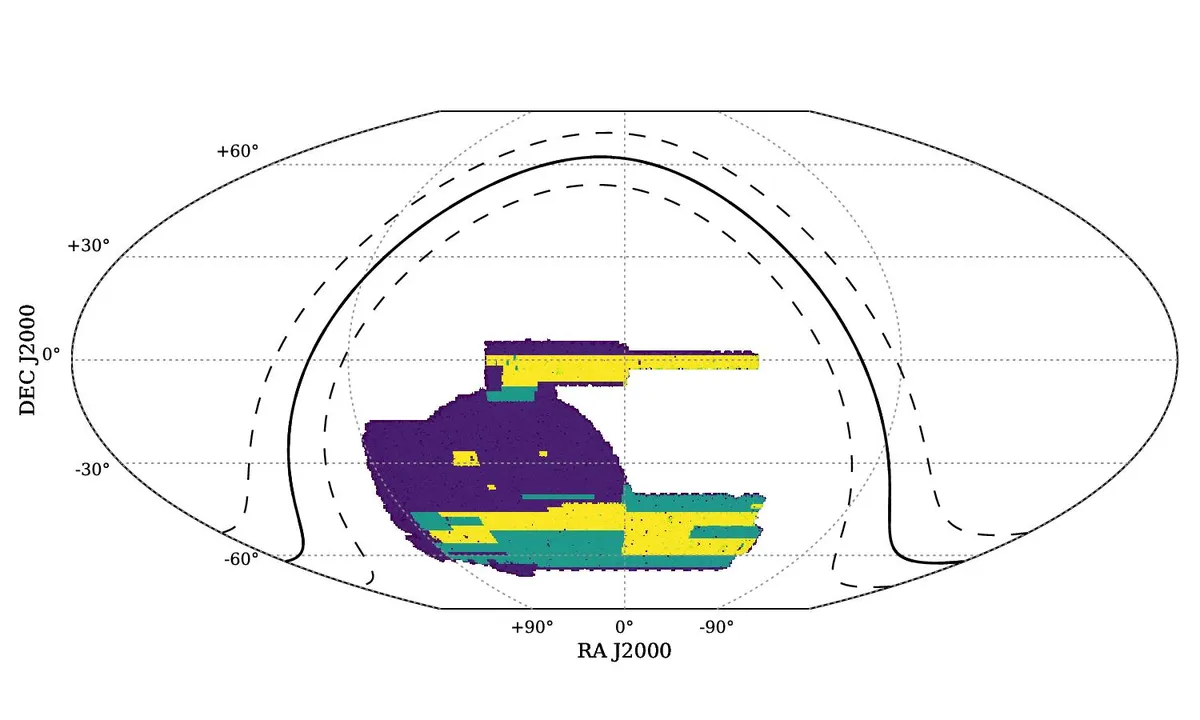
Spatial distribution of the Dark Energy Survey (DES) in purple and that of the Vista Hemisphere Survey (VHS) in green and yellow, in equatorial coordinates. The black line represents the plane of the Milky Way. In the region where DES and VHS overlap, more than 10,000 brown dwarfs have been classified using data from both surveys, along with data from the WISE space telescope. This is the largest catalog of brown dwarfs made to date.
Image 2:
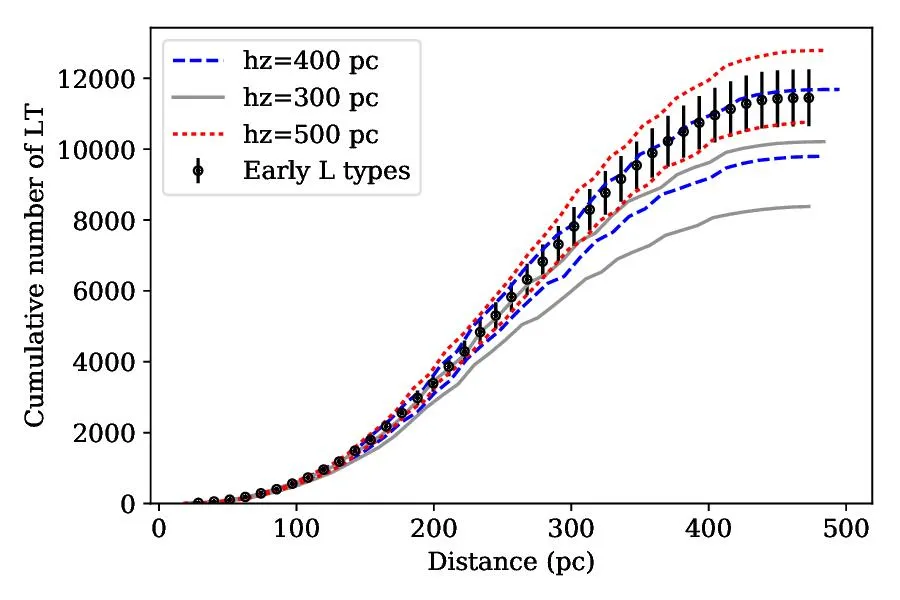
Cumulative measurement of the number of early-type brown dwarfs, as a function of distance from Earth (black dots). In red, gray, and blue, theoretical models of the same measurement, according to different brown dwarf formation processes. Stars like the Sun, for example, have an hz value of about 300 parsecs (pc), while brown dwarfs have a larger hz value, indicating that they are older than main sequence stars.