The cosmic dance does not stop and the sky offers a particular minuet between bright planets visible to the naked eye and the Moon.
Any regular observer will already have noticed the apparent closeness, in the sky, of Jupiter with the Moon, near Antares, the brightest star in the constellation Scorpius. And not far away, Mars.
Often, planetary alignments are announced to be observed only when the approach is maximum. I think it's better to observe the process, that is, how the planets approach and move away from each other, and how the Moon with its faster pace intersects them.
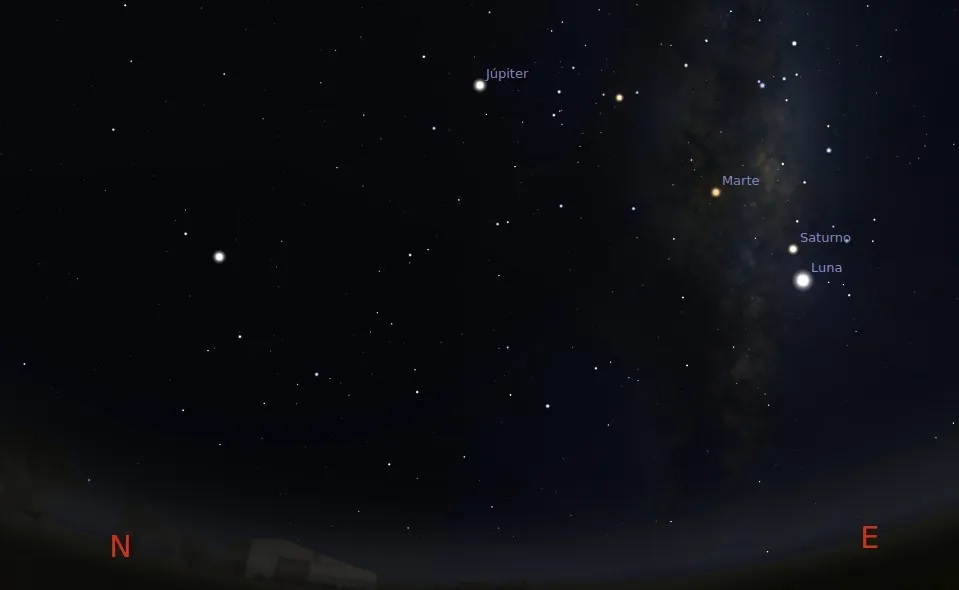
The current situation, always from the Southern Hemisphere, Argentina, Buenos Aires, can be shown with this image from the Stellarium simulator:
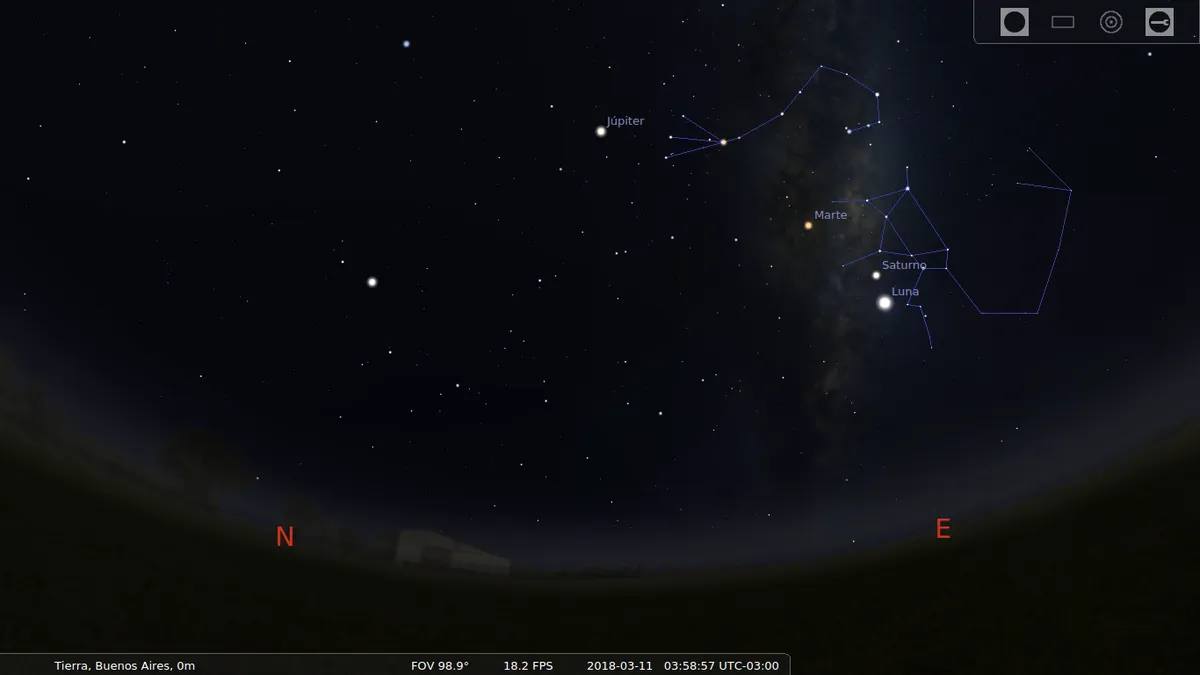
Jupiter very close to Antares and further "down" Mars and Saturn still accompanied by the Moon. The satellite will disappear from that scene in the coming nights while the distance between Mars and Saturn will shorten. At the end of the month, the Moon, full again on the 31st, will once again be in the vicinity of this landscape, but still somewhat distant.
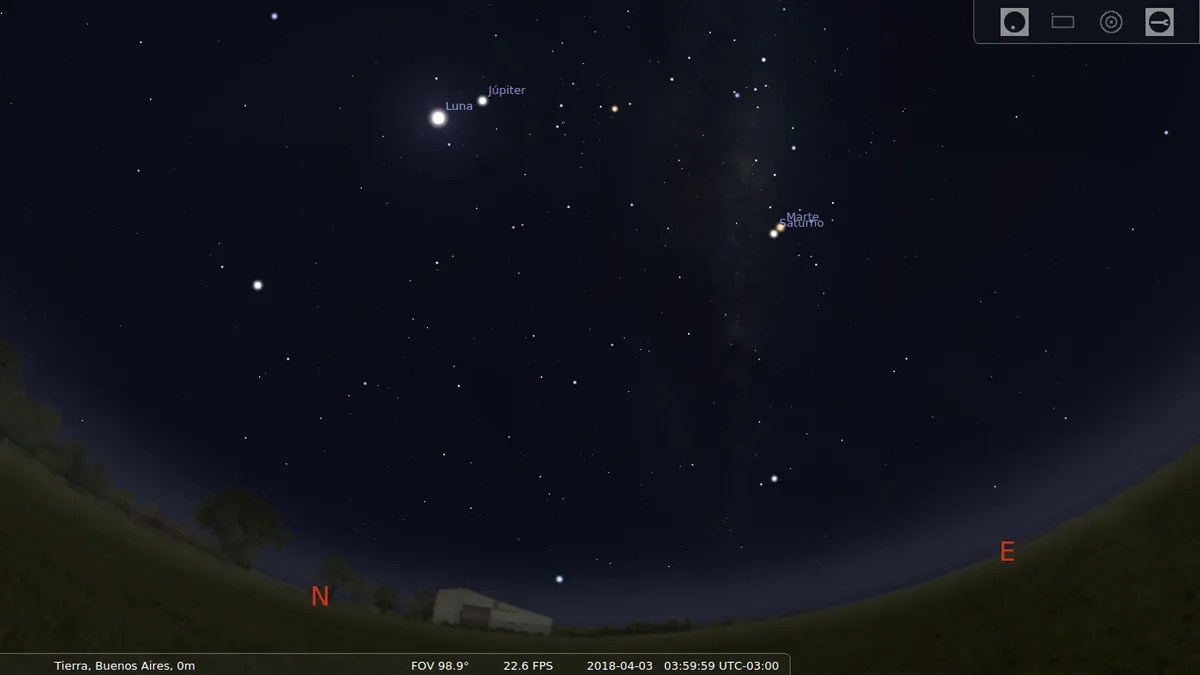
On the night of April 3 the full moon will be very close to Jupiter while Mars and Saturn will almost seem to touch.
Selene will continue on her way and a few days later she will be near the red planet and the one with the great rings, but the separation between them will grow.
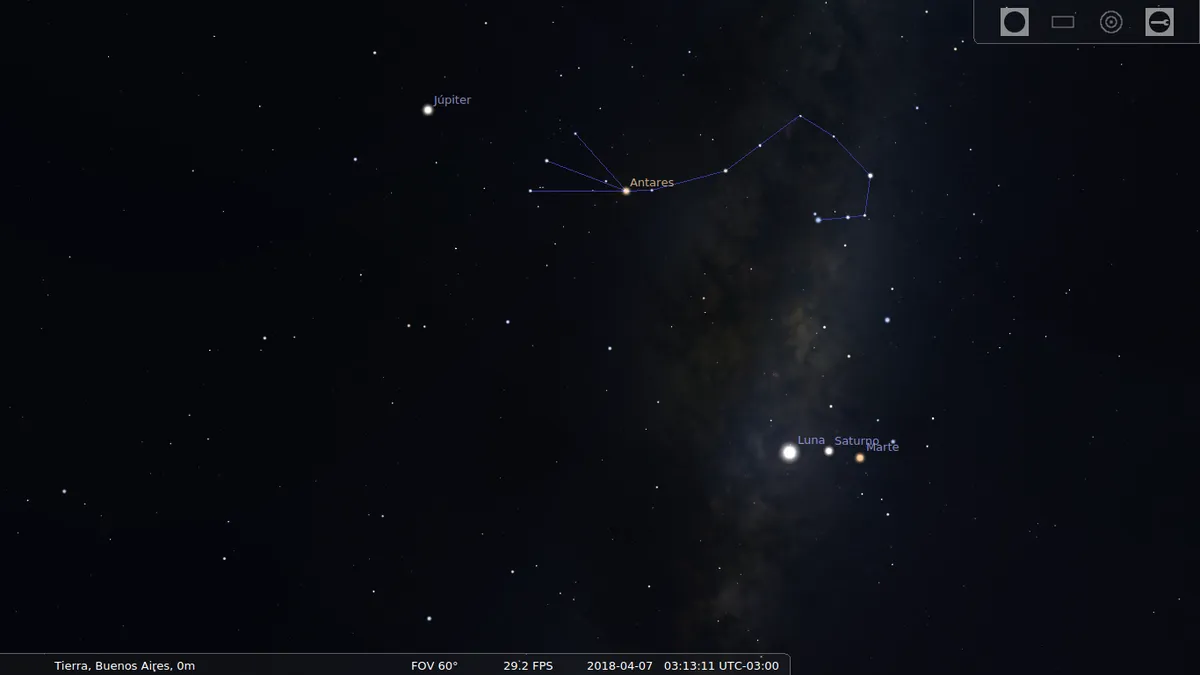
Despite this, the landscape will remain without major changes and in early May, again Saturn and Mars, farther apart than now, but relatively close, will once again be visited by the Moon.
Where to look?
From Buenos Aires, towards the northeast, after 3:00 hours, in the early morning. Due to the number of buildings, it's possible that only by 5:00 they will be observable sufficiently high in the sky. But that varies depending on how much sky we have in view.
Does it mean anything?
The apparent closeness of planets has no scientifically objective meaning, that is, it does not produce cataclysms, a cosmic portal does not open, nothing happens. Those who choose to blindly believe that planetary alignments bring good or bad fortune are prey to their own suggestion. Good and bad things happen to us permanently even if there are no alignments.
Planets do not emit cosmic emanations, they do not influence people's personalities or the growth of plants.
Cosmic ballet
There is a famous phrase, attributed to actor Leonard Nimoy (deceased) who appears as a character in episode 71 corresponding to the fourth season of The Simpsons, Marge vs. the Monorail (1993). Nimoy's character, while traveling on the monorail, says: "A solar eclipse. The cosmic ballet has begun..." In the episode, the monorail falls to pieces. Not because of the eclipse, but it was a scam, a fraud. I have a pending post about fake news in astronomy. I hope to finish it for next week...
News:
NatGeo: Impressive images of Jupiter, a turbulent and asymmetrical world http://www.nationalgeographic.com.es/ciencia/actualidad/impresionantes-imagenes-jupiter-mundo-turbulento-y-asimetrico_12470
For the week:
March 14 is a new "birthday" of Einstein (1879-1955) and Pi Day, because of the way the date is written in English: 3/14.
Notice:
The Astronomy Translation Network is being tested, in English. There are many very good resources, in English, that deserve to be translated into Spanish. Do you want to collaborate? Take a look:
https://sites.google.com/oao.iau.org/translation
Sources and related links
- Youtube: excerpt from The Simpsons episode and Leonard Nimoy
https://www.youtube.com/watch?v=Gto3gJdvANE - WikiSimpson: Marge vs. the Monorail
http://es.simpsons.wikia.com/wiki/Marge_vs._the_Monorail
About the images
Stellarium http://stellarium.org/es/