The already unleashed race for the succession is a way of thinking about who Stephen Hawking was and how he was interpreted, according to social discourses.
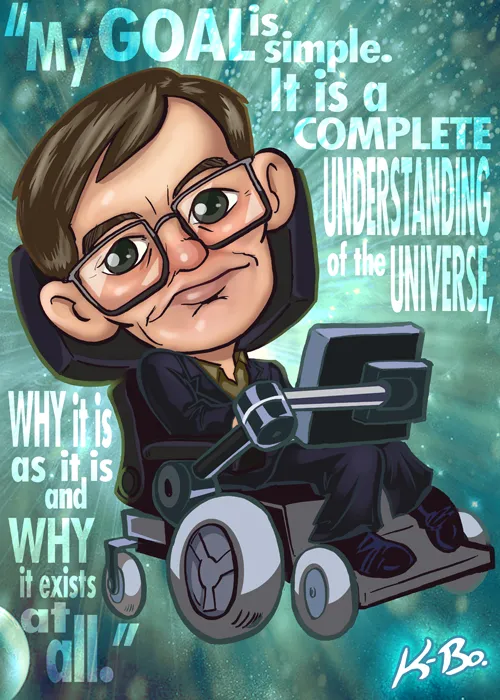
With the passing of the English astrophysicist, it is already possible to find discourses about who could be his "successor". At the same time, the biographical reviews written upon his death narrated him as "the successor of Einstein", or even of Newton.
It would be worth asking, regarding the search for the successor, what Hawking was like and how he was seen, in relation to the characteristics sought in whoever supposedly succeeds him. That is: will the new Hawking be a researcher in astrophysics who has made contributions similar to those of the Englishman, in importance and subject matter? Or will he be a popularizer, almost a rockstar of astrophysics, a diva? Or will he be a rebellious, ironic, politically incorrect scientist?
What is sought in the new one will be what was perceived in the previous one.
It seems quite clear that in the social valuation of Stephen Hawking, science does not weigh as much as other factors, particularly his resilience.
His scientific contributions were interesting, even the controversial or contradictory ones, in relation to the loss of information. Thinking of the Big Bang as a black hole in reverse, as well as the theoretical Hawking quantum radiation, allows for a certain degree of comparison with Einstein due to the relationship between the largest and the smallest.
The German physicist was also a celebrity in his lifetime. In both, pacifism can be traced, a certain negative predisposition towards the idea of divinity (with some differences), and some concerns about the development of humanity from a technical and also economic point of view.
Einstein was seriously rebellious, since his development of Relativity was based on doubting Newton's absolute time and space, something quasi-heretical for the beginning of the last century despite the fact that, supposedly, science is not based on authority, but on evidence, as Hawking liked to point out, although that played a bit against him, because it's somewhat complicated to verify the radiation that bears his name.
Here I stop to use some numbers that will help us understand Hawking's work and its importance, and even to question that very criterion of importance.
Beyond his books, some of which were best-sellers, his most outstanding scientific works are: Particle creation by black holes, cited to date more than 10 thousand times, along with "Black hole explosions?", with more than 4,000 citations.
If we do the same with other cosmologists, we might be surprised. The Argentine Juan Martín Maldacena has a paper cited today almost 17,000 times, from 1999. And several other highly cited ones. I won't be the first to do this.
DYING ON PI DAY IS 1/2 CURIOSITY
A curiosity before continuing: Hawking was born on January 8, like Galileo, and died on March 14, Einstein's birthday. Also, it was PI Day. The equations of Hawking Radiation imply that a black hole emits radiation equal to a black body corresponding to a temperature equal to k/2PI, where k is a parameter, the surface gravity.
It is curious that Hawking died on 14/3, a date that in English is written backwards and resembles the first digits of the irrational and transcendental number known as PI. It is curious, but...not that much. It would have been more curious if the date of death had been 28/6 (6/28 in English) which is...TAU Day. TAU is 2PI, that is, 6.28...Don't know what TAU is? I forbid you to search the internet for the TAU Manifesto. ;)
A METHODICAL COMPARISON
In 2011, the site Science2.0 made a comparison of scientific publications to find out who was the new Einstein.
The author used Google Scholar to find out the number of citations of recognized cosmologists. At the top of the list, who was there? Juan Martín Maldacena. Even above S. Weinberg and E. Witten. Followed by Lisa Randall, Polyakov. The Argentine had then more than 12 thousand citations, while Hawking had 8000, in line with Glashow.
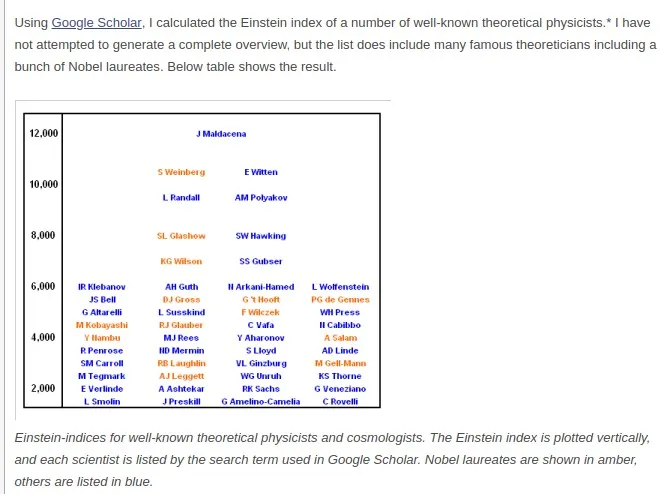
The comparisons used in social discourses do not indicate the comparison criterion. But it is possible to deduce it.
THE MEDIA COMPARISON
If it were only for scientific contributions, undoubtedly the contributions of Stephen Hawking (SWH) would be known because they deserve attention in the field of cosmology. If it were only for that, surely his name would have some circulation. But he would be known like Willem de Sitter or Jacob Bekenstein or Minkowski. Alan Sandage was the successor of Hubble (literally) and who knew of his existence outside of specialists?
And Leonard Susskind? And Sean Carroll? Max Tegmark? George Smoot? Mather, Hooft?
All have made interesting contributions, have written books, received awards. And compared to SWH, they don't come close to his level of public exposure.
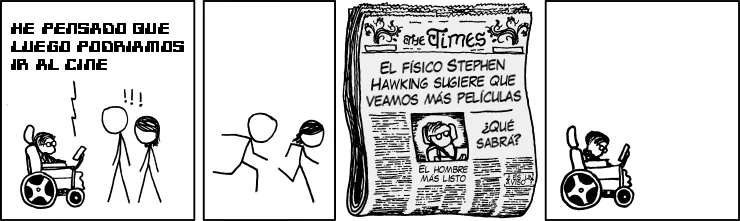
Evidently, in the discourses shared outside and within the scientific community, what is valued about Hawking is not only his scientific contribution (which in my view, is far from that of Einstein), but that SWH was seen as an icon, but in the semiotic sense of symbol.
ICON AND SYMBOL
SWH was considered a cultural icon, that is, a symbol. But he was a symbol of different things:
-Symbol of genius, of abstract mathematical thought, of technical language./Guru (which is almost the opposite).
-Symbol of personal improvement.
-Symbol of cosmology, astrophysics.
-Symbol of rebellion, but that rebellion, that badass character also has to do with being grumpy, short-tempered, perhaps in some sense being a "diva".
THE SUCCESSOR
In case it hasn't been noticed until now, I'll make it explicit: It is absurd, although tempting, simplistic and superficial, useless, worthless, fallacious and fetishistic, the elaboration of a pseudo-ranking of who has the biggest theory. It's like the Maradona-Pelé-Messi comparison. I reject this idea of succession as if it were the transfer of a crown to a king. It's medieval. Different would be a succession in relation to a numerical series, something that does not supplant, but follows in order, and not order of importance, but of contiguity. In that sense, there is a certain contiguity between Newton and Einstein, but not so much between the German and Hawking. What would we say about Newton vs Leibniz-Euler-Gauss?
RESILIENCE
Everything that stands out about Hawking has a double valence: the scientific recognition has its critical side, in relation to his contradictions and the lack of evidence.
The books, although bestsellers, to what extent were they read and understood?
His statements on various topics, including divinity and politics, have clearly had different interpretations, for and against.
About his personal life one could say the same, as noted in the recent film "The Theory of Everything" (James Marsh, 2014).
Regarding resilience there seems to be no double valence.
But, careful! Don't people who are not famous suffer similar afflictions, with or without outstanding personal talents? Without taking anything away from Hawking, surely there are many people with incurable diseases, but unknown, poor, or with many economic limitations.
CONCLUSION
If it is sincere, genuine, honest, the recognition of resilience, let it not be only for the illustrious. And let it not be only in words. Even those of us who are not rich, who don't have much to spare, we can do something for those other "Hawkings", whether or not they have advanced knowledge in mathematics.
It is admirable that someone can do a lot with little. I admire that ingenuity and creativity that I only have on a small scale and from time to time, a lucid idea may escape. With brilliant people, the scale is different: from Aristotle to Leonardo, from Heraclitus to Galileo. In between there are many very valuable, but unknown, people. We should also recognize in life those who do what is possible so that others live a little better, in different spheres. In astronomy, not only the unknown researchers (men and women), but also those who disseminate, teach, help learn to think critically. Teachers and doctors, whose recognition is deserved but not given, neither with speeches nor with decent salaries. Hawking defended the English public health system, against privatizations. We must be consistent with what we apparently value about Hawking. Otherwise it is hypocrisy, things that are said to look good, because it is politically correct. It is a contradiction because if Hawking was anything, he was not politically correct.
More than looking for the next one, the one in the succession, the replacement, we should look for the close one, who is also next-neighbor.
The most important question we can ask ourselves as a species is NOT what is the origin of everything. The greatest question is why do we think as we think, say as we say, and do what we do?
The answer seems to be inside a black hole in a social space-time that is not isotropic nor homogeneous nor flat, it is curved.
We will continue to encounter the discourse and memory of Hawking. HasTAU later, Stephen.
Sources and related links
- THE ICON, THE INDEX AND THE SYMBOL
Charles S. Peirce (c. 1893-1903)
http://www.unav.es/gep/IconoIndiceSimbolo.html - Popular Semiotics / 7: Icon, index, symbol by José Luis Petris
Revista Foul Táctico, Number 18, 2006.
http://www.foultactico.com.ar/pdf/foul%20tactico%20numero%2018.pdf - What is an ‘icon’? A brief answer from Peirce's semiotics
http://revistamito.com/que-es-un-icono-una-breve-respuesta-desde-la-semiotica-de-peirce/ - Stephen Hawking: a "badass"
http://www.noticiasdelcosmos.com/2012/04/stephen-hawking-un-badass.html - The announced World Cup
http://www.noticiasdelcosmos.com/2014/07/el-mundial-anunciado.html - Personalities from all disciplines bid farewell to the "extraordinary" Stephen Hawking
https://www.eldia.com/nota/2018-3-14-10-21-0-personalidades-de-todas-las-disciplinas-despidieron-al-extraordinario-stephen-hawking-informacion-general - Hawking, the last brilliant mind that revolutionized science, said goodbye
https://www.eldia.com/nota/2018-3-15-3-46-42-hawking-la-ultima-mente-brillante-que-revoluciono-la-ciencia-dijo-adios-informacion-general - https://www.theguardian.com/commentisfree/2018/mar/14/stephen-hawking-campaigner-nhs
- Stephen Hawking - An interactive history of his career
http://michael.szell.net/hawking/ - Who Is Today's Einstein? An Exercise In Ranking Scientists, by Johannes Koelman
http://www.science20.com/hammock_physicist/who_todays_einstein_exercise_ranking_scientists-75928 - Stephen Hawking is No Albert Einstein
By Alex B. Berezow
https://www.realclearscience.com/blog/2011/05/stephen-hawking-is-no-albert-einstein.html - Stephen Hawking's political views
http://www.bbc.com/news/uk-politics-43399019 - A black hole for science
https://www.pagina12.com.ar/101496-un-agujero-negro-para-la-ciencia - Professor Stephen Hawking 1942-2018
http://www.ctc.cam.ac.uk/news/180314_newsitem.php - Science mourns the death of Stephen Hawking
https://www.investigacionyciencia.es/noticias/la-ciencia-llora-la-muerte-de-stephen-hawking-16214 - Spanish astrophysicists point to Kip S. Thorne as Hawking's successor
http://www.europapress.es/ciencia/astronomia/noticia-astrofisicos-espanoles-apuntan-kip-thorne-sucesor-hawking-20180314172330.html
About the images
Stephen Hawking Art Card by K-Bo.
https://kevinbolk.deviantart.com/art/Stephen-Hawking-Art-Card-by-K-Bo-445137690
Stephen Hawking https://es.xkcd.com/strips/stephen-hawking/