Detail of planned activities at the planetariums of Buenos Aires.
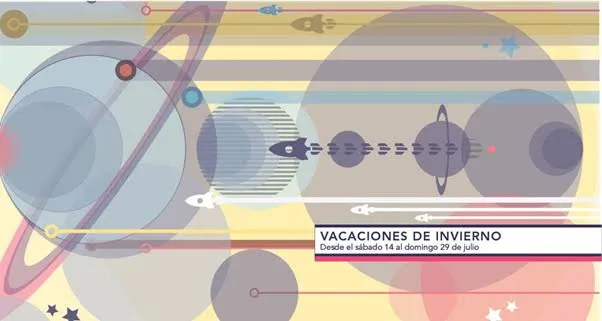
Winter vacation at the Planetario de La Plata
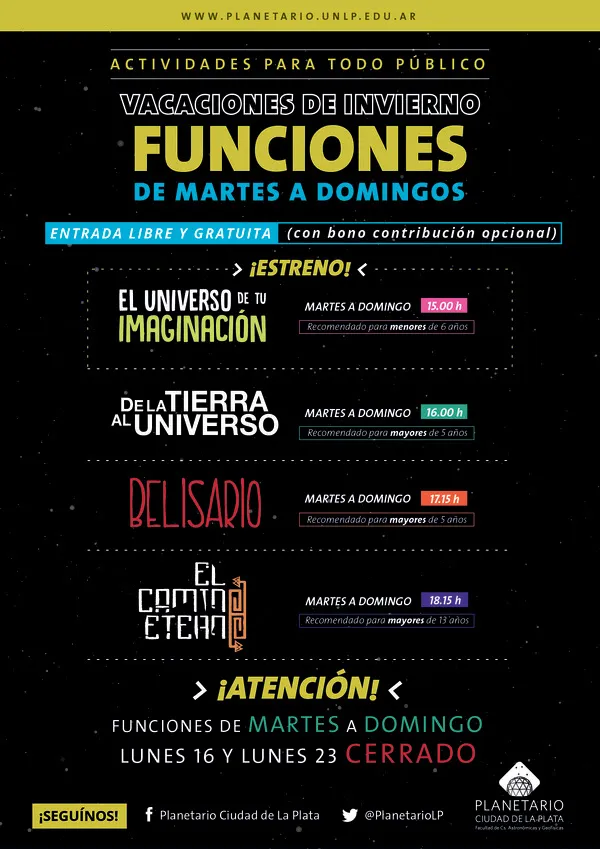
This winter vacation, the Planetario Ciudad de La Plata offers a full schedule whose variety of shows takes us to explore every corner of the universe from imagination, be it to the most remote stars, alongside a mouse astronaut, or on a journey through the astronomical observatories of our country.
From Tuesday, July 17 to Sunday, July 29 (closed Monday, July 23), the Planetarium opens its doors starting at 14 h with four daily shows, with free admission (optional contribution ticket of $30). Tickets are available starting at that time for the day's shows and until seats run out (175 seats per show).
In its hall, under a 17-meter diameter dome, and with surround sound, each show is a unique immersive sensory experience, where the viewer becomes the center: everything happens around them, in front, behind, above, and to the sides.
The first show of the day, El universo de tu imaginación, begins at 15:00 h. Recommended for the youngest audience, from 0 to 6 years old, and with original music by artist Hugo Figueras, the show invites in a story/song format to observe clouds, contemplate the night sky, the phases of the moon, and the constellations.
The second show, at 16:00 h, De la Tierra al Universo, takes us on an incredible journey from our blue planet to the wonders hidden in the starry sky. This show is suitable for all curious people from five years old and up.
At 17:15 h it's the turn of Belisario, el pequeño gran héroe del cosmos, where a little mouse astronaut will travel through time to inscribe his name in the history of Argentine astronautics. This animated show is recommended for ages 5 and up.
Closing the shows, at 18:15 h, El camino eterno, a documentary about astronomical observation sites in Argentina. In it, an astrophotographer searches for the perfect photo of the starry sky. To do so, he must move away from urban lights, travel to clear skies. His route will thus be traced by the places where the quintessential instruments for investigating the sky are located: the telescopes of astronomical observatories. This show is recommended for ages 13 and up.
In addition to the shows, in the building's hall, you can visit the photographic exhibition El camino eterno [CAPTURADO]. It illustrates, through a series of astrophotographs taken by astrophotographer Sergio Montúfar Codoñer, the search for the perfect photo of the starry sky. Also, thanks to the collaboration of Cintia Peri and Hernán Moyano, the behind-the-scenes of the filming of the documentary El camino eterno is also exhibited.
Vacation at the Planetario Galileo Galilei
The Planetarium adds attractions for the winter vacation: fulldome astronomical shows, tours of the Interactive Museum, guided visits, workshops, conferences, observation of the lunar eclipse, and two major novelties.
During the winter vacation, two new proposals will arrive at the Planetarium: the Curiosity robot and Una de estrellas. The robot, a scale replica of the one sent by NASA to Mars in 2011, will be the protagonist of the interactive micro-show Un curioso en Marte, carried out by the Galileo Galilei in conjunction with the Siemens Foundation. For its part, Una de estrellas will make -through a show in the dome- kids travel through space.
Both novelties will be part of the grid of activities that will take place at the Galileo Galilei this winter vacation: three fulldome astronomical shows, tours of the new Interactive Museum, guided visits, workshops, conferences, and telescope observation of a lunar eclipse.
Un curioso en Marte will take place before each main show at the Planetarium -dependent on the Ministry of Education and Innovation of the City of Buenos Aires- and will feature 360 videos.
The protagonist of this show was developed in our country by students of the Centro de Formación Industrial specializing in mechatronics “Hölters, who worked for a year on its development. This replica has 384 pieces specially made by 3D printers and is controlled by innovative software that allows the robot to make decisions based on programmed automations. To develop it, we formed different work groups focusing on specific knowledge from statics and material resistance to applied electronics and software programming. «It gives us great satisfaction to have applied our theoretical knowledge acquired in technical education to concrete, innovative, and outreach projects like this,» commented Ayrton Abad (22), former student of CFI Hölters and student of Energy Engineering at UNSAM.
For her part, Verónica Espino, operational manager of the Planetarium, pointed out: «This space is not only a meeting point between kids and science, but it is also a place where they can learn and put their abilities into practice. Curiosity is an example of what can be achieved when scientific vocations are fostered in schools, and that is what we want to promote from this space».
«Beyond offering an attractive playful and educational show, the goal of this project is to awaken the curiosity of the youngest for science and technology, seeking to disseminate and promote technical and scientific vocations», added Pablo Aldrovandi, coordinator of the Siemens Foundation Argentina.
Una de estrellas, the other attraction added to the winter vacation schedule, is a dome show for kids over 9 years old that will take place every day at 12, 15, and 17 hours. During the show, kids and adults can travel through space and learn more about the universe and its celestial bodies.
Sources and related links
- Official information provided by both institutions.
Planetario Galileo Galilei
http://www.planetario.gob.ar/ - Planetario Ciudad de La Plata
http://www.planetario.unlp.edu.ar/