They don't, they are a product of diffraction.
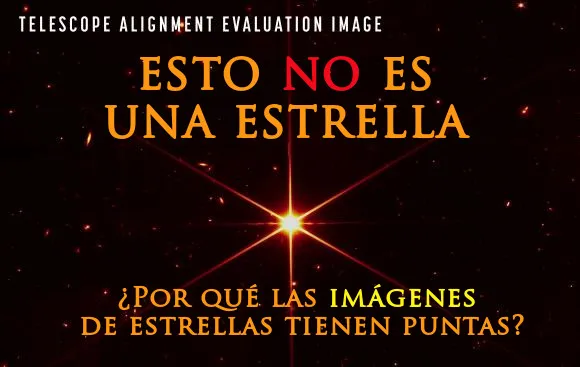
A photo taken with the recently launched James Webb Space Telescope (JWST) to align its mirrors was published a few days ago. The image shows a star with points. It is common to see stars with points in astronomical images. Why is that?
There are two reasons why, due to the effect of diffraction, points are produced in images of bright point-like objects.
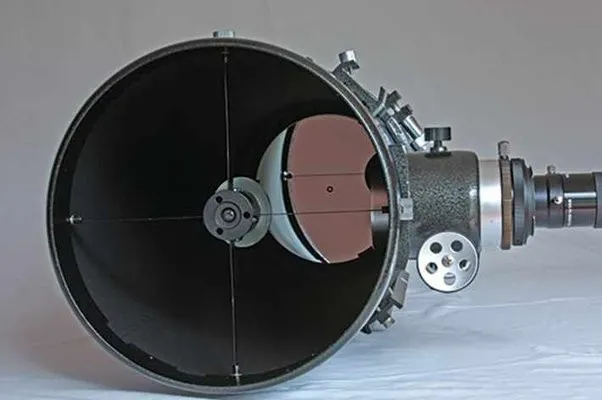
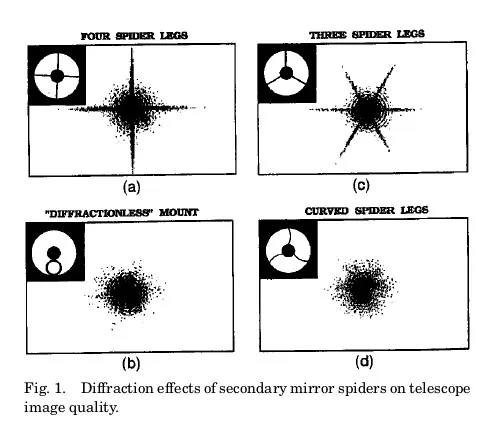
On one hand, when using Newtonian-type telescopes or similar. In these cases, inside a tube there is a concave mirror that reflects light rays towards an interior point. To be able to see that concentrated light, it is necessary to deflect it outside the tube. For this purpose, a small flat mirror, called a secondary, is placed at the focal point. This mirror must be held by some structure, generally known as a "spider". This support can have one or several "legs". The light, to reach the primary mirror, must pass through these "legs" and that is where those spikes, points, or rays in the images are produced.
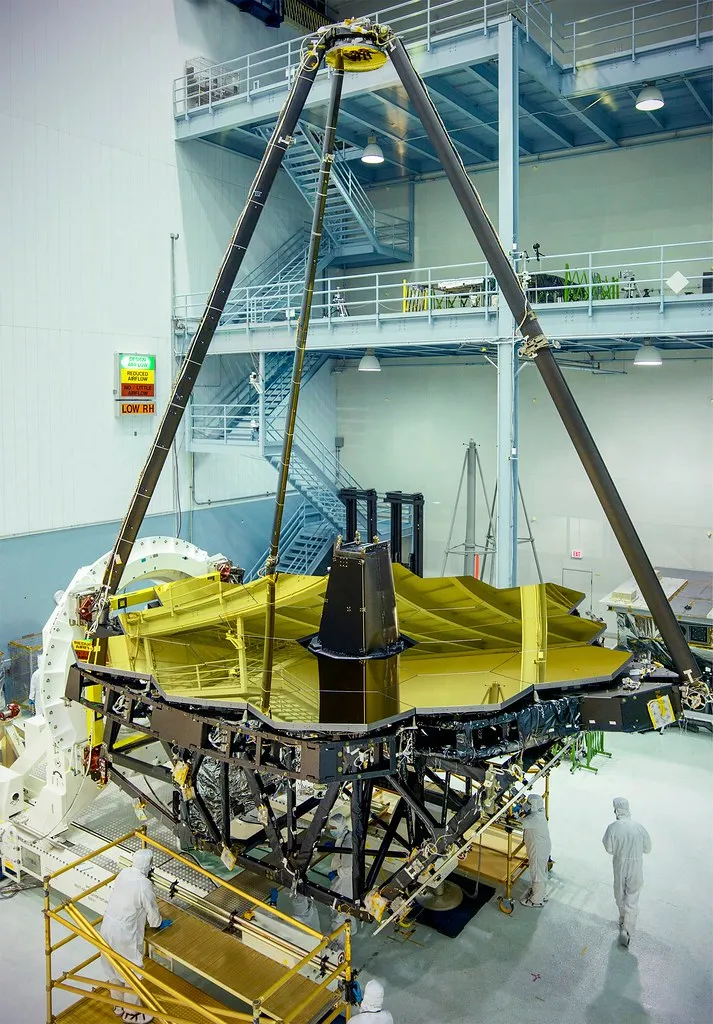
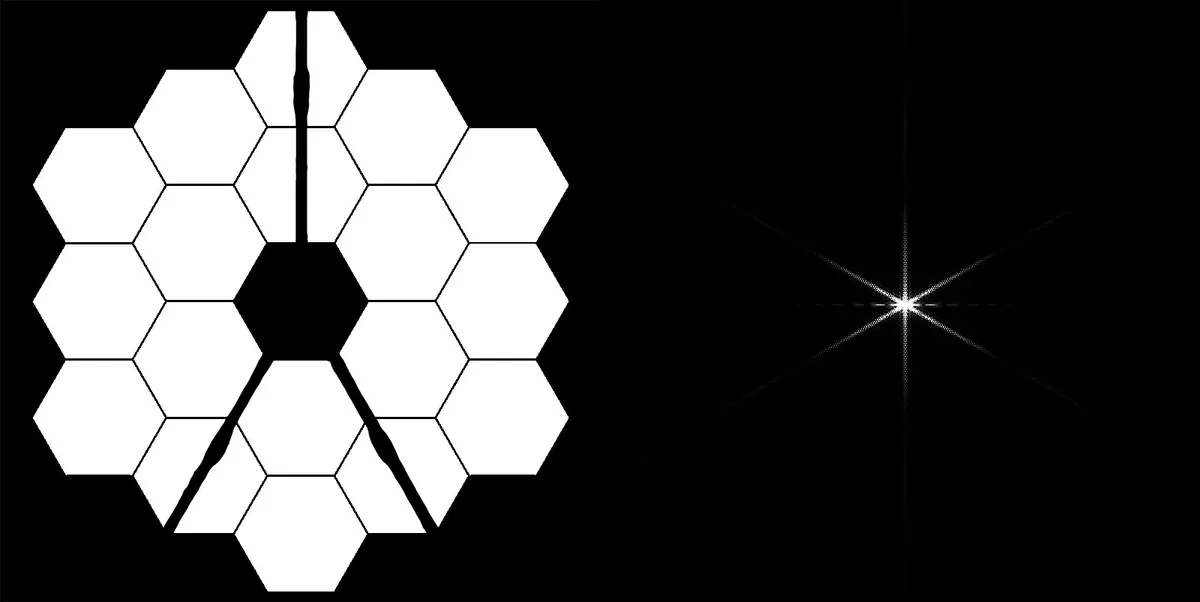
The JWST has a secondary mirror held by a tripod. But that alone does not explain the ray-points in the image that was released these days. There is another effect, also due to diffraction, produced not by the "spider" of the secondary, but by the shape of the primary.
Segmented mirror telescopes, like the James Webb, which are usually hexagonal, have a small gap that separates each segment and also produces this type of points or rays.
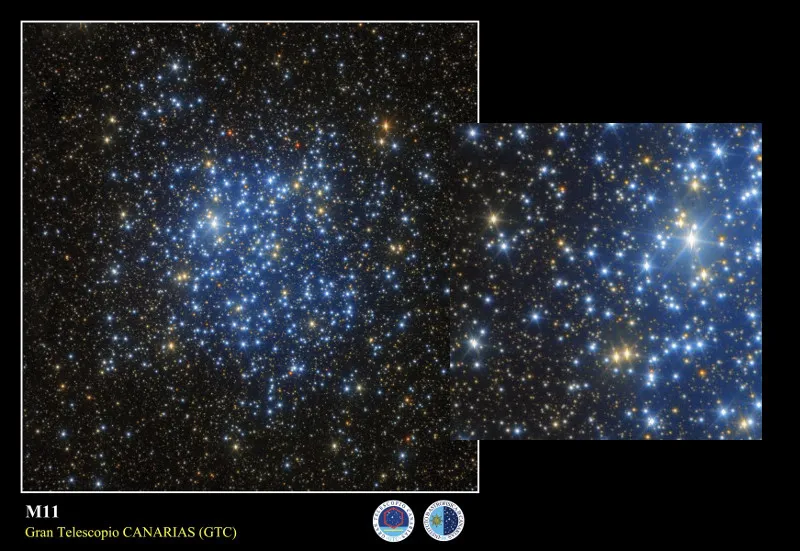
The GranTeCan, at Roque de los Muchachos, Canary Islands, also has a segmented primary. If we review its online image gallery, we can find a beautiful portrait of the Messier 11 cluster. If we enlarge the image, we will see the points of the stars.
In the case of the recent JWST image, both effects occur. The tripod that holds the secondary has two legs whose angles coincide with those of the hexagonal segments of the primary. But the third "leg" does not coincide and produces an extra ray or point, horizontal.
Ways have been sought to avoid this type of diffraction, for example with spiders or support struts with curved legs, with varied results.
We could then recall that "This is not a pipe", by René Magritte. The image of a star is NOT a star. What we see is not exactly a representation of reality.
Despite that, if someone asks you to draw a star, you will probably do it as is usually done, as an object with several points. But stars are not asterisks, although the word asterisk means "little star"(*).☉
Sources and related links
- https://www.wtamu.edu/~cbaird/sq/2015/11/16/why-do-the-spikes-that-shoot-out-of-stars-form-perfect-crosses/
- https://twitter.com/AstroGLB/status/1504216123713204225
- Wondering About the 6 Rays Coming out of JWST's Test Image? Here's why They Happen
https://www.universetoday.com/155062/wondering-about-the-6-rays-coming-out-of-jwsts-test-image-heres-why-they-happen/ - Diffraction Analysis of Large Segmented Mirror Concepts for Exoplanet Exploration
James E. Harvey et al (2018)
https://www.researchgate.net/publication/326236843_Diffraction_analysis_of_large_segmented_mirror_concepts_for_exoplanet_exploration - Diffraction effects of telescope secondary mirror spiders on various image-quality criteria
October 1995Applied Optics 34(28):6337-49
DOI:10.1364/AO.34.006337
https://www.researchgate.net/publication/47718414_Diffraction_effects_of_telescope_secondary_mirror_spiders_on_various_image-quality_criteria - Why does the alignment evaluation image from JWST look like this?
https://astronomy.stackexchange.com/questions/48836/why-does-the-alignment-evaluation-image-from-jwst-look-like-this - https://asterisk.apod.com/viewtopic.php?p=321493
- (*) Asterisco
https://es.wikipedia.org/wiki/Asterisco
About the images
Credits: NASA.
Gran Telescopio Canarias
Messier 11, Wild Duck Cluster
Daniel López/IAC http://www.gtc.iac.es/multimedia/imageGallery.php