The IAU100-NameExoWorlds Project gives every country in the world the opportunity to name an exoplanet and its host star. The Argentine case. My proposal.
As part of its centennial commemorations, the International Astronomical Union (IAU) is organizing the global competition IAU100-NameExoWorlds, which allows any country in the world to give a popular name to a selected exoplanet and its host star. More than 70 countries have already registered to organize national campaigns that will give the public the opportunity to vote. The goal of this initiative is to raise awareness of our place in the Universe and to reflect on how Earth might be perceived by a civilization on another planet.
In recent years, astronomers have discovered thousands of planets and planetary systems orbiting nearby stars. Some are small and rocky like Earth, while others are gas giants like Jupiter. It is now believed that most stars in the Universe could have planets orbiting them and that some of them might have physical characteristics similar to Earth's. The vast number of stars in the Universe, each potentially with orbiting planets, along with the ubiquity of prebiotic compounds, suggests that extraterrestrial life may be likely.
The IAU is the authority responsible for assigning official designations and names to celestial bodies and now, while celebrating its first 100 years of fostering international collaboration (IAU100), it wishes to contribute to the fraternity of all people with a significant display of global identity. After the first NameExoWorlds competition, which named 19 exoplanets in 2015, the IAU, as part of the IAU100-NameExoWorlds project, will offer each country the opportunity to name a planetary system, comprising an exoplanet and its host star. The star designated for each nation is visible from that country and is bright enough to be observed through small telescopes. This is only the second time in history that a competition will lead to the naming of stars and exoplanets.
"This exciting event invites everyone worldwide to think about their collective place in the Universe, while stimulating creativity and global citizenship," shared Debra Elmegreen, President-Elect of the IAU. "The NameExoworlds initiative reminds us that we are all together under one sky."
After carefully selecting a large sample of well-studied and confirmed exoplanets [1] and their host stars, the IAU100-NameExoWorlds Steering Committee assigned a star-planet system to each country, taking into account the association with the country and the visibility of the host star in the country.
In each participating country, a national committee has been specially created by the National Outreach Coordinators for Astronomy (IAU NOC) to carry out the competition at the national level. The national committee, following the methodology and guidelines established by the IAU100-NameExoWorlds Steering Committee, is the body responsible for providing the conditions for public participation, disseminating the project in the country, and establishing a voting system.
The National Competitions will be held from June to November 2019, and after final validation by the IAU100 NameExoWorlds Steering Committee, the global results will be announced in December 2019. The winning names will be used freely in parallel with the existing scientific nomenclature, with due credit to the people who proposed them.
While this is not the case for Argentina, if your country is not yet organizing a national competition and you are part of a scientific organization or non-governmental organization interested in conducting a national competition, please contact [email protected] with a brief statement (maximum 1 page) indicating your experience and potential plans for the campaign. Questions about national campaigns should be directed specifically to the national committees.
Notes
[1] The NameExoWorlds campaign has selected planetary systems to name planets orbiting stars that could be observed with a small telescope from the latitude of each country's capital. The system often has a link to the assigned country, such as the facilities used to discover the planet or the scientists involved in its discovery. The existence of the planet is generally more secure for systems discovered long ago, as more years of research have been had to ensure its existence, due to continuous observation of the system. For this reason, the sample focuses on exoplanets revealed during the first two decades of exoplanet exploration, with most discovery dates before 2012. The visual brightnesses vary between apparent visual magnitudes of 6 and 12. All planets were discovered using the Doppler spectroscopy (radial velocity) method or the transit method, and all were discovered using ground-based telescopes. All planets are likely to be gas giants similar to Jupiter and Saturn, with estimated masses between 10% and 500% of Jupiter's mass. All these systems are composed of single stars with a single known planet orbiting them. It is possible that the stars have additional planetary and stellar companions that may be discovered in the future. The selection has been made in such a way that each country has the same opportunity to name similar celestial bodies.
THE ARGENTINE CASE
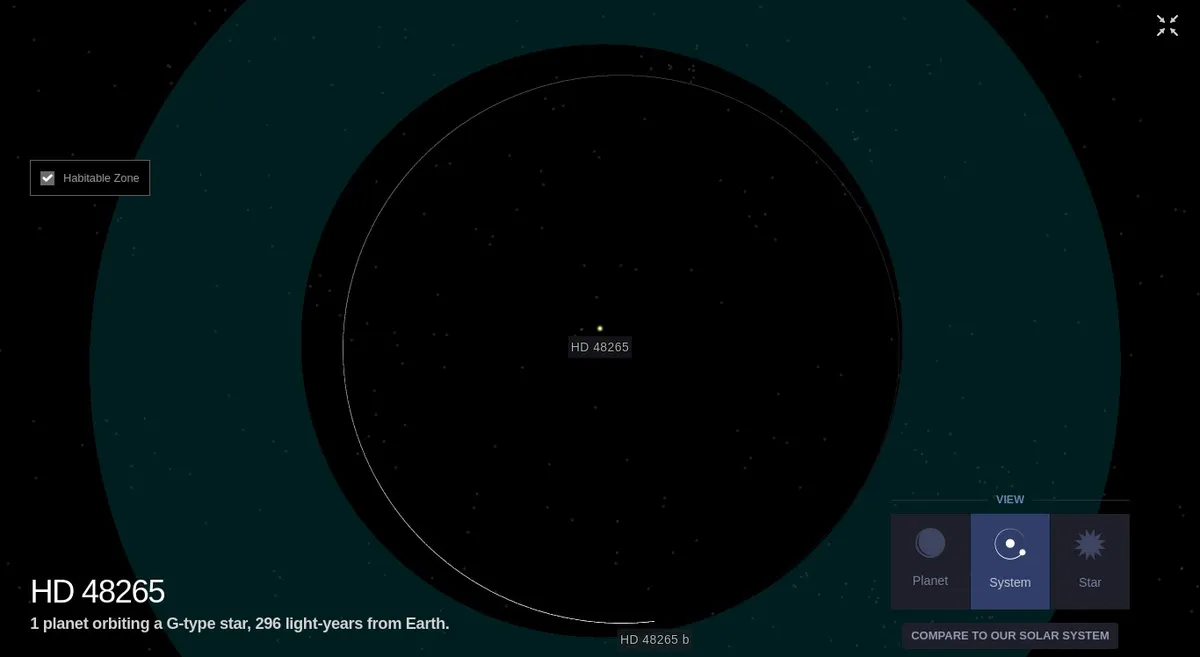
The International Astronomical Union (IAU) has entrusted the Argentine National Node for the Dissemination of Astronomy (NOC) with the mission of naming the exoplanet HD 48265b and its host star. This system is located in the constellation Puppis (RA: 06h 40m 01.73s, Dec: -48° 32' 31.0") and its star is a yellow-white subgiant with an apparent visual magnitude of 8, so it is not visible to the naked eye. Among the group of astronomers who discovered this system, Dante Minniti, a graduate of the Universidad Nacional de Córdoba, stands out.
The NOC is calling for a public contest to choose the name of the mentioned celestial bodies.
The system is composed of a single star with a single known planet orbiting it. But it is possible that in the future it will be discovered that the star has more planetary companions and even stellar companions.
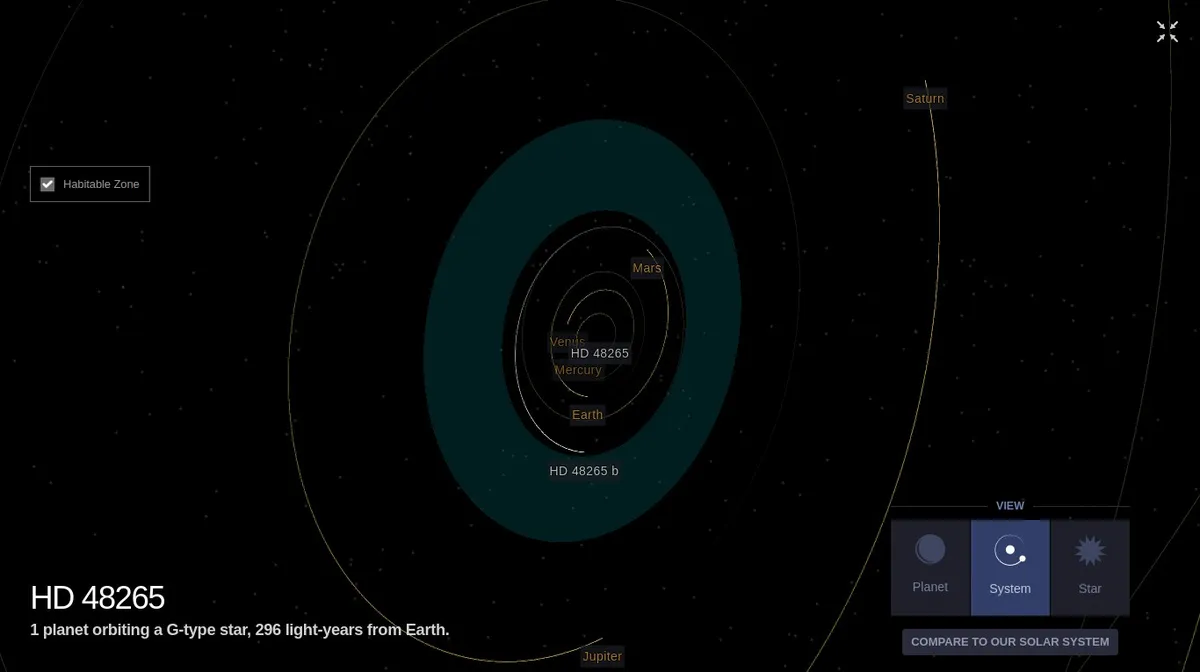
According to NASA's exoplanet portal, HD 48265 b is a gas giant of 1.47 Jupiter masses, orbiting the star in 2 years, located at 1.8 Astronomical Units, within the habitable zone. The system is 296 light-years from Earth.
Names may be proposed by the public or by institutions (schools, civil societies, amateur associations, etc.). To participate in the contest, it is necessary to send a note to the NOC indicating the proposed name, a justification of no more than one page, and the contact details of the proponent (ID, address, phone number). These names may be in Spanish or in any of the indigenous languages spoken in Argentina. If the language is not Spanish, the justification should indicate which language it is, as well as the meaning and context of the name. In this case, the proponent must indicate if they are a speaker of the language in question. In the case of institutions, the submission must be directed by their authorities.
The note can be uploaded to the NOC website:
http://sion.frm.utn.edu.ar/NOC-Argentina/index.php/iau100-bautismo-de-exoplanetas/
sent by email to the address:
[email protected]
sent by regular mail to:
"Concurso Nombrá un ExoMundo"
ITeDA Mendoza
Figueroa Alcorta 122
5501 Godoy Cruz Mendoza
or delivered in person at the Planetariums of Buenos Aires, La Plata, Córdoba and Malargüe.
Proposals may be sent between June 15 and August 31, 2019. In the case of postal mail, the postmark date will be taken as the sending date. All information related to this call is available on the aforementioned website.
Proposals will be reviewed by a Selection Committee. (see http://www.nameexoworlds.iau.org/argentina).
To verify compliance with the IAU criteria for exoplanet names, you can consult the page https://www.iau.org/public/themes/naming_exoplanets. The Committee will select 20 finalist proposals (the Committee's decision will be final), which will participate in a public vote (between September 10 and November 10, 2019) that will determine the winner. The winning proposal will be announced on November 11, 2019, and sent to the IAU to formalize the naming.
RULES FOR NAMING AN EXOPLANET
IAU has some rules for naming exoplanets in the case of a public campaign:
-Up to 16 characters
-Preferably one word
-Must be pronounceable (in some language)
-Must not be offensive
-Not too similar to an existing astronomical object.
Not allowed:
-Pet names
-Commercial-type names
-Names of individuals, places or events related to political, religious or military activities.
-Names of living persons.
The "popular names" voted by the public do not replace the scientific designations.
MY PROPOSAL
There is a long debate about what could be called "Argentineness". It is really difficult to find a common denominator among all natives or inhabitants of Argentina. However, we can use mathematics. Between 2/3 and 4/5 there does not seem to be a common denominator. But a new denominator 15 would include both fractions, since 15 is divisible by both 3 and 5. This new denominator or common factor is a product, a multiplication.
So perhaps we can find not a single thing, but a product or sum of things that can come close to a concept of "the Argentine".
For example, it could be: Tango + mate + soccer + che.
The "che" is very typical of Argentines, but although its colloquial use is not related to the figure of Ernesto Guevara, it could be objected to due to one of the rules about names of individuals related to political issues.
It occurs to me that the star could be called: "Argentrella".
And the exoplanet, a giant, could be called "Astor", in homage to Astor Piazzolla.
The name of the star would be sufficiently general as not to link it to a specific activity, as would happen with the word Tango.
It is unnecessary to recall that the word Argentina itself comes from the word "silver", from the Latin "argentum" and that both the Ruta del Plata and the Río de la Plata have the same origin.
However, terms like Del Plata, Argentum, Argenta, Argento have been widely used. Other endings, like Argente, Argenella, etc., have also been used. But, let's see the literal result (in quotes) of this term on Google:
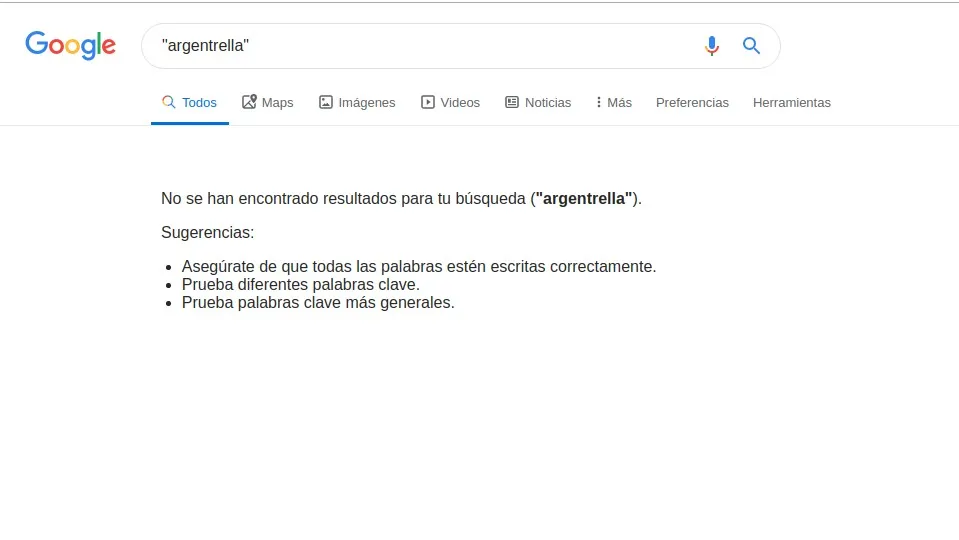
And the name of the planet would not only be deserved due to the internationally recognized talent of an avant-garde artist, but it would allow, in case other exoplanets are found in the same system, names of other transcendent artists of the country, be they musicians, writers, men or women.
Argentina has, in its cultural heritage, many important artists. If we think only of musicians we would have a long list. It is difficult or impossible to determine "the best", but I believe the international transcendence of Piazzolla's music is undeniable. Creator of unforgettable songs like "Adiós Nonino", "Libertango", "Fuga y misterio" or "Balada para un loco", among other compositions like The Seasons.
It will be said that tango in general is more related to the City of Buenos Aires than to the rest of the country, but other names, in case there are other planets in the system, could be linked to other musics (for example Yupanqui). What is beyond doubt is that around "Argentrella" there has to be tango and if there is tango, Astor has to be there.
It would also be an exoplanet with its own music.
Sources and related links
ExoWorlds website name: http://nameexoworlds.iau.org/
IAU100 website: https://www.iau-100.org/
Contest website in Argentina:
http://sion.frm.utn.edu.ar/NOC-Argentina/index.php/iau100-bautismo-de-exoplanetas/
IAU/Argentina exoplanet website: http://www.nameexoworlds.iau.org/argentina
Contact in Argentina
Beatriz García
National Node for the Dissemination of Astronomy beatriz.garcí[email protected]
NASA EXOPLANET EXPLORATION https://exoplanets.nasa.gov/exoplanet-catalog/6647/hd-48265-b/
Low Mass Companions for Five Solar-Type Stars from the Magellan Planet Search Program
Dante Minniti et al. arXiv:0810.5348 [astro-ph]
https://arxiv.org/abs/0810.5348
About the images
Credit: NASA